Personally, the shift toward privacy coins highlights a demand for better on-chain anonymity.#privacy #security
Quick Video Breakdown: This Blog Article
This video clearly explains this blog article.
Even if you don’t have time to read the text, you can quickly grasp the key points through this video. Please check it out!
If you find this video helpful, please follow the YouTube channel “BlockChainBulletin,” which delivers daily Crypto news.
https://www.youtube.com/@BlockChainBulletins
Read this article in your native language (10+ supported) 👉
[Read in your language]
Understanding Today’s Crypto and Blockchain Developments: Focus on Technology and Risks
Jon: Today’s news in crypto and blockchain highlights important shifts in technology, privacy, and security that could shape digital infrastructure. From privacy-focused networks gaining traction to new threats targeting blockchain projects, these stories emphasize the need for robust governance and user awareness. Remember, cryptocurrency involves significant risks and uncertainties, including volatility and regulatory changes.
Lila: That sounds relevant for anyone trying to understand how these technologies work in the real world. Can you break it down simply? I’m curious about what this means for everyday users and why privacy and security are such big deals here.
Bitcoin Holds Above $92K as AI and DePIN Sectors Lead Selective Rally
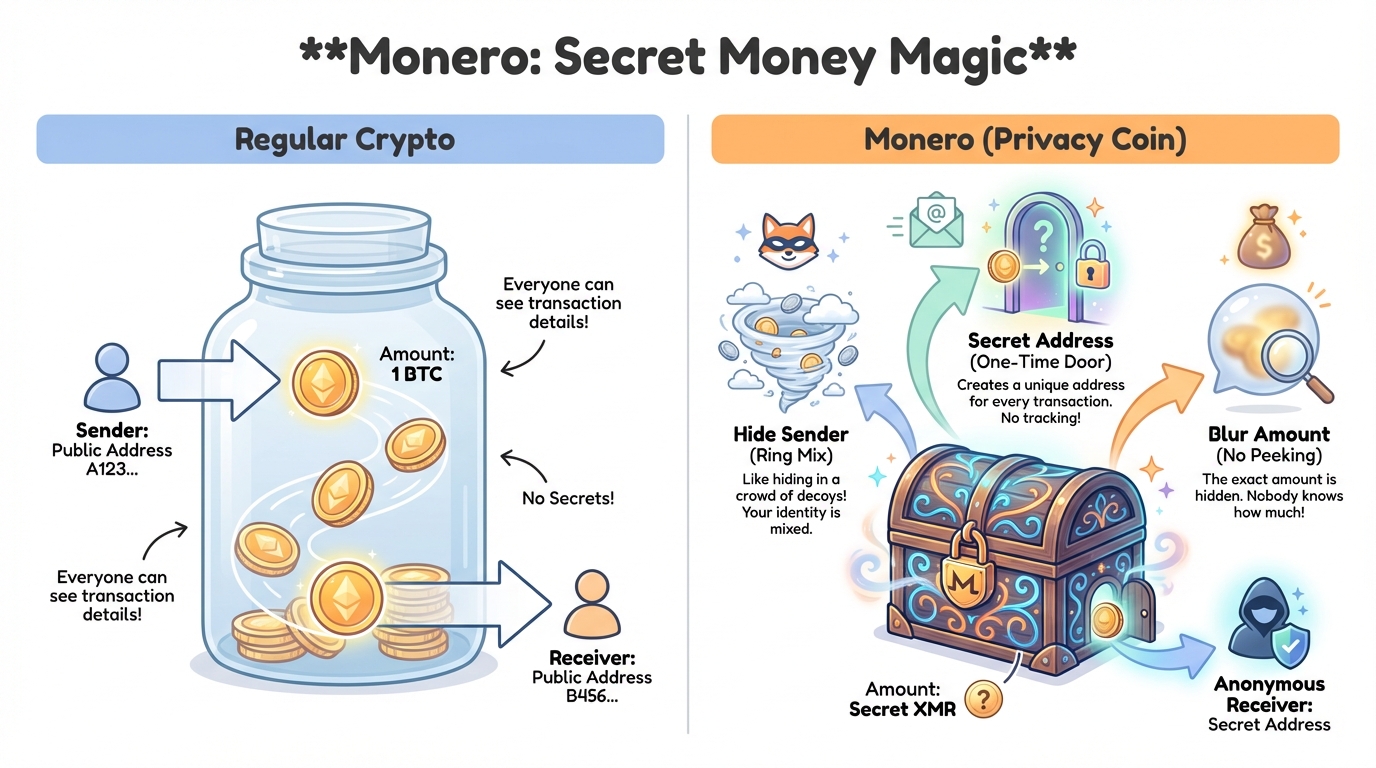
Jon: Let’s start with the market stabilization. Based on recent reports, Bitcoin is holding above $92,000, with a small increase, while Ethereum is around $3,150. But this isn’t about prices—it’s about sector rotation in blockchain technologies. Privacy tokens like Monero are seeing strong interest due to their focus on on-chain anonymity. Monero uses a proof-of-work consensus mechanism, which is a way networks agree on transactions through computational puzzles, and it incorporates ring signatures and stealth addresses to hide transaction details automatically.
Lila: Proof-of-work? That’s like Bitcoin’s mining system, right? Where computers solve problems to validate blocks. And ring signatures sound complicated—can you explain that in plain terms? Why is this rotation happening now?
Jon: Exactly, proof-of-work is the consensus where miners compete to add blocks to the chain. Ring signatures mix a real transaction with fake ones to obscure the sender, amount, and receiver, making it private by default. This contrasts with something like Zcash, which uses zk-SNARKs—zero-knowledge proofs that allow verification without revealing details—but it’s optional there. Monero is a Layer 1 blockchain, meaning it’s a base network, not built on top of another like Layer 2 solutions that scale existing chains.
Lila: So, for governance, does this mean more regulations might come into play because of the privacy aspect? And what about AI-linked tokens? I’ve heard of DePIN—what’s that?
Jon: Good questions. Governance-wise, privacy coins face regulatory scrutiny worldwide because they can evade tracking, which governments monitor for illicit activities. This could lead to delistings from exchanges. As for AI tokens like FET (Fetch.ai) and TAO (Bittensor), they’re part of decentralized AI networks. DePIN stands for Decentralized Physical Infrastructure Networks, like projects that share hardware resources for computing. These are gaining traction for their real-world utility in areas like data processing. The rotation shows capital moving toward technologies with practical applications, but it increases volatility risks if major networks don’t keep up.
Lila: Okay, that makes sense. So what does this change for users or developers? Does it make blockchain more useful for everyday things?
Jon: For users, it could mean better privacy options in transactions, but with risks of regulatory backlash. Developers might focus more on building scalable, private protocols. Societally, it highlights the tension between innovation and oversight. Always remember, these developments come with uncertainties like potential enforcement actions.
Privacy Coins Surge with Projections of Outperformance vs BTC/ETH by 2026
Jon: Building on that, privacy coins as a sector have grown, with their market cap over $24 billion and transaction share up to about 11.4%. Monero and Zcash are leading in usage. Monero’s CryptoNote protocol enforces privacy through dynamic ring signatures, unlike Ethereum’s account-based model where privacy tools like mixers are add-ons and have faced sanctions.
Lila: Account-based model? That’s different from Bitcoin’s UTXO, right? UTXO is like unspent transaction outputs, tracking coins directly. And why are projections saying these might outperform bigger ones by 2026?
Jon: Yes, Bitcoin uses UTXO for tracking unspent coins, which is simpler for some verifications, while Ethereum’s model tracks balances in accounts, enabling smart contracts. Projections from researchers suggest privacy coins could see more adoption due to demand for anonymity amid increasing surveillance. Zcash, another Layer 1, uses zk-SNARKs for shielded transactions, allowing selective privacy. Governance implications include potential global regulations boosting these as alternatives, but also risks of crackdowns.
Lila: So, it’s about resilience in tech? What chain type are these? And does this affect society, like in terms of data protection?
Jon: They’re primarily Layer 1 blockchains with proof-of-work consensus. For society, it means better tools for financial privacy, which is crucial in digital economies, but it raises ethical questions about traceability for security. Users might see more options for private transactions, developers could integrate these features, but regulatory risks could limit accessibility.
Lila: Got it. So this changes how we think about blockchain as a privacy tool, but with big uncertainties.
GoBruteforcer Botnet Targets Crypto Project Databases via Weak Credentials
Jon: On the security side, there’s a botnet called GoBruteforcer targeting crypto and blockchain databases. It’s written in Golang and exploits weak passwords, like default ones in servers, to take over systems. It then brute-forces other services and even scans for valuable crypto addresses.
Lila: Botnet? That’s a network of hacked computers, right? Like zombies controlled by attackers. And brute-forcing means trying tons of passwords? Why crypto projects specifically?
Jon: Correct— a botnet is compromised devices used for attacks. Brute-forcing is automated guessing. This one targets crypto because many projects use default setups, like in DeFi (Decentralized Finance, which is blockchain-based lending and trading without banks). It’s not tied to a specific chain type but affects various infrastructures, including those on Layer 1 or sidechains (parallel chains for specific functions).
Lila: Consensus mechanism doesn’t apply here, I guess, since it’s about security breaches. What about governance? Are there regulations that could help prevent this?
Jon: Consensus isn’t directly involved; this is more about operational security. Governance-wise, better standards for credentials could come from industry groups or regulations, but it’s up to projects to implement. It parallels older botnets but focuses on crypto APIs.
Lila: So what does this change? For users, does it mean more risks in using these projects?
Jon: It exposes vulnerabilities, potentially leading to data leaks or fund losses. Developers need stronger security, like unique passwords and firewalls. Societally, it underscores the need for education on cyber threats in blockchain, with risks of larger attacks if not addressed.
| Topic | Impact | Relevance |
|---|---|---|
| Bitcoin and Sector Rally | Highlights shift to privacy and AI utilities, increasing volatility risks. | Emphasizes tech adoption and regulatory tensions for infrastructure. |
| Privacy Coins Surge | Grows adoption for anonymity, but faces delisting risks. | Shows demand for private tech amid surveillance concerns. |
| GoBruteforcer Botnet | Exposes security flaws, risking data breaches. | Underlines need for better cybersecurity in blockchain projects. |
Jon: Overall, these stories point to a maturing ecosystem where privacy, AI integration, and security are key. Long-term, this could strengthen digital infrastructure, but it depends on balanced regulation and tech advancements.
Lila: Thanks for explaining without the hype. It’s clear we need to stay cautious, learn about regulations, and do our own research—DYOR, as they say. No rushing into anything.
👨💻 Author: SnowJon
A researcher sharing practical insights on Web3 and AI based on academic study and real-world observation.
His focus is on translating complex technologies into clear, responsible explanations for a general audience.
*AI tools may assist drafting, but all factual verification and editorial judgment are performed by the author.*
⚠️ Risk & Education Notice
Cryptocurrency and blockchain technologies involve legal, technical, and financial risks.
This article is provided strictly for educational and informational purposes and does not constitute financial advice.
Readers are encouraged to conduct independent research and comply with local laws and regulations.
▼ AI tools to streamline research and content production (free tiers may be available)
Free AI search & fact-checking
👉 Genspark
Recommended use: Quickly verify key claims and track down primary sources before publishing
Ultra-fast slides & pitch decks (free trial may be available)
👉 Gamma
Recommended use: Turn your article outline into a clean slide deck for sharing and repurposing
Auto-convert trending articles into short-form videos (free trial may be available)
👉 Revid.ai
Recommended use: Generate short-video scripts and visuals from your headline/section structure
Faceless explainer video generation (free creation may be available)
👉 Nolang
Recommended use: Create narrated explainer videos from bullet points or simple diagrams
Full task automation (start from a free plan)
👉 Make.com
Recommended use: Automate your workflow from publishing → social posting → logging → next-task creation
※Links may include affiliate tracking, and free tiers/features can change; please check each official site for the latest details.