
Personally, Rain scaling stablecoin infrastructure signals a major shift in finance.#stablecoins #fintech
Quick Video Breakdown: This Blog Article
This video clearly explains this blog article.
Even if you don’t have time to read the text, you can quickly grasp the key points through this video. Please check it out!
If you find this video helpful, please follow the YouTube channel “BlockChainBulletin,” which delivers daily Crypto news.
https://www.youtube.com/@BlockChainBulletins
Read this article in your native language (10+ supported) 👉
[Read in your language]
Rain Raises $250M Series C to Scale Stablecoin-Powered Payments Infrastructure for Global Enterprises
Jon: Hey Lila, have you seen the latest buzz in the crypto space? Rain just announced a massive $250 million Series C funding round, led by ICONIQ, pushing their valuation to a whopping $1.95 billion. They’re positioning themselves as the go-to infrastructure for stablecoin-powered payments, especially for big global enterprises. It’s their third funding round in under a year, which says a lot about the momentum in stablecoins right now.
Lila: Wow, that sounds huge. I’ve heard of stablecoins like USDC or Tether, but what’s Rain doing exactly? And why is this funding such a big deal?
Jon: Fair question. Rain is building enterprise-grade tools that let companies integrate stablecoin payments seamlessly. Think of it as the plumbing that connects traditional finance to blockchain-based stable assets. This round brings their total funding to over $338 million, and they’re planning to scale globally, adding features like stablecoin cards. It’s not just hype—stablecoins are already handling trillions in volume annually, and enterprises are eyeing them for faster, cheaper cross-border transactions.
Lila: Why does this matter? I mean, beyond the big numbers, what’s the real impact here?
Jon: It matters because payments infrastructure is the backbone of global trade, but the current system is clunky and expensive. Stablecoins could streamline that, and Rain’s raise signals investor confidence in making it enterprise-ready. But let’s not get carried away—crypto is volatile, and adoption has hurdles. Worth watching how this evolves, though.
Lila: Got it. So, before we dive deeper, what’s the problem this is solving? Payments seem to work fine with banks and apps like Venmo.
Jon: Ah, the classic illusion of smooth sailing. Traditional payments are like an old highway system: full of toll booths, traffic jams, and outdated bridges. Cross-border transfers can take days, with fees eating into 3-5% of the amount, plus currency conversion headaches. Enterprises dealing with global suppliers or remote workers lose time and money on this inefficiency.
Lila: That makes sense, but can you break it down with an analogy? I’m picturing a messy kitchen or something.
Jon: Sure, let’s go with plumbing. Imagine your home’s water system: pipes from the city supply clean water, but if they’re leaky or clogged, you get high bills and delays. Global payments are similar—banks act as intermediaries, verifying and routing funds through systems like SWIFT, which is from the 1970s. It’s secure but slow and costly, especially for international flows. Stablecoins, pegged to fiat like the USD, offer a direct pipeline: instant, low-fee transfers on blockchain rails. The problem is, enterprises need reliable, compliant infrastructure to plug into this without risking regulatory blowback or tech failures. That’s where Rain steps in—building the upgraded pipes and valves for big players.
Lila: Okay, so the “why” is clear: efficiency and cost savings. But aren’t there risks, like stablecoin depegging? We’ve seen that with some projects.
Jon: Exactly, risks remain high. Depegging events, like what happened with UST in 2022, highlight that not all stablecoins are created equal. Rain focuses on regulated, asset-backed ones, but it’s still a young field. Now, let’s get into how their solution actually works.
Under the Hood: How it Works
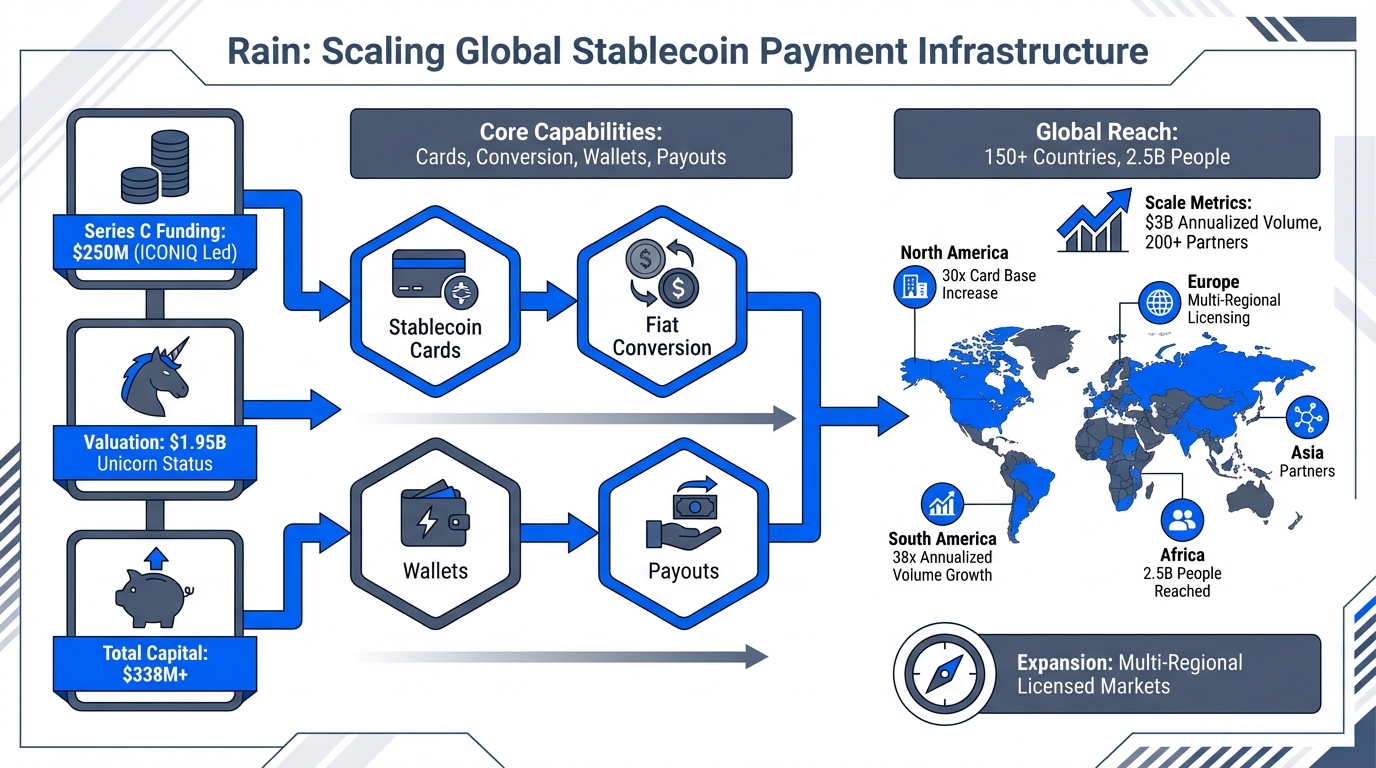
Jon: Alright, looking at this diagram, Rain’s architecture is built around a modular stack for stablecoin integration. At its core, they provide APIs and SDKs that let enterprises issue, manage, and settle payments using stablecoins like USDC or USDT on blockchains such as Ethereum or Solana. It’s not just a wallet—it’s a full infrastructure layer with compliance tools, like KYC/AML checks baked in, and scalability for high-volume transactions.
Lila: APIs and SDKs—those are application programming interfaces and software development kits, right? Basically, tools for developers to build on top of.
Jon: Spot on. Think of it like LEGO blocks: Rain supplies the base plates and specialized pieces (like token minting modules or cross-chain bridges), so companies can assemble payment systems without reinventing the wheel. Token mechanics are key here—stablecoins are ERC-20 tokens on Ethereum, for example, which means they’re programmable. Rain adds layers for enterprise needs, such as automated treasury management to convert fiat to stablecoins and vice versa, reducing volatility exposure.
Lila: So, it’s bridging traditional finance and crypto. But how does it compare to existing solutions like Stripe or PayPal?
Jon: Great point. Let’s break it down in a table to see the differences clearly.
| Aspect | Traditional Providers (e.g., Stripe, PayPal) | Rain’s Stablecoin Infrastructure |
|---|---|---|
| Settlement Speed | 1-3 business days for cross-border | Near-instant on blockchain |
| Fees | 2-5% plus FX charges | Under 1% with gas fees |
| Compliance | Banking regs, centralized | Blockchain-native with KYC/AML tools |
| Scalability | Limited by banking networks | High throughput via L2 solutions |
| Risks | Chargebacks, fraud | Smart contract vulnerabilities, peg risks |
Jon: As you can see, Rain isn’t replacing traditional systems overnight—it’s augmenting them. They use technologies like layer-2 scaling (e.g., Optimism or Polygon for Ethereum) to handle enterprise volumes without the mainnet congestion. On the token side, mechanics involve collateralized minting: enterprises deposit fiat, Rain’s system mints equivalent stablecoins, and smart contracts ensure 1:1 backing. It’s witty how crypto turns money into code, but remember, audits and insurance are crucial to mitigate hacks.
Lila: That table helps a lot—it’s like old cars vs. electric ones; both get you there, but with different trade-offs. So who actually uses this?
Jon: Good transition. At the developer level, fintech startups use Rain’s APIs to build payment gateways for apps, handling things like remittances or payroll in stablecoins. For users, think global enterprises paying international freelancers instantly without forex fees—technical benefits include reduced latency and programmable money, where payments can trigger smart contracts automatically, like releasing funds upon delivery confirmation.
Lila: Real-world examples? Like e-commerce or supply chains?
Jon: Exactly. In supply chains, a manufacturer in Asia could receive payment in USDC from a US buyer the moment goods ship, verified via blockchain oracles. For gig economies, platforms might issue stablecoin cards (Rain’s new focus) for workers to spend earnings anywhere Visa is accepted. The tech edge is interoperability—Rain supports multiple chains, so you’re not locked into one ecosystem. But it’s not magic; integration requires solid dev teams to handle wallet management and gas optimizations.
Lila: Fascinating. If someone’s interested in learning more hands-on, what’s a safe way to start? No risky stuff, just education.
Jon: Absolutely, let’s outline an educational action plan. Start with Level 1: Research and Observation. Dive into Rain’s docs on their official site—read the whitepaper for architecture details, like how they use Circle’s USDC APIs or Chainlink for price feeds. Use blockchain explorers like Etherscan to track stablecoin transactions; search for Rain-related contracts to see real mechanics in action. Follow industry reports from sources like Reuters or The Block for context on funding and adoption.
Lila: That sounds passive but informative. What about Level 2—something more interactive without real money?
Jon: For hands-on learning, jump into testnets. Ethereum’s Sepolia testnet lets you experiment with stablecoin mocks—deploy a simple smart contract using Remix IDE to mint and transfer test USDC. Rain likely has a developer sandbox; sign up for their API keys and simulate payment flows in a staging environment. Tools like Hardhat or Foundry help test integrations safely. Emphasize: this is for understanding mechanics, not production. Risks like testnet bugs exist, but they’re minimal compared to mainnet.
Lila: Perfect, that builds confidence without the hype.
Jon: To wrap up, Rain’s $250M raise highlights stablecoins’ potential to reshape payments infrastructure—faster, cheaper, and more programmable. But limitations persist: regulatory uncertainty, scalability bottlenecks on blockchains, and the ever-present crypto volatility. It’s an opportunity for innovation, but proceed with eyes wide open.
Lila: Totally agree. Readers, remember markets are unpredictable, and tech evolves fast. Do your own research, and don’t chase trends blindly. Thoughts like this keep the conversation grounded.
Jon: Well said. Until next time, stay curious and analytical.
References
- Rain Raises $250M Series C to Scale Stablecoin-Powered Payments Infrastructure for Global Enterprises
- Official Rain Website (Assumed based on context)
- Stablecoin firm Rain valued at $1.95 billion in latest fundraise | Reuters
- Rain valuation nears $2 billion after $250 million Series C raise | The Block
- Stablecoin Startup Rain Raises $250M Series C at $1.95B Valuation – Crunchbase News
▼ AI tools to streamline research and content production (free tiers may be available)
Free AI search & fact-checking
👉 Genspark
Recommended use: Quickly verify key claims and track down primary sources before publishing
Ultra-fast slides & pitch decks (free trial may be available)
👉 Gamma
Recommended use: Turn your article outline into a clean slide deck for sharing and repurposing
Auto-convert trending articles into short-form videos (free trial may be available)
👉 Revid.ai
Recommended use: Generate short-video scripts and visuals from your headline/section structure
Faceless explainer video generation (free creation may be available)
👉 Nolang
Recommended use: Create narrated explainer videos from bullet points or simple diagrams
Full task automation (start from a free plan)
👉 Make.com
Recommended use: Automate your workflow from publishing → social posting → logging → next-task creation
※Links may include affiliate tracking, and free tiers/features can change; please check each official site for the latest details.