
Personally, these Bitcoin ETFs shifts suggest a natural pause in market momentum#Bitcoin #crypto
Quick Video Breakdown: This Blog Article
This video clearly explains this blog article.
Even if you don’t have time to read the text, you can quickly grasp the key points through this video. Please check it out!
If you find this video helpful, please follow the YouTube channel “BlockChainBulletin,” which delivers daily Crypto news.
https://www.youtube.com/@BlockChainBulletins
Read this article in your native language (10+ supported) 👉
[Read in your language]
Bitcoin ETFs Wiped Out $1.1 Billion in 72 Hours as a Critical Demand Metric Turned Negative
Jon: Hey Lila, have you seen the latest on Bitcoin ETFs? According to this piece on CryptoSlate, U.S. spot Bitcoin ETFs just saw outflows of $1.1 billion over just 72 hours. It’s like the market hit a speed bump right after the new year buzz. The article calls it the start of a “boring sideways era” for Bitcoin, with a key demand metric flipping negative. Basically, investor enthusiasm cooled off fast, reversing some early 2026 gains.
Lila: Whoa, that sounds dramatic. I’ve been following crypto news, but ETFs are still a bit fuzzy for me. Can you break down what happened at a high level? And why the big outflows now?
Jon: Sure thing. Bitcoin ETFs are exchange-traded funds that hold actual Bitcoin, letting traditional investors buy into crypto without dealing with wallets or exchanges directly. They’re traded on stock markets like any other ETF. The news here is that after a strong start to 2026, these funds experienced massive redemptions—people selling shares, which forces the funds to sell underlying Bitcoin. Over three days, it totaled $1.1 billion, nearly wiping out the inflows from earlier in the year. Analysts point to things like tariff fears, profit-taking, and a general dip in risk appetite. Bitcoin’s price is hovering around $90,000, down a bit from recent highs.
Lila: Okay, got it. But why does this matter? Is it a sign of bigger trouble for Bitcoin, or just a blip?
Jon: Great question—it’s not panic stations, but it’s worth paying attention to. This outflow highlights how ETF flows can influence Bitcoin’s price and sentiment. When demand metrics turn negative, it means fewer new buyers are stepping in, which could lead to sideways trading. Think of it as a thermometer for institutional interest. If it stays negative, Bitcoin might consolidate rather than rocket higher. But remember, crypto’s volatile; this could flip quickly with new catalysts.
Lila: Makes sense. So, what’s the underlying problem here? It seems like these ETFs are supposed to make Bitcoin more accessible, but now they’re causing outflows. Can you explain the “why” behind this?
Jon: Absolutely. The core issue is liquidity and sentiment fracturing. ETFs were a game-changer when they launched in 2024, bringing in billions from big players like pension funds. But now, with market consolidation—prices not moving much—investors are rebalancing portfolios. A critical demand metric, like net flows or something called the “ETF flow velocity,” turned negative, signaling more money leaving than entering. It’s not that Bitcoin’s fundamentals are broken; it’s more about external factors like economic data, tariff risks, and even broader market caution stalling the rally.
Lila: Hmm, “flow velocity” sounds technical. Can you clarify that? Maybe with an analogy to make it stick?
Jon: Sure, let’s analogize it to traffic on a highway. Imagine Bitcoin’s price as a car speeding along. ETF inflows are like more cars joining the fast lane, accelerating everything. Outflows? That’s cars exiting suddenly, causing congestion and slowing the flow. The “critical demand metric” turning negative is like a traffic light going red—fewer new cars (buyers) entering, while others peel off. In real terms, this happened amid fears of new tariffs and cooling investor sentiment, leading to $1.1 billion vanishing in 72 hours. It’s a structural thing: ETFs amplify traditional finance behaviors into crypto, for better or worse.
Lila: That highway analogy helps a lot—now I see how these flows can jam up the market. So, if that’s the problem, how do Bitcoin ETFs actually work under the hood to create this dynamic?
Under the Hood: How it Works
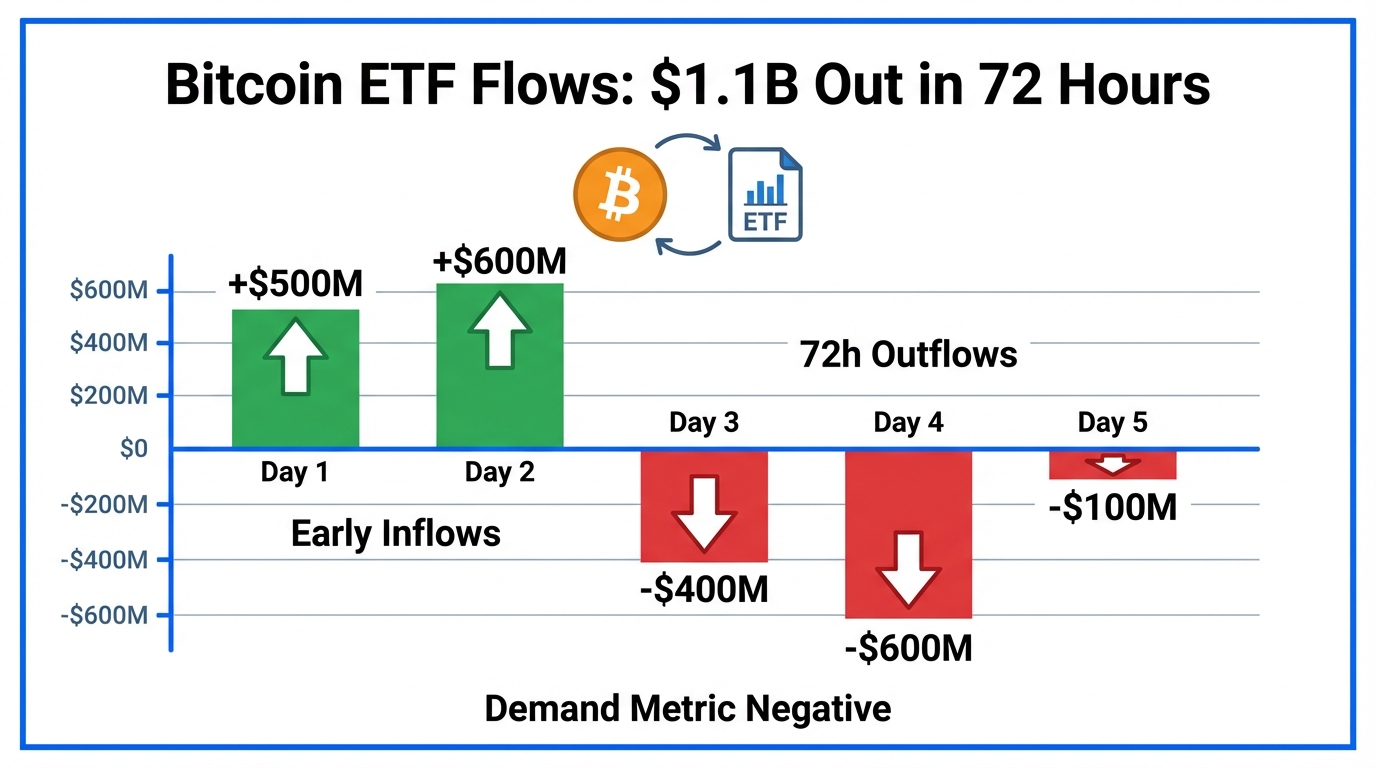
Jon: Alright, let’s dive into the mechanics. Bitcoin ETFs, specifically spot ones, track the real-time price of Bitcoin by holding the actual asset in custody. Unlike futures-based ETFs, these buy and store Bitcoin directly through authorized participants—big banks or firms that create or redeem shares. When investors buy ETF shares on the stock market, it increases demand, prompting more Bitcoin purchases. Outflows work the opposite: redemptions mean selling Bitcoin back into the market, which can pressure prices downward.
Lila: So, it’s like a bridge between Wall Street and crypto. But how does the demand metric fit in? Is there a way to compare this to traditional ETFs?
Jon: Exactly—it’s that bridge amplifying flows. The demand metric here likely refers to net ETF flows, which turned negative, meaning more outflows than inflows. To illustrate, let’s compare Bitcoin ETFs to traditional stock ETFs.
| Aspect | Bitcoin ETFs | Traditional Stock ETFs |
|---|---|---|
| Underlying Asset | Actual Bitcoin held in custody | Stocks or indices |
| Flow Impact on Price | Direct: Inflows buy BTC, outflows sell BTC | Indirect: Less immediate pressure on individual stocks |
| Volatility Exposure | High, tied to crypto market swings | Varies, often lower for broad indices |
| Recent Example | $1.1B outflow in 72 hours, demand negative | Outflows during market corrections, but less crypto-specific drama |
Jon: As you can see, Bitcoin ETFs are more directly linked to the asset’s price, which is why outflows like this can feel amplified. The architecture involves creation/redemption mechanisms: Authorized participants exchange baskets of Bitcoin for ETF shares or vice versa, keeping the ETF price close to Bitcoin’s spot price via arbitrage.
Lila: That table really clarifies the differences. The direct link explains why these outflows hit Bitcoin harder. Okay, so with that understanding, who actually uses Bitcoin ETFs? Like, beyond just investors cashing out?
Jon: Good pivot—use cases focus on accessibility and integration. For institutional investors, like hedge funds or retirement plans, ETFs provide a regulated way to gain Bitcoin exposure without the hassle of self-custody or regulatory hurdles. Technically, this means easier portfolio diversification—adding crypto as an asset class for hedging inflation or uncorrelated returns. Developers and fintech firms use ETF data for building analytics tools, like dashboards tracking flows to predict market moves. Users benefit from liquidity: You can trade during stock market hours, with lower fees than direct crypto buys. It’s not about hype; it’s about making Bitcoin a standard financial instrument, though events like this outflow show the risks of sentiment shifts.
Lila: Interesting— so it’s more about technical integration than quick profits. If someone’s curious to learn more without jumping in headfirst, what’s a good action plan? Start with research?
Jon: Exactly, let’s outline an educational path. Level 1: Research and Observation. Begin by reading whitepapers or docs from ETF providers like BlackRock’s IBIT or Fidelity’s FBTC— their sites explain mechanics without jargon. Use blockchain explorers like Blockchain.com to track Bitcoin holdings in ETF wallets. Dashboards from Coinglass or Farside Investors show real-time ETF flows; observe how inflows/outflows correlate with price. It’s like watching market weather patterns— no cost, just learning.
Lila: Observing sounds safe. What about Level 2— something hands-on but low-risk?
Jon: For Level 2: Testnet or Hands-on Learning. Since ETFs are tradable securities, you can’t “testnet” them directly, but simulate via paper trading on platforms like TradingView. Set up a demo account to track Bitcoin ETF prices against spot BTC, experimenting with mock portfolios to see how flows affect values. For deeper crypto understanding, try Bitcoin testnets—free networks where you can practice transactions without real money. Tools like Blockstream’s explorer let you explore without risk. Emphasize: This is for education, understanding mechanics like custody and arbitrage, not for actual trading. Risks remain, even in learning mode—volatility can be misleading if not contextualized.
Lila: Appreciate the focus on safe experimentation. Wrapping up, what’s your take on the future here?
Jon: In summary, this $1.1 billion outflow is a reminder of Bitcoin ETFs’ double-edged sword: They bring mainstream adoption but also import traditional market whims. The opportunity lies in maturing crypto as an asset class, with better liquidity and tools. Limitations? Volatility, regulatory shifts, and metrics like this turning negative could prolong sideways eras. Worth watching how flows evolve—perhaps with new catalysts like economic clarity.
Lila: Totally— and let’s not forget, crypto’s full of uncertainty. Prices swing wildly, so approach with caution and focus on learning over speculation. Thanks for breaking this down, Jon.
Jon: Anytime, Lila. Stay curious, stay informed.
—
References
- Bitcoin ETFs wiped out $1.1 billion in 72 hours as a critical demand metric turned negative
- Bitcoin Official Website
- Spot bitcoin ETFs extend negative streak, reporting $400 million in outflows | The Block
- Bitcoin ETFs Bleed as Market Awaits Key Tariff Ruling
▼ AI tools to streamline research and content production (free tiers may be available)
Free AI search & fact-checking
👉 Genspark
Recommended use: Quickly verify key claims and track down primary sources before publishing
Ultra-fast slides & pitch decks (free trial may be available)
👉 Gamma
Recommended use: Turn your article outline into a clean slide deck for sharing and repurposing
Auto-convert trending articles into short-form videos (free trial may be available)
👉 Revid.ai
Recommended use: Generate short-video scripts and visuals from your headline/section structure
Faceless explainer video generation (free creation may be available)
👉 Nolang
Recommended use: Create narrated explainer videos from bullet points or simple diagrams
Full task automation (start from a free plan)
👉 Make.com
Recommended use: Automate your workflow from publishing → social posting → logging → next-task creation
※Links may include affiliate tracking, and free tiers/features can change; please check each official site for the latest details.