Personally, seeing the US consider Bitcoin for reserves signals a maturing digital asset class.#Bitcoin #economy
Quick Video Breakdown: This Blog Article
This video clearly explains this blog article.
Even if you don’t have time to read the text, you can quickly grasp the key points through this video. Please check it out!
If you find this video helpful, please follow the YouTube channel “BlockChainBulletin,” which delivers daily Crypto news.
https://www.youtube.com/@BlockChainBulletins
Read this article in your native language (10+ supported) 👉
[Read in your language]
This Investor Thinks the United States Could Start Buying Bitcoin in 2026
Jon: Hey Lila, have you seen this latest buzz from Bitcoin Magazine? Cathie Wood, the ARK Invest CEO, is predicting that the US government might start actively buying Bitcoin in 2026 as part of a national strategic reserve. It’s based on the idea that with crypto becoming a big political topic, especially under President Trump’s second term, the US could move beyond just holding seized Bitcoin to actually purchasing it on the open market.
Lila: Whoa, that sounds huge. The government buying Bitcoin? Like, the same way they stockpile oil or gold? But isn’t the US already holding some Bitcoin from seizures?
Jon: Exactly. Right now, the US Marshals Service manages forfeited Bitcoin from criminal cases—think Silk Road or other busts. But Wood’s take is that this could evolve into a deliberate strategy, treating Bitcoin as a strategic asset. She mentioned in the article that it might push prices higher, with estimates floating around $172,000 to $315,000 by year-end, depending on analysts. Of course, that’s speculative—Bitcoin’s at about $93,000 as we speak in early 2026, after a recent 8% jump.
Lila: Why does this matter? Is it just another hype cycle, or is there real substance here?
Jon: It matters because it could signal a shift in how nations view digital assets. If the US starts buying, it legitimizes Bitcoin as a reserve asset, potentially stabilizing it against volatility. But remember, this is all based on political winds—Trump’s pro-crypto stance might drive deregulation, but nothing’s set in stone. It’s worth watching for its implications on global finance, not as a get-rich-quick scheme.
Lila: Okay, that makes sense. But let’s dig deeper—what’s the underlying problem this idea is trying to solve?
Jon: The core problem is how traditional financial systems handle reserves in an increasingly digital world. Governments hoard assets like gold or oil to hedge against economic shocks, but these are physical and slow to mobilize. Bitcoin, being digital and borderless, could offer a modern alternative. The issue is trust and scarcity—fiat currencies can be printed endlessly, leading to inflation, while Bitcoin has a fixed supply of 21 million coins.
Lila: Fixed supply? Clarify that for me—how does that work, and why is it a problem solver?
Jon: Think of it like a plumbing system in a city. Traditional money is like an adjustable faucet—central banks can turn up the water (print more money) during droughts (recessions), but too much floods the streets (inflation). Bitcoin is like a reservoir with a hard cap: only 21 million BTC ever, mined at a predictable rate that halves every four years. This scarcity mimics gold, making it a potential “digital gold” for reserves. If the US buys in, it’s like upgrading from old pipes to a smart system that prevents overflooding.
Lila: Nice analogy. So, the problem is over-reliance on inflatable currencies, and Bitcoin’s design offers a hedge?
Jon: Precisely. But it’s not without clogs—Bitcoin’s volatility is like erratic water pressure, and regulatory uncertainty could block the flow entirely.
Under the Hood: How it Works
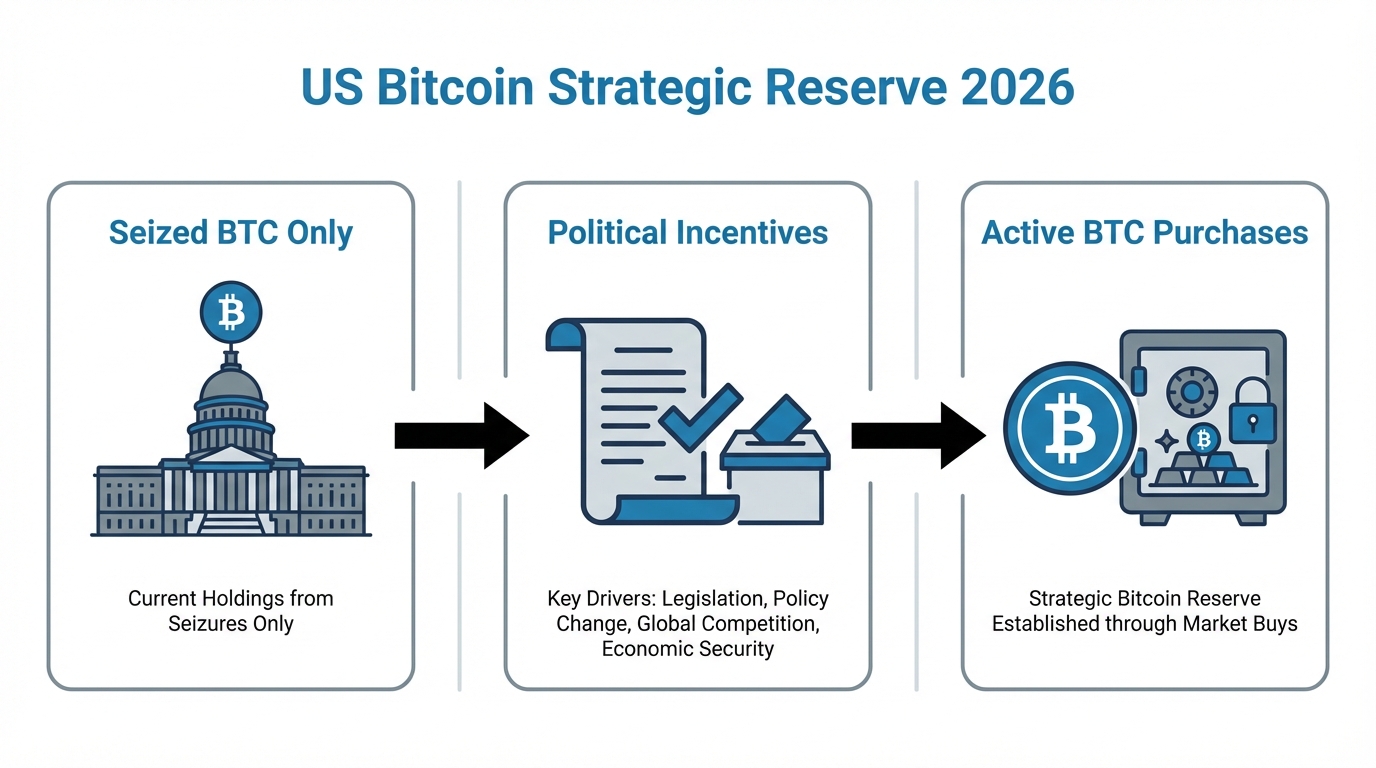
Jon: Alright, let’s peel back the layers. At its core, Bitcoin operates on a decentralized blockchain—a distributed ledger where transactions are verified by a network of nodes using proof-of-work consensus. Miners solve complex puzzles to add blocks, earning new BTC as rewards. This ensures security without a central authority.
Lila: Proof-of-work? That’s the energy-intensive part, right? Like digital mining?
Jon: Spot on. It’s like a global lottery where computers compete to validate transactions, preventing double-spending. For a strategic reserve, the US would likely hold BTC in secure wallets, possibly multisig for added safety—requiring multiple keys to access funds. Buying would involve exchanges or over-the-counter deals to avoid market disruption.
Lila: So, not just dumping cash into Coinbase? That sounds more sophisticated.
Jon: Exactly. And token mechanics: Bitcoin isn’t like utility tokens; it’s pure store-of-value with no smart contracts. Its halving events—next one in 2028—reduce issuance, boosting scarcity. If governments buy, it could accelerate adoption, but let’s compare it to traditional reserves for clarity.
| Aspect | Traditional Reserves (e.g., Gold/Oil) | Bitcoin as Reserve |
|---|---|---|
| Storage | Physical vaults, high security costs | Digital wallets, potentially lower overhead but cyber risks |
| Supply | Variable, dependent on mining/extraction | Fixed at 21 million, predictable halvings |
| Liquidity | Moderate, requires physical transport | High, instant global transfers |
| Volatility | Relatively stable | High, market-driven swings |
| Geopolitical Edge | Tied to physical locations | Borderless, resistant to sanctions |
Jon: See how Bitcoin flips the script? It’s not perfect—energy use is a valid critique—but the architecture is robust for long-term holding.
Lila: So who actually uses this? I mean, beyond governments potentially stockpiling, what’s the real-world application?
Jon: Great question. On the user level, individuals use Bitcoin for remittances—sending money across borders without banks, faster and cheaper than wire transfers. Developers build on it via layers like Lightning Network for microtransactions, enabling apps for instant payments. Institutionally, companies like MicroStrategy treat it as a treasury asset to hedge inflation. If the US buys in, it could inspire other nations, creating a network effect where Bitcoin becomes a standard for international settlements. The technical benefit is decentralization—no single point of failure, making it resilient to economic disruptions.
Lila: That sounds practical. Like using it for everyday tech, not just speculation.
Jon: Absolutely. Think peer-to-peer electronic cash, as Satoshi intended. Now, for those wanting to learn more without risks…
Lila: Yeah, an educational action plan would be helpful. Start with basics?
Jon: Level 1: Research and Observation. Dive into Bitcoin’s whitepaper at bitcoin.org—it’s a short read explaining the basics. Use block explorers like Blockchain.com to watch live transactions; it’s like peering into the plumbing without touching it. Follow reputable analyses from sources like CoinDesk or Bitcoin Magazine to understand market contexts, such as ETF inflows driving prices.
Lila: Cool, no wallet needed yet. What about hands-on?
Jon: Level 2: Testnet Experimentation. Bitcoin has a testnet—a sandbox version where you can get free test BTC. Set up a wallet like Electrum, practice sending transactions without real value at stake. It’s minimal-risk learning, helping you grasp mechanics like addresses and confirmations. Tools like Blockstream’s explorer let you simulate without costs. Remember, this is for education—volatility means real involvement carries risks.
Lila: Perfect for beginners like me.
Jon: To wrap up, this idea of a US Bitcoin reserve highlights Bitcoin’s maturing role in finance—scarcity, decentralization, and potential stability if adopted widely. But limitations abound: regulatory hurdles, environmental concerns from mining, and inherent price swings.
Lila: Right, and let’s not forget the uncertainty. Crypto markets are volatile; what seems promising in 2026 could shift with politics or tech changes. Approach with curiosity, not expectations.
Jon: Well said. It’s an evolving space—worth understanding the mechanics, but always with a level head.
References
- This Investor Thinks the United States Could Start Buying Bitcoin in 2026
- Official Bitcoin Website
- The boldest bitcoin predictions for 2026 are in — from $75,000 to $225,000
- Can Bitcoin Bounce Back in 2026?
▼ AI tools to streamline research and content production (free tiers may be available)
Free AI search & fact-checking
👉 Genspark
Recommended use: Quickly verify key claims and track down primary sources before publishing
Ultra-fast slides & pitch decks (free trial may be available)
👉 Gamma
Recommended use: Turn your article outline into a clean slide deck for sharing and repurposing
Auto-convert trending articles into short-form videos (free trial may be available)
👉 Revid.ai
Recommended use: Generate short-video scripts and visuals from your headline/section structure
Faceless explainer video generation (free creation may be available)
👉 Nolang
Recommended use: Create narrated explainer videos from bullet points or simple diagrams
Full task automation (start from a free plan)
👉 Make.com
Recommended use: Automate your workflow from publishing → social posting → logging → next-task creation
※Links may include affiliate tracking, and free tiers/features can change; please check each official site for the latest details.