In my view new crypto ETFs signal institutional interest yet governance remains a critical focus.#Bitcoin #Solana
Quick Video Breakdown: This Blog Article
This video clearly explains this blog article.
Even if you don’t have time to read the text, you can quickly grasp the key points through this video. Please check it out!
If you find this video helpful, please follow the YouTube channel “BlockChainBulletin,” which delivers daily Crypto news.
https://www.youtube.com/@BlockChainBulletins
Read this article in your native language (10+ supported) 👉
[Read in your language]
Understanding Recent Developments in Crypto and Blockchain: Institutional Moves, Vulnerabilities, and Market Flows
Jon: Today’s news in the crypto and blockchain space highlights important shifts in how traditional finance is integrating with decentralized technologies, alongside reminders of ongoing risks in smart contract security. These developments matter for society because they influence how regulated financial products could make blockchain-based assets more accessible, while also underscoring the need for robust governance and regulatory oversight in digital infrastructure.
Lila: That sounds significant, but I’m not sure how it affects everyday people or developers. Can you break it down step by step, starting with why these changes could impact digital trust and long-term adoption?
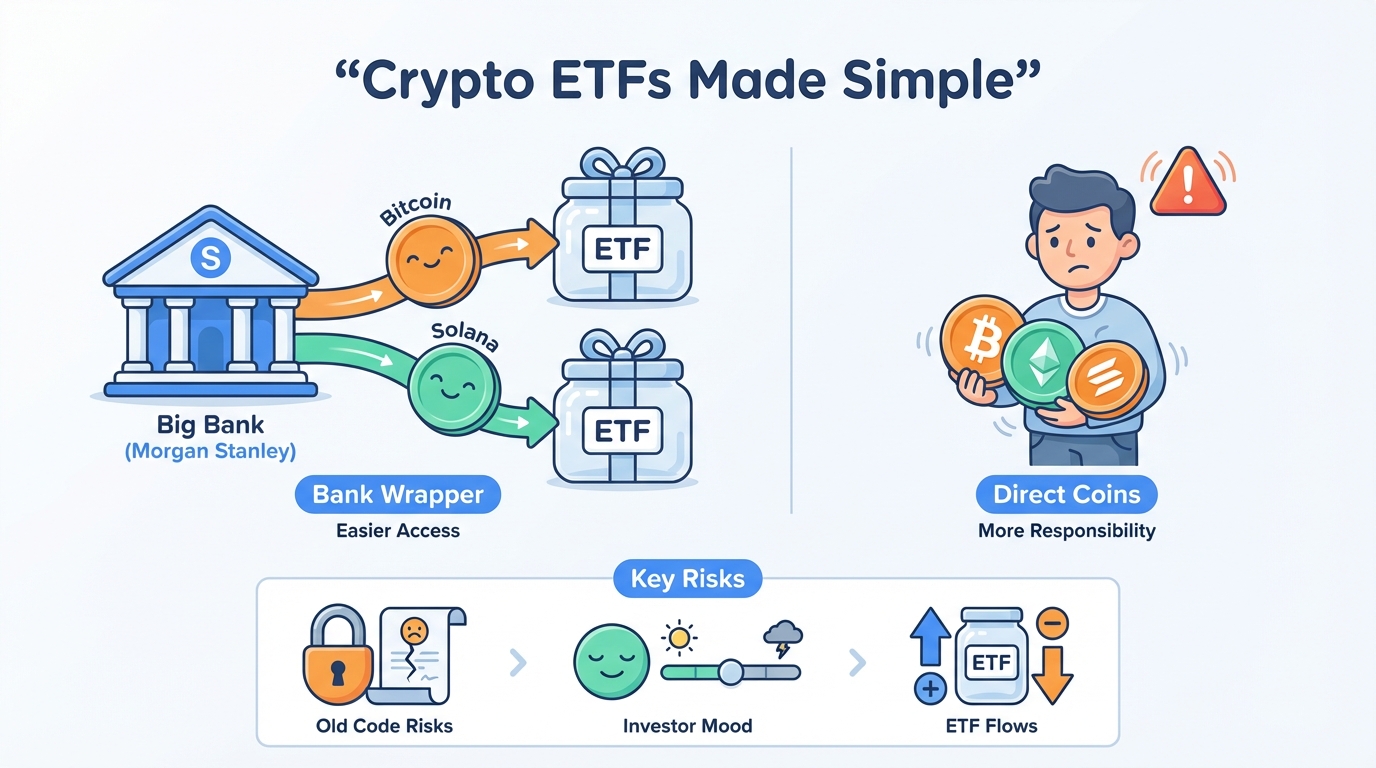
Morgan Stanley Files for Spot Bitcoin and Solana ETFs, Deepening Wall Street’s Crypto Pivot
Jon: One key story is Morgan Stanley, a major U.S. bank, filing for spot exchange-traded funds (ETFs) that would track the prices of Bitcoin and Solana. This is based on recent reports, and it signals a growing integration of blockchain assets into traditional finance. Spot ETFs are investment products that hold the actual underlying asset, like Bitcoin or Solana tokens, and allow investors to gain exposure without directly owning the tokens. This move could make crypto more accessible through regulated channels, but it’s important to note that filings don’t guarantee approval, and the SEC might delay or deny them based on concerns like market manipulation or custody risks.
Lila: Okay, so ETFs are like baskets that let people invest in something without handling it themselves, right? Like buying a share in a fund that owns gold instead of buying gold bars. But what about the technology here? What’s the consensus mechanism for these, and how does it affect users?
Jon: Exactly, that’s a good analogy for ETFs. Bitcoin uses a proof-of-work consensus mechanism, where computers solve complex puzzles to validate transactions and secure the network—it’s energy-intensive but proven for security over time. Solana, on the other hand, combines proof-of-history, which timestamps transactions efficiently, with proof-of-stake, where validators stake tokens to participate in securing the network. Solana is a Layer 1 blockchain, meaning it’s a base network, not built on top of another like Layer 2 solutions that scale existing chains.
Lila: Proof-of-stake sounds like validators put up their own money as collateral to keep things honest. Does this ETF filing change anything for governance or regulations?
Jon: Yes, in proof-of-stake, validators can lose staked tokens if they act maliciously, which incentivizes good behavior. For governance, this filing highlights regulatory implications: if approved, it would require strong custody solutions for Solana’s high-throughput network, which has had outages in the past. Regulators like the SEC would focus on ensuring investor protection, such as how staking rewards are handled—whether they go to the ETF holders or the issuer. This could set precedents for how non-Bitcoin assets are regulated in financial products.
Lila: So what does this change for users, developers, or society? Is it just easier access, or something bigger?
Jon: For users, it means potentially safer, regulated ways to engage with crypto without managing wallets or keys directly, reducing some technical barriers. Developers might see more institutional interest in building on Solana, as ETFs could increase liquidity and adoption. Societally, it could normalize blockchain in mainstream finance, but it also centralizes some control with big banks, which might affect decentralization ideals. Remember, cryptocurrency involves significant risks, like volatility and regulatory uncertainty.
Lila: That makes sense—it’s bridging old finance with new tech, but we should watch for how it impacts true decentralization.
Truebit Exploit Drains 8,535 ETH and Vaporizes TRU Token Value
Jon: Another critical story is an exploit in Truebit, where an attacker drained about 8,535 ETH, worth around $26.6 million based on recent values, by exploiting a vulnerability in an old smart contract. Truebit is a project for scalable off-chain computation with on-chain verification, but this incident targeted its token economics, not the core verification tech. The TRU token value dropped nearly 99.9%, serving as a stark reminder of legacy code risks in blockchain.
Lila: Smart contracts are like automated agreements on the blockchain that run code when conditions are met, right? But what went wrong here, and what’s the consensus mechanism involved?
Jon: Yes, smart contracts are self-executing programs on the blockchain. Truebit operates on Ethereum, which uses proof-of-stake since its 2022 upgrade, where validators stake ETH to secure the network. This exploit involved abusing outdated contract logic to mint or obtain TRU tokens cheaply and dump them, draining ETH. It’s a Layer 2-like solution for computation, but not a full Layer 2 scaling layer; it’s more focused on verifiable off-chain processing.
Lila: So, if it’s on Ethereum, does this affect Ethereum’s governance or raise regulatory flags?
Jon: Ethereum’s governance is decentralized through proposals and community consensus, but exploits like this highlight the need for better contract auditing and deprecation processes. Regulators might use it to push for stricter security standards in DeFi—decentralized finance, which is lending, borrowing, and trading without traditional banks. No direct regulatory action is reported yet, but it could influence future oversight on legacy contracts.
Lila: What does this change for users, developers, or society? Is it just a loss for holders, or a broader lesson?
Jon: For users, it underscores the risks of holding tokens in projects with inactive development; always research governance and audits. Developers should prioritize upgradeable contracts with timelocks—delays on changes for security—and clear ways to disable old code. Societally, it reminds us that blockchain’s immutability can be a double-edged sword, amplifying vulnerabilities if not managed well. Cryptocurrency involves significant risks, including total loss from exploits.
Lila: Got it—it’s a wake-up call for better maintenance in the ecosystem.
Spot Bitcoin and Ethereum ETF Flows Flip from Strong Inflows to Sustained Outflows
Jon: Finally, there’s been a shift in flows for spot Bitcoin and Ethereum ETFs. Early in the week, there were strong net inflows, like $697 million for Bitcoin ETFs, but this flipped to outflows totaling hundreds of millions mid-week. This reflects how macro economic conditions influence crypto exposure through these regulated products.
Lila: Inflows mean money coming in to buy more of the asset, and outflows mean selling, right? What’s the tech side—consensus and chain types?
Jon: Correct. Bitcoin is a Layer 1 with proof-of-work, as mentioned earlier. Ethereum is also Layer 1, now proof-of-stake. ETFs don’t change the underlying tech but act as a demand channel, affecting token availability without users interacting on-chain.
Lila: How about governance or regulations here?
Jon: Governance for these chains remains community-driven, but ETF flows are regulated by bodies like the SEC, ensuring transparency in reporting. This volatility in flows shows how traditional finance’s risk appetite can impact crypto markets, potentially leading to calls for more stable regulatory frameworks.
Lila: So what does this change for users, developers, or society?
Jon: Users might see more price stability over time as institutional involvement grows, but short-term swings highlight uncertainty. Developers could benefit from increased liquidity for building apps. Societally, it integrates crypto into broader economies, but with risks of amplified volatility from macro events. Always approach with caution.
| Topic | Impact | Relevance |
|---|---|---|
| Morgan Stanley ETF Filings | Potential for regulated access to Bitcoin and Solana, influencing liquidity and adoption. | Highlights integration of blockchain with traditional finance, emphasizing regulatory hurdles. |
| Truebit Exploit | Loss of funds and token value, exposing legacy contract vulnerabilities. | Stresses importance of security audits and governance in decentralized systems. |
| ETF Flows Shift | Volatility in institutional demand, affecting market dynamics. | Shows how macro factors influence blockchain adoption and infrastructure. |
Jon: Overall, these stories point to a maturing ecosystem where institutional involvement is growing, but technical and regulatory challenges persist. The long-term implications could strengthen digital infrastructure if governance improves, but uncertainty remains high.
Lila: Thanks for explaining this responsibly. It’s clear we need to stay informed about regulations and risks, and always do our own research before engaging with any crypto tech.
👨💻 Author: SnowJon
A researcher sharing practical insights on Web3 and AI based on academic study and real-world observation.
His focus is on translating complex technologies into clear, responsible explanations for a general audience.
*AI tools may assist drafting, but all factual verification and editorial judgment are performed by the author.*
⚠️ Risk & Education Notice
Cryptocurrency and blockchain technologies involve legal, technical, and financial risks.
This article is provided strictly for educational and informational purposes and does not constitute financial advice.
Readers are encouraged to conduct independent research and comply with local laws and regulations.
▼ AI tools to streamline research and content production (free tiers may be available)
Free AI search & fact-checking
👉 Genspark
Recommended use: Quickly verify key claims and track down primary sources before publishing
Ultra-fast slides & pitch decks (free trial may be available)
👉 Gamma
Recommended use: Turn your article outline into a clean slide deck for sharing and repurposing
Auto-convert trending articles into short-form videos (free trial may be available)
👉 Revid.ai
Recommended use: Generate short-video scripts and visuals from your headline/section structure
Faceless explainer video generation (free creation may be available)
👉 Nolang
Recommended use: Create narrated explainer videos from bullet points or simple diagrams
Full task automation (start from a free plan)
👉 Make.com
Recommended use: Automate your workflow from publishing → social posting → logging → next-task creation
※Links may include affiliate tracking, and free tiers/features can change; please check each official site for the latest details.