
In my view the recent Bitcoin whale activity highlights a focus on long term conviction.#Bitcoin #Whales
Quick Video Breakdown: This Blog Article
This video clearly explains this blog article.
Even if you don’t have time to read the text, you can quickly grasp the key points through this video. Please check it out!
If you find this video helpful, please follow the YouTube channel “BlockChainBulletin,” which delivers daily Crypto news.
https://www.youtube.com/@BlockChainBulletins
Read this article in your native language (10+ supported) 👉
[Read in your language]
Bitcoin Set for a Big Move? Whales Accumulate While Small Wallets Sell – Decoding the Pattern
Jon: Hey Lila, I came across this intriguing piece from CryptoSlate about Bitcoin whale activity. The title says it all: “Bitcoin set for big move as whales add 56,227 BTC while tiny wallets sell – this pattern usually ends one way.” Essentially, large holders – those “whales” with massive Bitcoin stacks – have been scooping up over 56,000 BTC recently, even as smaller wallets are offloading their coins. It’s a classic dynamic in crypto markets, and the article suggests it often precedes upward price momentum.
Lila: Interesting, Jon. I’ve heard about whales in crypto before, but this sounds like a specific pattern. Why does this matter? Is it just market noise, or is there something deeper going on that could signal bigger changes in Bitcoin’s price?
Jon: Great question – it matters because it highlights how Bitcoin’s market isn’t just random fluctuations; it’s driven by the behaviors of different holder groups. Whales, typically defined as addresses holding 1,000 BTC or more, have accumulated 56,227 BTC in a short period, per on-chain data. Meanwhile, “tiny wallets” – those with less than 1 BTC – are selling off, often taking profits or reacting to short-term volatility. Historically, when whales buy during consolidation phases and retail sells, it can lead to a bullish breakout. But remember, this is observational data, not a crystal ball. Crypto markets are volatile, and patterns don’t always hold.
Lila: Okay, that makes sense at a high level. But let’s dig into why this happens. What’s the underlying problem or dynamic here that creates these patterns?
Jon: The core issue is the asymmetry in information, resources, and holding power between large and small players in Bitcoin’s ecosystem. Small holders often react emotionally to price dips or news, selling to lock in gains or cut losses. Whales, on the other hand, can afford to think long-term – they have the capital to weather storms and accumulate when others panic. It’s like a structural imbalance in the market’s “food chain.”
Lila: Asymmetry sounds a bit abstract. Can you break it down with an analogy?
Jon: Sure, think of it like a busy highway during rush hour. Small cars (retail holders) are zipping in and out of lanes, reacting to every traffic jam by exiting early or switching routes impulsively. They might save a few minutes here and there but often end up stressed and inefficient. Big trucks (whales), however, stay the course – they’re loaded with goods, so they plan for the long haul, ignoring short detours. If traffic clears up ahead, those trucks barrel through while the small cars are still scattered on side roads. In Bitcoin terms, when whales accumulate during a “traffic jam” (market consolidation), and retail sells off, it often signals the road is about to open up for a smoother ride – potentially higher prices. But again, highways can have unexpected crashes, so it’s not foolproof.
Lila: Haha, I like the traffic analogy – it really paints the picture of patience versus panic. So, if that’s the “why,” how does this actually play out under the hood in Bitcoin’s system?
Under the Hood: How it Works
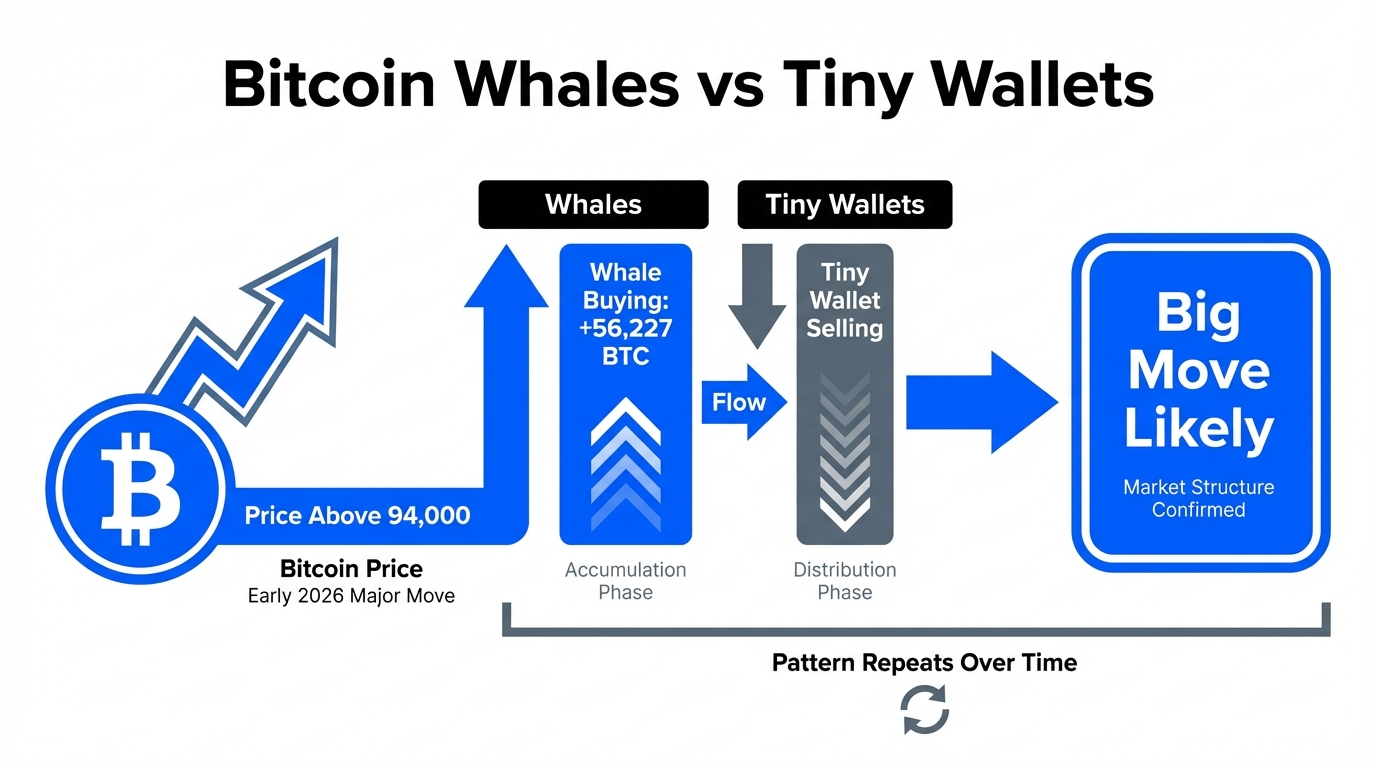
Jon: Alright, let’s peel back the layers. Bitcoin operates on a decentralized ledger called the blockchain, where every transaction is recorded transparently. Whale accumulation patterns like this are tracked via on-chain analytics – tools that analyze wallet addresses, transaction volumes, and holder behaviors without revealing personal identities. In this case, data shows whales adding 56,227 BTC while smaller wallets distribute. This isn’t magic; it’s rooted in Bitcoin’s proof-of-work consensus mechanism, where miners validate transactions, ensuring the network’s security and immutability.
Lila: Proof-of-work – that’s the energy-intensive mining thing, right? How does that tie into whales buying and selling?
Jon: Exactly. Proof-of-work secures the network by requiring computational effort to add blocks, making it hard to manipulate. For market patterns, it’s the transparency of the blockchain that lets us see these shifts. Whales often move coins from exchanges to cold storage during accumulation, reducing selling pressure. Small wallets might sell to exchanges, increasing supply. This dynamic can create a supply squeeze, potentially driving prices up if demand holds steady.
Lila: Got it. To make sure I understand, can we compare this to past patterns or other assets?
Jon: Absolutely. Let’s look at a quick comparison of whale vs. retail behavior in Bitcoin versus traditional stocks, based on historical data.
| Aspect | Bitcoin Whales | Bitcoin Retail (Tiny Wallets) | Traditional Stocks (e.g., Institutional vs. Retail) |
|---|---|---|---|
| Typical Behavior in Consolidation | Accumulate (e.g., +56,227 BTC recently) | Sell off for quick profits or fear | Institutions buy dips; retail panics |
| Market Impact | Reduces supply, potential for bullish breakout | Increases supply, adds downward pressure | Similar, but regulated markets limit extremes |
| Historical Outcome | Often precedes rallies (e.g., post-2022 bear market) | Misses rebounds if selling too early | Institutions drive long-term trends |
| Risks | Manipulation concerns, but blockchain transparency helps | Emotional decisions lead to losses | Regulatory oversight reduces volatility |
Jon: As you can see, Bitcoin’s decentralized nature amplifies these behaviors compared to stocks, where regulations curb extreme whale influence. Tools like Glassnode or Chainalysis pull this data from the blockchain, showing metrics like the “Exchange Whale Ratio” – which has surged recently, indicating big players are active.
Lila: That table really clarifies the differences. So who actually uses this kind of information or benefits from these patterns in practice?
Jon: Good pivot. On the technical side, developers and analysts use on-chain data for building market intelligence tools, like dashboards that track whale movements to predict liquidity shifts. For users, it’s about understanding market health – traders might watch for accumulation as a signal to hold positions longer, focusing on Bitcoin’s role as a store of value. Institutions, like those accumulating via ETFs, leverage this for strategic entries. The benefit is in the transparency: it democratizes access to what was once insider info in traditional finance.
Lila: Beyond tracking, are there real-world applications, like in DeFi or payments?
Jon: Absolutely. In DeFi, whale patterns influence lending protocols on networks like Ethereum that integrate Bitcoin via wrapped tokens (e.g., WBTC). If whales accumulate, it could stabilize collateral values, making loans more reliable. For payments, businesses accepting Bitcoin might adjust strategies based on these trends – holding more during accumulation phases for potential appreciation. The key technical perk is Bitcoin’s scarcity mechanic: with only 21 million BTC ever, whale hoarding tightens supply, reinforcing its deflationary design. But it’s all about the engineering – the protocol’s halving events every four years further this by slowing new supply, amplifying accumulation effects.
Lila: Fascinating. If someone’s inspired to learn more, what’s a safe way to start without jumping into risky stuff?
Jon: Let’s break it into levels. For Level 1: Research and Observation, start by exploring Bitcoin’s whitepaper at bitcoin.org – it’s the foundational doc explaining the peer-to-peer electronic cash system. Then, use blockchain explorers like Blockchair or Blockchain.com to view real-time transactions and whale addresses. Dashboards from Glassnode offer free tiers for tracking metrics like holder distribution. It’s like window-shopping; observe without committing.
Lila: And for hands-on? Level 2 sounds like getting practical safely.
Jon: Right. For Level 2: Testnet and Hands-on Learning, dive into Bitcoin’s testnet – a sandbox version of the network where you can experiment with fake BTC. Set up a wallet like Electrum, create test transactions, and even simulate mining with tools like Bitcoin Core’s regtest mode. This lets you understand mechanics like UTXOs (unspent transaction outputs, basically your spendable balances) without real risk. If you’re into coding, build a simple script using libraries like python-bitcoinlib to query the blockchain. Emphasize: this is for education, not speculation – risks remain in live markets.
Lila: Solid advice. Wrapping up, what’s the big takeaway here?
Jon: In summary, this whale accumulation pattern – adding 56,227 BTC amid retail selling – often signals potential upward moves due to supply dynamics and Bitcoin’s robust architecture. It’s a reminder of the network’s resilience, built on transparent, secure tech. Limitations include external factors like regulations or macroeconomics that can override patterns.
Lila: True, and let’s not forget volatility – crypto can swing wildly, so patterns are guides, not guarantees. Approach with curiosity and caution.
Jon: Well said. The future? If 2026 trends hold from recent reports, like ongoing whale buys amid DeFi integrations, Bitcoin could see more institutional adoption. But it’s an evolving space – stay informed, think critically.
About the Authors:
Jon is a seasoned Web3 researcher with over a decade in blockchain architecture. Lila brings a learner’s perspective, bridging complex topics for everyday understanding. Together, they explore crypto’s technical frontiers without the hype.
References
- Bitcoin set for big move as whales add 56,227 BTC while tiny wallets sell – this pattern usually ends one way
- Bitcoin Official Website
- Bitcoin Whales Accumulate 270,000 BTC as Market Consolidates
- Bitcoin Whale Holdings Decline Through 2025: Could Q1 2026 Reverse the Trend?
- Bitcoin Whales Accumulate BTC as Exchange Supply Falls to 7-Year Low