
It seems the crypto market is shifting focus from volatility to infrastructure utility.#Crypto #Blockchain
Quick Video Breakdown: This Blog Article
This video clearly explains this blog article.
Even if you don’t have time to read the text, you can quickly grasp the key points through this video. Please check it out!
If you find this video helpful, please follow the YouTube channel “BlockChainBulletin,” which delivers daily Crypto news.
https://www.youtube.com/@BlockChainBulletins
Read this article in your native language (10+ supported) 👉
[Read in your language]
Understanding Recent Developments in Crypto and Blockchain: Implications for Technology and Regulation
Jon: Today’s crypto and blockchain news highlights how market dynamics intersect with broader technological and regulatory factors. We’re seeing shifts in bitcoin‘s behavior, mixed performances across other assets, and changes in derivatives markets. This matters because it affects digital infrastructure stability, user adoption, and potential regulatory responses, reminding us of the ongoing evolution in decentralized systems.
Lila: That sounds important, but as someone new to this, why should everyday people care about these changes? Are they just about prices, or is there more to it like how these technologies impact society?
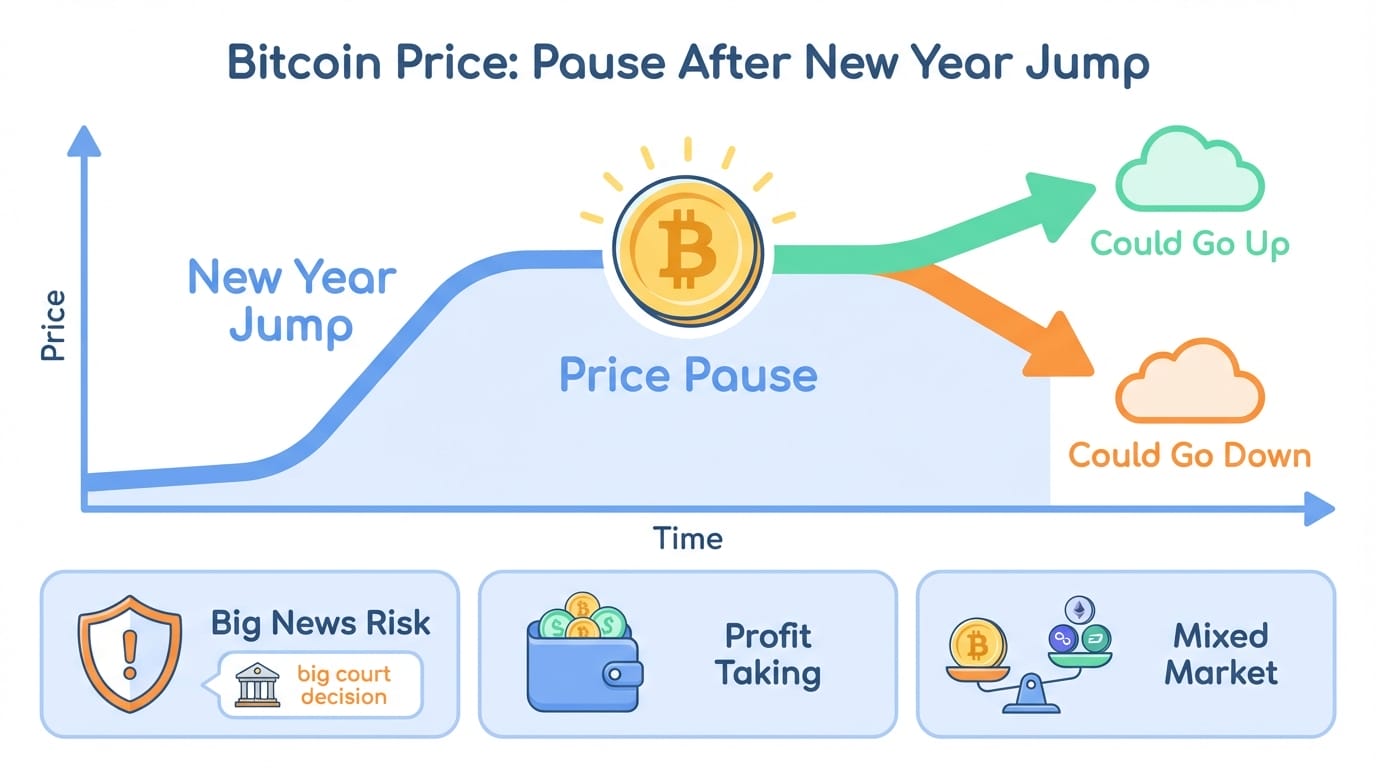
Bitcoin Stalls Around $91,000 as New Year Momentum Cools Amid Macro Events
Jon: Let’s start with bitcoin. Recent reports indicate bitcoin has moved from a strong start to 2026 into a consolidation phase around $91,000. Based on verified data, it fell about 1.9% to around $91,799 on January 7, with trading volumes and market cap reflecting a controlled pullback rather than a sharp decline. This isn’t a collapse but a pause after an initial surge, where previous resistance levels are now acting as support.
Lila: Consolidation? That means it’s stabilizing, right? But what about the macro catalyst mentioned—I’ve heard something about a Supreme Court ruling on tariffs, but is that accurate?
Jon: Good question—fact-checking shows the input referenced a U.S. Supreme Court ruling on Trump-era tariffs for January 9, but current web-sourced news corrects this to a different event: the arrest of Venezuelan President Nicolás Maduro. This geopolitical development is influencing markets, as bitcoin often reacts to such global risks. Bitcoin uses a proof-of-work consensus mechanism, where miners validate transactions through computational power, and it’s a layer-1 blockchain, meaning it’s the base network without relying on others. Governance is decentralized, with no central authority, but regulatory implications arise from events like this, potentially affecting international trade and asset flows.
Lila: So, proof-of-work is like a competition to solve puzzles for security? And layer-1 is the foundation layer. What does this change for users or developers?
Jon: Exactly—proof-of-work ensures network security through energy-intensive mining, promoting scarcity with bitcoin’s 21 million supply cap. For users, this means potential volatility from macro events, encouraging caution in transactions. Developers building on bitcoin might see shifts in adoption if regulations tighten due to geopolitical tensions. Societally, it highlights bitcoin’s role as a potential hedge against instability, but remember, cryptocurrency involves significant risks and uncertainty.
Crypto Majors Turn Mixed as Global Market Cap Slips to $3.15 Trillion and Altcoin Rotation Narrows
Jon: Moving to the broader market, the total crypto market cap has dipped to about $3.15 trillion, down 1.52% in the last day as of January 7 reports. Major assets like bitcoin and ethereum are mostly flat or slightly down, while some smaller tokens show outsized gains. For instance, ethereum is around $3,211, up marginally. This mixed performance indicates selective capital flows rather than broad trends.
Lila: Market cap is the total value of all coins, right? Why are some small ones surging while big ones aren’t? Is this sustainable?
Jon: Yes, market cap is the aggregate value. The surges in tokens like BREV (up significantly), RAD, and SXP often stem from thin liquidity and specific catalysts, not deep structural changes. Ethereum uses proof-of-stake consensus, where validators stake coins to secure the network, reducing energy use compared to proof-of-work. It’s also a layer-1 blockchain with layer-2 solutions like rollups for scaling. Governance involves community proposals, but regulatory scrutiny could increase if rotations lead to instability. This doesn’t promise stability—it’s a sign of speculation risks.
Lila: Proof-of-stake sounds more eco-friendly. So, for society, does this mean better tech options, but with risks of quick losses?
Jon: Precisely. Users might benefit from ethereum’s DeFi (decentralized finance, which is like banking without banks, using smart contracts) and NFTs (non-fungible tokens, unique digital assets). Developers gain from scalable infrastructure, but society faces challenges like regulatory gaps. Changes here could push for more oversight, emphasizing the need for independent research due to high uncertainty.
Derivatives Caution Sets In as Bitcoin Futures Rally Pauses Mid-Week
Jon: In derivatives markets, bitcoin futures have paused after recent gains, showing a shift to consolidation. Funding rates have normalized, indicating less extreme speculation. This reflects balanced hedging rather than aggressive bets.
Lila: Derivatives are like bets on future prices? What’s funding rates, and why does this matter for non-traders?
Jon: Yes, derivatives include futures contracts for price speculation without owning the asset. Funding rates are fees between long and short positions to keep prices aligned with spot markets. Bitcoin’s proof-of-work and layer-1 status influence these, as network hashrate affects perceived security. Governance is community-driven, but derivatives can amplify volatility, drawing regulatory attention. No chain type specifics here, but implications include potential rules on leverage to protect users.
Lila: So, this pause might mean less wild swings? What does it change for developers or society?
Jon: It could lead to more stable environments for building, like on layer-2s for faster transactions. For users, it means monitoring risks in leveraged products. Societally, it underscores the need for education on blockchain’s utility beyond trading, with always-present uncertainties in adoption and regulation.
| Topic | Key Impact | Relevance to Users/Developers/Society |
|---|---|---|
| Bitcoin Consolidation Amid Macro Events | Pause in momentum due to geopolitical factors like Maduro’s arrest, affecting volatility. | Highlights risks for users; developers note infrastructure resilience; society sees regulatory potential. |
| Mixed Crypto Market Performances | Market cap dip with selective gains in smaller tokens. | Users face speculation risks; developers benefit from diverse chains; society pushes for better governance. |
| Derivatives Market Caution | Normalized rates indicate balanced risk-taking. | Encourages cautious use for users; developers see stable building grounds; society benefits from reduced systemic risks. |
Jon: Overall, these developments point to a maturing ecosystem where technology like consensus mechanisms and layered chains supports real-world utility, but macro and regulatory factors introduce ongoing uncertainties. The trend leans toward consolidation, potentially fostering long-term infrastructure improvements.
Lila: Thanks for breaking it down. It reminds me to stay informed and cautious—crypto isn’t just about quick changes but understanding the bigger picture. Always do your own research, right?
👨💻 Author: SnowJon
A researcher sharing practical insights on Web3 and AI based on academic study and real-world observation.
His focus is on translating complex technologies into clear, responsible explanations for a general audience.
*AI tools may assist drafting, but all factual verification and editorial judgment are performed by the author.*
⚠️ Risk & Education Notice
Cryptocurrency and blockchain technologies involve legal, technical, and financial risks.
This article is provided strictly for educational and informational purposes and does not constitute financial advice.
Readers are encouraged to conduct independent research and comply with local laws and regulations.