
Personally, Bitcoin ETFs outflows suggest institutional liquidity is less sticky than assumed.#BitcoinETFs #MarketLiquidity
Quick Video Breakdown: This Blog Article
This video clearly explains this blog article.
Even if you don’t have time to read the text, you can quickly grasp the key points through this video. Please check it out!
If you find this video helpful, please follow the YouTube channel “BlockChainBulletin,” which delivers daily Crypto news.
https://www.youtube.com/@BlockChainBulletins
Read this article in your native language (10+ supported) 👉
[Read in your language]
Bitcoin ETFs Failed a Critical Holiday Stress Test as $1.29 Billion Vanished Through “Tactical” Positioning
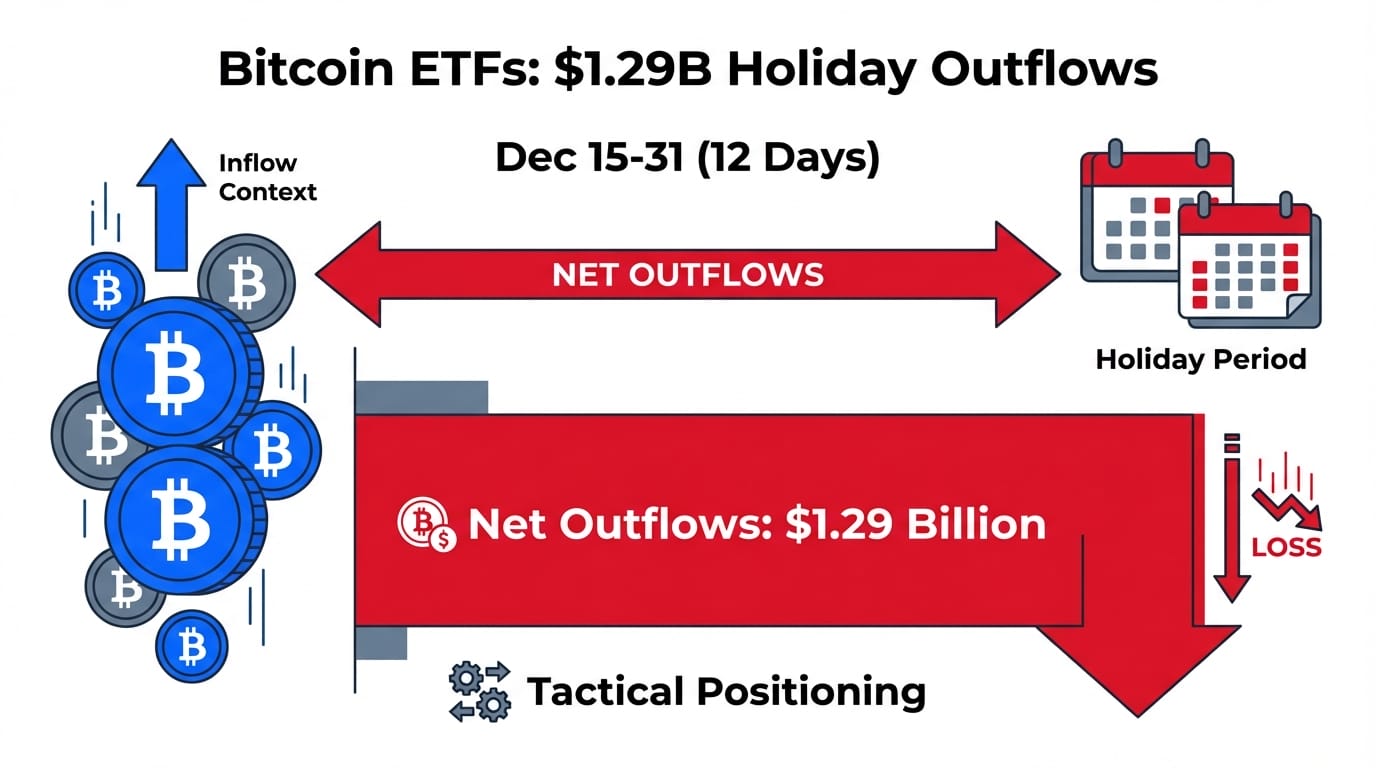
Jon: Hey Lila, I came across this intriguing piece from CryptoSlate about Bitcoin ETFs facing a rough patch over the holidays. Essentially, institutional investors pulled out a whopping $1.29 billion in just 12 days, labeled as “tactical positioning.” It’s like the market’s version of end-of-year spring cleaning, but with real consequences for liquidity.
Lila: Wow, that sounds dramatic. Bitcoin ETFs have been all the rage since their launch, right? But $1.29 billion vanishing? That’s not pocket change. Why does this matter?
Jon: Exactly, it’s a big deal because it highlights how these ETFs, which were supposed to bring stable, institutional money into Bitcoin, aren’t as “sticky” as hoped. Over the holiday period, with thinner trading volumes, these outflows dumped about 14,500 BTC onto the market. Prices dipped around 20% in late 2025, testing the system’s resilience. It matters for anyone watching crypto‘s maturation—ETFs were pitched as a bridge to traditional finance, but this shows they’re still vulnerable to Wall Street’s year-end maneuvers.
Lila: Okay, so it’s not just random selling; there’s a structural reason behind it?
Jon: Spot on. Let’s dive into the “why.” The problem stems from how institutional investors treat these ETFs. Unlike retail holders who might HODL through volatility, big players use them for tactical positioning—short-term bets tied to broader portfolios. Come year-end, they rebalance books, close positions for tax reasons, or shift allocations. In crypto, with its 24/7 market but holiday-thin liquidity, this creates a perfect storm. It’s like a highway during rush hour: fine when everyone’s driving steadily, but if a bunch of cars suddenly exit, it causes backups and crashes.
Lila: That analogy helps. So, the thin liquidity amplified the impact? Can you break it down more?
Jon: Absolutely. Liquidity is the market’s plumbing—how easily you can buy or sell without massive price swings. Over holidays, fewer traders mean shallower order books. When $1.29 billion exits via ETFs, it’s not gradual; it’s a flood. Reports note this was the sharpest outflow on record, with Bitcoin dropping to around $90K after peaking higher. The irony? ETFs were meant to add depth, but tactical moves exposed their fragility. Think of it as an accounting trick: firms “window dress” portfolios by dumping volatile assets before reporting periods, making books look cleaner.
Lila: Got it—it’s more about finance mechanics than Bitcoin itself failing. But how do these ETFs even function under the hood to allow this?
Under the Hood: How it Works
Jon: Alright, let’s peel back the layers. Bitcoin ETFs, like BlackRock’s IBIT or Fidelity’s offerings, are exchange-traded funds that track Bitcoin’s spot price. They don’t hold actual BTC in your brokerage account; instead, the ETF provider custodies the Bitcoin through trusted entities like Coinbase. When you buy shares, you’re essentially getting exposure without dealing with wallets or keys. The mechanics involve authorized participants (APs)—big banks that create or redeem ETF shares in large blocks, keeping the price pegged to Bitcoin’s value via arbitrage.
Lila: So, it’s like a wrapper around Bitcoin for traditional investors? That makes sense for accessibility.
Jon: Precisely. Under the hood, it’s a creation/redemption process. APs deposit Bitcoin (or cash equivalents) to create new shares when demand rises, or redeem shares for Bitcoin when outflows hit. This happened en masse during the holidays: tactical positioning meant APs redeemed shares, flooding the market with BTC. The stress test failed because thin liquidity couldn’t absorb it without price slippage. To compare, let’s look at traditional ETFs versus crypto ones.
| Aspect | Traditional Stock ETFs | Bitcoin Spot ETFs |
|---|---|---|
| Underlying Asset | Stocks or bonds, highly liquid in regulated markets | Bitcoin, volatile and traded 24/7 on global exchanges |
| Liquidity During Holidays | Markets close, reducing volatility spikes | Always open, but thinner volumes amplify outflows |
| Investor Behavior | Long-term holdings common | Tactical positioning leads to quick exits |
| Risk of Stress Tests | Lower, due to circuit breakers | Higher, as seen with $1.29B vanishing |
Lila: The table clarifies the differences. So, Bitcoin ETFs are more exposed to crypto’s wild side. But beyond the mechanics, who actually uses these?
Jon: Great question. On the user side, retail investors use them for easy Bitcoin exposure via brokerage accounts—no need for crypto exchanges. Institutions like hedge funds employ them for portfolio diversification, hedging against inflation, or tactical plays without direct custody hassles. Developers and analysts might track ETF flows via dashboards to gauge market sentiment. Technically, they benefit from regulated access, reducing counterparty risks compared to holding on exchanges. For instance, in 2025, ETFs absorbed $24B in inflows before the year-end dump, showing their role in bridging TradFi and crypto.
Lila: So who actually uses this? I mean, beyond investors, are there broader applications?
Jon: Absolutely. Think macro funds using ETFs to position against dollar weakness, or pension funds dipping toes into digital assets for yield. On the tech side, blockchain developers integrate ETF data into apps for real-time analytics. It’s not just trading; it’s about data flows informing DeFi protocols or even NFT markets indirectly. The key benefit is liquidity provision—ETFs can stabilize Bitcoin’s price over time by attracting steady capital, though events like this stress test show it’s still evolving.
Lila: That sounds practical. If someone’s interested in learning more without jumping in headfirst, what’s a good starting point?
Jon: Let’s break it into levels for an educational action plan. First, Level 1: Research and Observation. Start by reading whitepapers from issuers like BlackRock or the SEC‘s ETF approvals. Use explorers like Glassnode or CoinDesk for flow data—track inflows/outflows to see patterns. Dashboards on Dune Analytics let you query ETF metrics without any cost or risk. It’s like window-shopping; observe how tactical positioning affects prices.
Lila: Nice, low-barrier entry. What about getting hands-on safely for Level 2?
Jon: For Level 2: Testnet or Hands-on Learning, simulate with test environments. Platforms like TradingView offer paper trading for ETFs, where you practice strategies with fake money. Dive into blockchain testnets via tools like Etherscan to understand custody mechanics without real Bitcoin. Experiment with open-source scripts on GitHub to model ETF arbitrage—it’s minimal-risk learning that builds intuition on liquidity dynamics. Remember, this is for education; real markets have volatility.
Lila: Perfect, keeps it responsible. Wrapping up, what’s the big takeaway here?
Jon: In summary, this holiday stress test exposed Bitcoin ETFs’ limitations—tactical outflows can shake the market, but it also shows the system’s growing pains toward maturity. Analysts predict $180-220B in AUM by 2026, suggesting resilience. Limitations include ongoing volatility and macro ties, but the opportunity lies in better understanding these mechanics for informed perspectives.
Lila: Totally agree. Readers, remember crypto’s full of uncertainty and volatility—approach with caution and continuous learning.
Jon: Well said. It’s a thoughtful space to watch as it evolves.
—
References
- Bitcoin ETFs failed a critical holiday stress test as $1.29 billion vanished through “tactical” positioning
- Official Bitcoin Website
- Bitcoin ETFs lose record $4.57 billion in two months – CoinDesk
- $2.2 Billion BTC & ETH Options Expiry Kicks Off 2026 Volatility Test – BeInCrypto
- Bitcoin Ends 2025 Bruised but Structurally Strong as the Market Resets for 2026 – Investing.com