
Personally, I believe DeFi adoption faces an evolution in 2026 rather than a complete end.#DeFi #regulation
Quick Video Breakdown: This Blog Article
This video clearly explains this blog article.
Even if you don’t have time to read the text, you can quickly grasp the key points through this video. Please check it out!
If you find this video helpful, please follow the YouTube channel “BlockChainBulletin,” which delivers daily Crypto news.
https://www.youtube.com/@BlockChainBulletins
Read this article in your native language (10+ supported) 👉
[Read in your language]
Will DeFi Adoption Officially End in 2026?
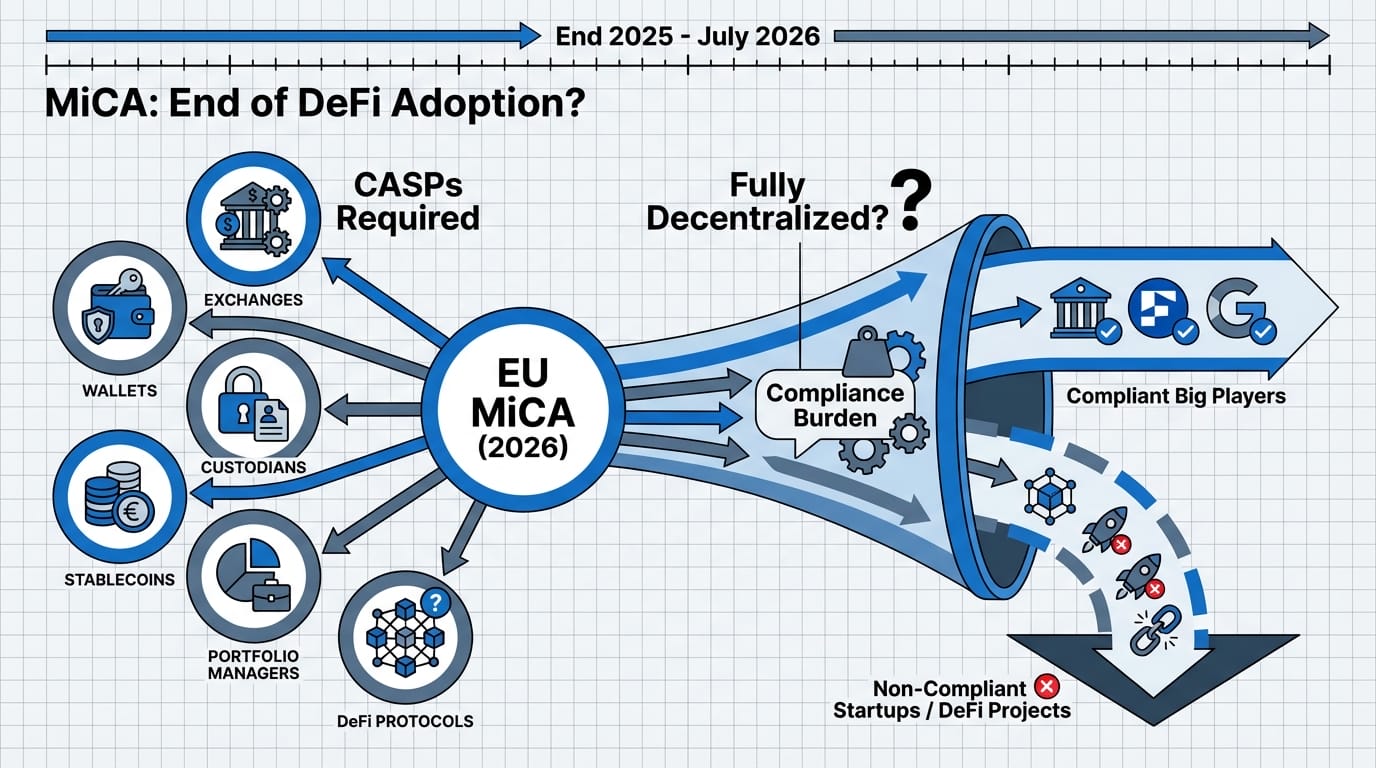
Jon: Hey Lila, I came across this intriguing article on CryptoSlate titled “Will DeFi adoption officially end in 2026?” It’s stirring up some debate in the Web3 space. Essentially, it’s discussing how the European Union’s MiCA regulation—Markets in Crypto-Assets—will fully kick in by July 2026, potentially reshaping how DeFi operates, especially for exchanges and self-custody wallets. No hype here, just a level-headed look at what this could mean for decentralized finance.
Lila: Interesting, Jon. I’ve heard bits about MiCA, but I’m not fully up to speed. So, the article suggests DeFi might “end” in 2026? That sounds dramatic. Can you break down the high-level points from the piece?
Jon: Absolutely, and yeah, the title is a bit provocative—classic crypto journalism wit. The guest post by Shane Neagle argues that between late 2025 and mid-2026, MiCA will enforce strict rules on crypto service providers. Think mandatory licensing, consumer protections, and transparency requirements. For DeFi, which thrives on pseudonymity and borderless access, this could mean big changes. Exchanges might need to KYC users, and self-custody wallets could face restrictions if they’re seen as “hosting” services. It’s not literally ending DeFi, but it might curb its unregulated growth, especially in Europe.
Lila: Why does this matter? Isn’t DeFi global? If Europe tightens up, can’t people just use it elsewhere?
Jon: Great question—it matters because Europe is a massive market, and regulations like this often set precedents. If MiCA forces DeFi protocols to comply or geo-block users, it could slow adoption. Remember, DeFi has seen explosive growth; total value locked hit over $100 billion in recent years. But with regs incoming, we’re talking potential shifts in how accessible and innovative DeFi remains. It’s a reminder that crypto isn’t in a vacuum—real-world laws are catching up.
Lila: Okay, that makes sense. But let’s dig into the problem here. What’s the core issue with DeFi that regulations like MiCA are trying to address?
Jon: At its heart, the problem is the tension between DeFi’s decentralized ethos and the need for oversight. DeFi lets anyone lend, borrow, or trade assets without banks, using smart contracts on blockchains like Ethereum. But without rules, it’s ripe for scams, money laundering, or market manipulation. MiCA aims to protect users by treating crypto like traditional finance—requiring audits, reserves for stablecoins, and anti-fraud measures. The article points out that by 2026, this could make “permissionless” DeFi less appealing if protocols have to add gates.
Lila: That sounds abstract. Can you give me a real-world analogy to clarify?
Jon: Sure, think of DeFi like a bustling farmers’ market where anyone can set up a stall to sell or trade goods without a permit. It’s efficient, open, and innovative—prices fluctuate based on supply and demand, no middlemen skimming fees. But if the city steps in with health inspections, vendor licenses, and taxes (like MiCA), some stalls might close or move underground. The market doesn’t “end,” but it becomes more structured, potentially safer but less wild and accessible. That’s the structural problem: balancing freedom with safety.
Lila: Ah, got it. So regulations could tame the Wild West vibe of DeFi. But does that mean adoption grinds to a halt?
Jon: Not necessarily—it might evolve it. Some predict it’ll push DeFi toward hybrid models, where compliance meets decentralization. Worth watching, but risks remain, as always in this space.
Under the Hood: How it Works
Jon: Alright, let’s peel back the layers on DeFi mechanics, especially in light of potential regulatory impacts. The diagram above illustrates a typical DeFi stack—blockchain base layer, smart contracts, oracles for real-world data, and user interfaces like wallets. At its core, DeFi runs on permissionless blockchains. Take Ethereum: it uses smart contracts—self-executing code—to handle things like automated lending in protocols like Aave. You deposit crypto as collateral, borrow against it, and interest rates adjust algorithmically based on supply/demand.
Lila: Smart contracts sound fancy. So, they’re like vending machines that dispense loans automatically?
Jon: Exactly—input your collateral, and out comes the loan, no banker needed. But with MiCA, if a protocol is deemed a “crypto-asset service provider,” it might need to verify identities, which adds friction. Token mechanics are key too: many DeFi projects have governance tokens (like UNI for Uniswap) that let holders vote on changes. These tokens often have utility, but regs could classify them as securities, triggering more scrutiny.
Lila: Okay, confirming: so DeFi isn’t just one thing—it’s a bunch of protocols interacting?
Jon: Spot on. It’s composable, like LEGO bricks. One protocol’s output feeds another’s input. For consensus, most DeFi sits on proof-of-stake chains now, where validators stake tokens to secure the network, earning rewards. MiCA might not directly touch this, but it could affect how users access it via regulated gateways.
Lila: How does this compare to traditional finance? Maybe a table would help visualize.
Jon: Good idea. Here’s a quick comparison of DeFi vs. traditional finance, highlighting why regs like MiCA matter.
| Aspect | Traditional Finance | DeFi |
|---|---|---|
| Access | Requires banks, IDs, approval | Permissionless, wallet-based |
| Regulation | Heavy, with oversight bodies | Light, but evolving (e.g., MiCA) |
| Risks | Systemic failures, bailouts | Smart contract bugs, volatility |
| Efficiency | Slower, intermediary fees | 24/7, automated |
| Impact of 2026 Regs | Already compliant | May require adaptations, potentially slowing adoption |
Jon: As you see, DeFi’s strengths are its openness, but that’s what regs target to mitigate abuses.
Lila: So who actually uses this? Beyond speculators, I mean—who benefits technically from DeFi, and how might 2026 change that?
Jon: Developers and users alike. On the dev side, builders create protocols for yield farming—locking assets to earn rewards—or DEXs (decentralized exchanges) for peer-to-peer trading without custodians. Users get financial inclusion: someone in a developing country can access loans without a credit score. Technically, it’s about disintermediation—cutting out banks for lower costs and global reach. Post-2026, with MiCA, use cases might shift to compliant DeFi, like tokenized assets in regulated environments, benefiting institutional players who need that security layer. It’s not all doom; it could legitimize DeFi for mainstream adoption.
Lila: Makes sense. For everyday folks or learners like me, how do we get started understanding this without jumping into risks?
Jon: Let’s break it into levels. Level 1: Research and observation. Start by reading whitepapers on sites like Ethereum.org or Aave’s docs. Use blockchain explorers like Etherscan to track transactions—see how DeFi pools work in real-time. Dashboards like DeFiLlama show total value locked and protocol stats. It’s passive learning: understand the mechanics without touching anything.
Lila: Cool, that’s low-pressure. What about Level 2—something hands-on but safe?
Jon: Absolutely, dive into testnets. Ethereum’s Sepolia testnet lets you experiment with fake ETH—deploy a simple smart contract or interact with a DeFi simulator. Tools like Remix IDE make it easy to code and test without real money. It’s all about learning the architecture safely; emphasize minimal-risk experimentation to grasp how regs might integrate.
Lila: Helpful. No rushing into mainnet, I assume.
Jon: Precisely—build knowledge first.
Jon: Wrapping up, the opportunity in DeFi is its potential for efficient, borderless finance, but limitations like upcoming regs in 2026 could reshape it. MiCA might not “end” adoption but force evolution—perhaps more hybrid models blending DeFi with compliance. It’s worth watching how protocols adapt.
Lila: Yeah, and remember, crypto’s volatile—prices swing wildly, and nothing’s certain. Do your own research, folks.
Jon: Well said. The future’s uncertain, but understanding the tech keeps you ahead.
References
- Will DeFi adoption officially end in 2026?
- Ethereum DeFi Overview
- DeFiLlama Dashboard
- Ethereum Price Predictions for 2026