
In my view, Ethereum prioritizing user experience marks a shift toward mass utility.#Ethereum #VitalikButerin
Quick Video Breakdown: This Blog Article
This video clearly explains this blog article.
Even if you don’t have time to read the text, you can quickly grasp the key points through this video. Please check it out!
If you find this video helpful, please follow the YouTube channel “BlockChainBulletin,” which delivers daily Crypto news.
https://www.youtube.com/@BlockChainBulletins
Read this article in your native language (10+ supported) 👉
[Read in your language]
Vitalik Buterin Outlines Usability and Decentralization as Ethereum’s Core Tests
Jon: Hey Lila, I came across this recent piece from Vitalik Buterin where he’s laying out the big challenges for Ethereum heading into 2026. It’s all about making the network more usable for everyday folks while keeping that core decentralization intact. No fluff, just straight talk on what needs to happen for Ethereum to live up to its “world computer” promise.
Lila: Sounds intriguing, Jon. I’ve been following Ethereum’s updates, but Vitalik’s takes are always worth dissecting. Can you give me the high-level rundown from the article?
Jon: Sure thing. In his New Year’s message, Buterin highlights that Ethereum made solid technical strides in 2025—like gas limit improvements and zkEVM upgrades—but the real tests for 2026 are usability and decentralization. He stresses focusing on building infrastructure that’s accessible without sacrificing the network’s resistance to censorship or centralized control. It’s not about chasing the latest crypto hype; it’s about creating practical, trustless applications that anyone can use globally. For instance, recent reports note Ethereum’s price reacting positively, up about 2% after his outline, but that’s secondary to the tech mission.
Lila: Why does this matter? Ethereum’s been around for years—aren’t usability and decentralization already baked in?
Jon: Great question, and it’s exactly why Buterin’s pushing this now. It matters because Ethereum aims to be the backbone of a free, open internet, but if it’s too clunky or starts leaning on big centralized players, it loses its edge. Think of it as evolving from a prototype to a reliable daily driver. Without nailing usability, adoption stalls; without decentralization, it becomes just another corporate database. Sources like CoinDesk and The Block echo this, noting that 2026 could define whether Ethereum fulfills its vision amid ongoing scalability debates.
Lila: Okay, that sets the stage. But let’s dive deeper—what’s the actual problem here that Buterin’s calling out?
Jon: The core issue is the tension between making Ethereum easy to use and ensuring it remains truly decentralized. Right now, many users rely on centralized interfaces or services to interact with the network because the raw tech can be intimidating—high gas fees during congestion, complex wallet setups, and the risk of user errors leading to lost funds. Buterin points out that if we prioritize short-term trends over real decentralization, Ethereum risks becoming vulnerable to censorship or control by a few big entities, like what we’ve seen in traditional finance.
Lila: That makes sense, but can you clarify with an analogy? I’m picturing something everyday to wrap my head around it.
Jon: Absolutely. Imagine Ethereum as a massive public highway system. Decentralization is like keeping it open to all drivers without toll booths controlled by one company—anyone can build ramps or drive on it freely. But usability is ensuring the roads aren’t riddled with potholes, confusing signs, or traffic jams that make driving a nightmare. In 2025, we patched some potholes with upgrades like better scaling, but for 2026, Buterin’s saying we need smoother on-ramps for new drivers (usability) while preventing any single authority from installing gates (decentralization). Without both, the highway either gets gridlocked or turns into a private toll road. Reports from DailyCoin and CryptoPotato back this, emphasizing how technical gains alone won’t cut it if users can’t navigate easily.
Lila: Nice analogy—that clicks. So, the problem is balancing accessibility with preserving the open, permissionless nature. How do we actually address that under the hood?
Under the Hood: How it Works
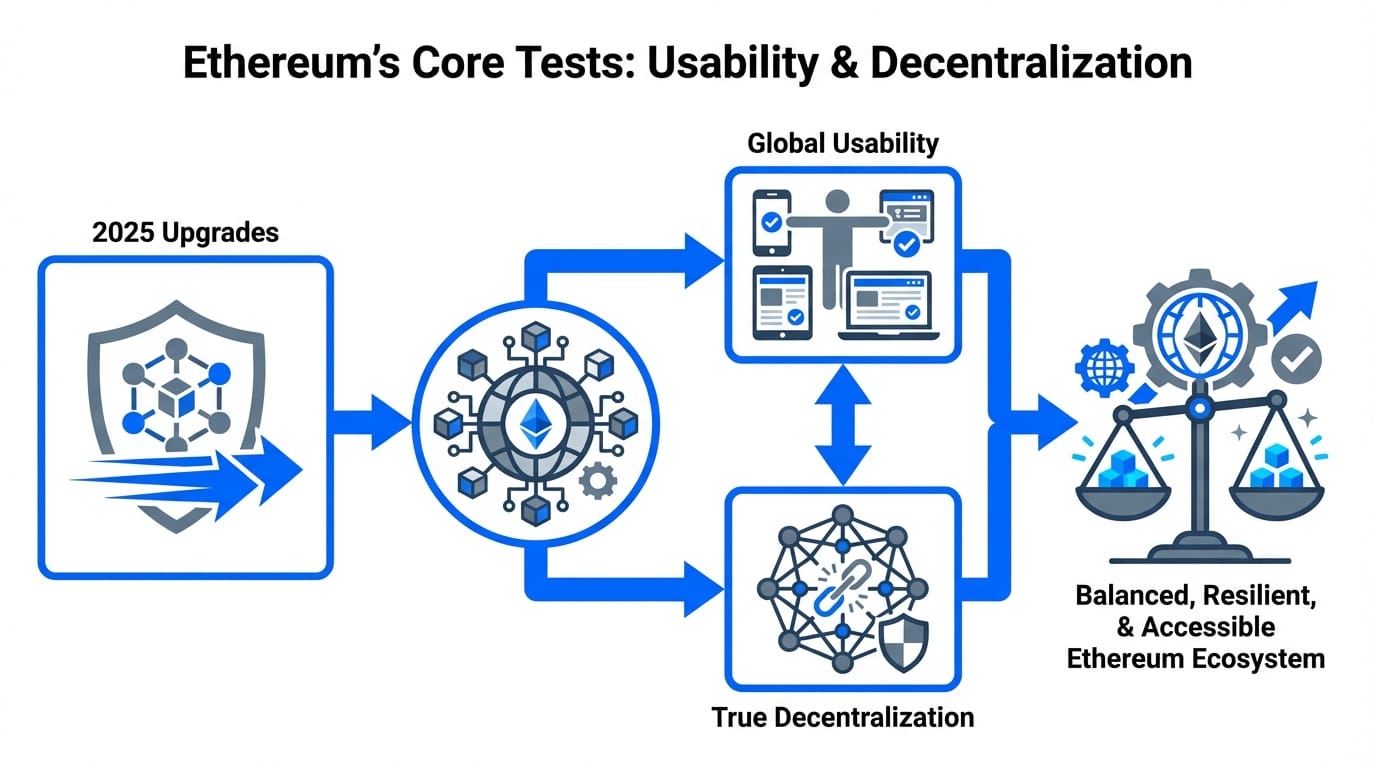
Jon: Alright, let’s peel back the layers. At its core, Ethereum is a blockchain network powered by proof-of-stake consensus since the Merge in 2022. Nodes worldwide validate transactions using Ethereum’s virtual machine (EVM), which runs smart contracts—essentially self-executing code that enforces rules without intermediaries. For usability, initiatives like account abstraction (via proposals like ERC-4337) aim to make wallets more intuitive, letting users pay fees in any token or recover keys socially, rather than dealing with seed phrases. On decentralization, Buterin stresses scaling solutions like rollups—layer-2 networks that bundle transactions off-chain and settle on Ethereum’s mainnet—to reduce costs without centralizing control. ZkEVMs, for example, use zero-knowledge proofs to verify computations efficiently, keeping things verifiable by anyone.
Lila: Whoa, zero-knowledge proofs? Can you simplify that? And how does this tie into the 2026 goals?
Jon: Sure—zero-knowledge proofs are like proving you know a secret without revealing it. In Ethereum, they let you verify a bunch of transactions are correct without re-running every detail on the main chain, which boosts speed and cuts fees. For 2026, Buterin’s outline pushes for these to enhance usability (faster, cheaper apps) while decentralizing further—think more solo stakers running nodes from home, not just big data centers. It’s about distributing power so no single point can censor or fail the network.
Lila: Got it. To compare, how does this stack up against, say, older blockchain models or centralized alternatives?
Jon: Good point. Let’s break it down in a table for clarity.
| Aspect | Traditional Centralized Systems (e.g., Banks) | Current Ethereum | 2026 Vision (Per Buterin) |
|---|---|---|---|
| Usability | User-friendly apps, but controlled by entity | Clunky interfaces, high fees during peaks | Intuitive dApps, low-cost via L2s and abstraction |
| Decentralization | Central authority decides rules | Distributed nodes, but staking pools dominate | More solo staking, censorship-resistant |
| Scalability | Handles high volume, but single-point failure | Limited TPS, improved by rollups | Global scale with zk tech, no trade-offs |
| Risks | Censorship by authority | Volatility, smart contract bugs | Ongoing challenges, but focused mitigation |
Jon: As you can see, the 2026 push aims to bridge the gaps, making Ethereum a viable alternative without the downsides of centralization.
Lila: So who actually uses this? I mean, beyond the tech enthusiasts—what are the real-world applications driving this focus?
Jon: Excellent pivot. On the developer side, it’s about building dApps (decentralized applications) for finance, like DeFi protocols where users lend or borrow without banks, or NFTs for digital ownership. Usability improvements mean easier integration for things like social logins or gasless transactions, attracting more builders. For users, think supply chain tracking—verifying product origins transparently—or decentralized social media that can’t be shut down by a CEO. Buterin’s vision emphasizes real utility, like tokenized real-world assets (RWAs), where physical items are represented on-chain securely. The technical benefit is censorship resistance: in regions with unstable governments, Ethereum could enable uncensorable payments or data storage. Sources like Live Bitcoin News highlight how this strengthens Ethereum’s role in a global, open economy, focusing on scalable infrastructure.
Lila: That sounds practical. And for gaming or everyday finance?
Jon: Spot on. In gaming, decentralized economies let players truly own in-game assets across titles. For finance, it’s about privacy-focused transactions via zk tech, reducing reliance on big tech intermediaries. The key is the network’s neutrality—apps run without permission, fostering innovation. Crowdfund Insider notes Buterin’s call for genuinely decentralized dApps with real-world use cases, like secure voting systems or cross-border remittances.
Lila: Cool. Now, if someone’s interested in learning more hands-on, what’s an educational action plan? Start with basics?
Jon: Let’s structure it step-by-step. For Level 1: Research and Observation, begin by reading the official Ethereum docs at ethereum.org. Dive into Buterin’s blog or X posts for context—his 2026 message is a goldmine. Use block explorers like Etherscan to watch live transactions and see gas fees in action. Track network stats on dashboards like Dune Analytics to understand decentralization metrics, such as node distribution. It’s all about observing without any commitment.
Lila: And for getting hands-on safely? How do I try this without real risks?
Jon: That’s Level 2: Testnet and Hands-on Learning. Jump into Ethereum’s testnets like Sepolia or Goerli—these are sandbox environments with fake ETH, so no real money at stake. Set up a wallet like MetaMask, deploy a simple smart contract using Remix IDE, and experiment with rollups on networks like Optimism or Arbitrum testnets. It’s minimal-risk experimentation: test usability features, like sending transactions, and see decentralization in play by running a lightweight node simulator. Emphasize learning the mechanics—understand how a transaction confirms across nodes. Resources from the Ethereum Foundation guide this safely.
Lila: Perfect for building intuition.
Jon: To wrap up, Buterin’s outline spotlights Ethereum’s opportunity to become a truly global, usable platform while staying decentralized. The limitations? Technical hurdles like quantum resistance or regulatory uncertainties persist, and adoption depends on community efforts. It’s a thoughtful evolution, not a guaranteed win.
Lila: Absolutely. Remember, crypto spaces are volatile—prices swing, and tech evolves fast. Approach with curiosity, but always factor in the uncertainties.
Jon: Well said. Here’s to informed exploration in 2026.
Author Profiles
Jon is a Web3 researcher with years of experience in blockchain architecture. Lila is a developer passionate about making tech accessible.
References
- Vitalik Buterin Outlines Usability and Decentralization as Ethereum’s Core Tests
- Official Ethereum Website
- Vitalik Buterin on the two goals Ethereum must meet to become the ‘world computer’ – CoinDesk
- Vitalik Buterin stresses real usability and decentralization over winning ‘next meta’ | The Block