
Personally, Bitcoin consolidating suggests the sector is prioritizing utility over volatility.#Bitcoin #Ethereum
Quick Video Breakdown: This Blog Article
This video clearly explains this blog article.
Even if you don’t have time to read the text, you can quickly grasp the key points through this video. Please check it out!
If you find this video helpful, please follow the YouTube channel “BlockChainBulletin,” which delivers daily Crypto news.
https://www.youtube.com/@BlockChainBulletins
Read this article in your native language (10+ supported) 👉
[Read in your language]
Understanding Crypto and Blockchain Developments in Early 2026
Jon: Welcome to our discussion on the latest in crypto and blockchain. Today, we’re looking at news that highlights shifts in market dynamics, institutional involvement, and technological resilience. These developments matter because they influence how blockchain infrastructure evolves, how regulations might adapt, and what this means for digital economies in society. It’s a reminder of the ongoing maturation of these technologies amid economic uncertainties.
Lila: That sounds important, but as someone new to this, I’m wondering: with all the ups and downs in crypto, how do these stories affect everyday users or the bigger picture, like regulations and tech adoption? And remember, crypto comes with significant risks and uncertainties.
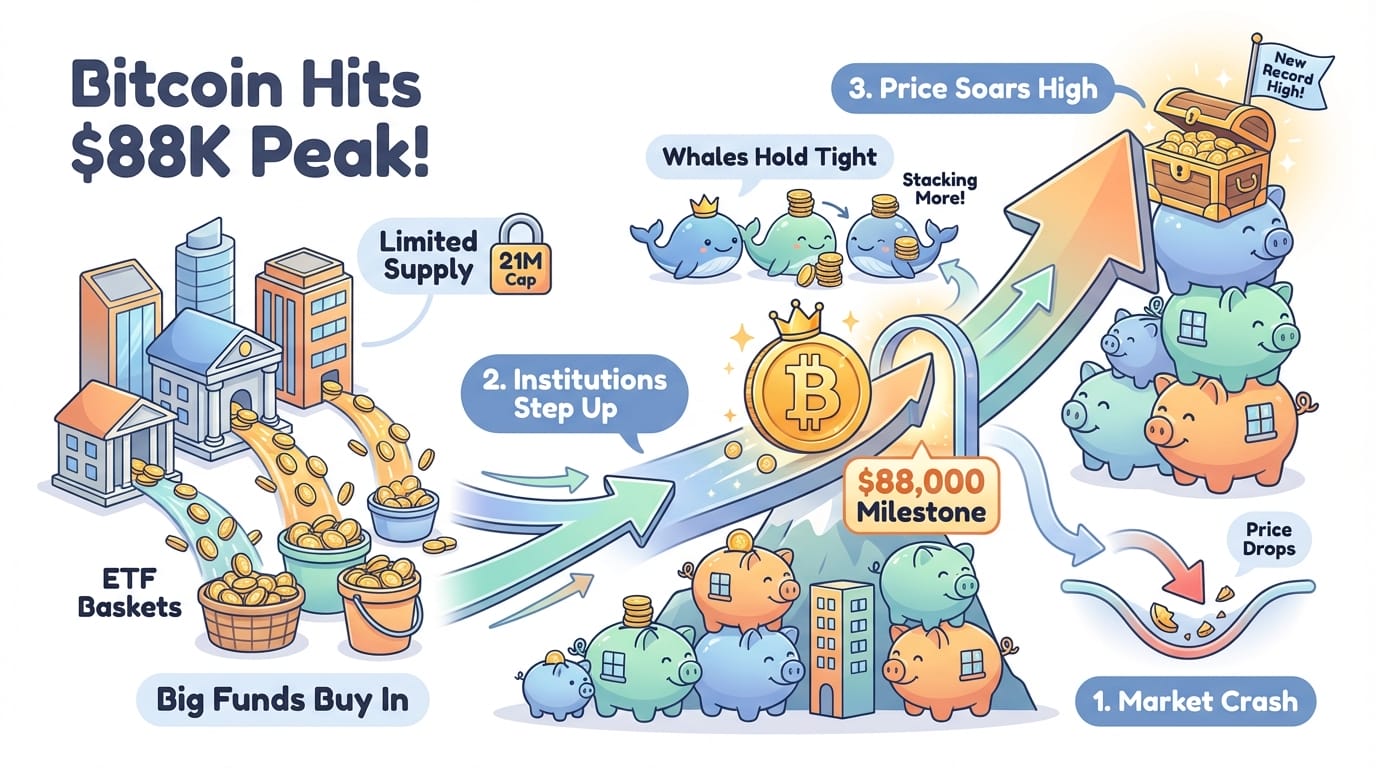
Bitcoin’s Consolidation After 2025 Sell-Off and Potential for Recovery
Jon: Let’s start with Bitcoin. Recent reports indicate Bitcoin is currently trading in a range between about $87,500 and $88,000, showing consolidation after a significant sell-off in late 2025. This follows a year where crypto surged but then crashed, leading to Bitcoin’s first annual loss since 2022. The global crypto market cap is around $3 trillion, but macroeconomic pressures are weighing in.
Lila: Wait, I thought Bitcoin was hitting record highs? The news I heard mentioned surges to $88,000. Can you clarify that?
Jon: That’s a common misconception from initial hype, but based on verified sources like The Economic Times and Reuters, Bitcoin has actually dipped below $88,000 and is range-bound. It’s not surging to new highs right now; instead, it’s consolidating amid broader market trends. Bitcoin uses a Proof-of-Work consensus mechanism, where miners compete to validate transactions and add blocks every 10 minutes on average. This secures the network but consumes significant energy. As a Layer 1 blockchain, it’s the base layer without built-in smart contracts like Ethereum.
Lila: Proof-of-Work? That’s like miners solving puzzles to verify transactions, right? And Layer 1 means it’s the main chain? So, what about governance or regulations here?
Jon: Exactly, Lila. Proof-of-Work involves computational work to prevent spam and secure the chain. Governance in Bitcoin is decentralized, with changes proposed via Bitcoin Improvement Proposals (BIPs) and adopted through community consensus, often signaled by miners. Regulatorily, the push for U.S. leadership in crypto under recent administrations could lead to clearer rules, but it also brings risks like increased oversight on institutional products like ETFs.
Lila: So what does this change for users, developers, or society?
Jon: For users, it means potential stability in Bitcoin as a store of value, but with high volatility risks. Developers might focus on building on top of it, like Lightning Network for faster payments. Societally, it underscores blockchain’s role in financial inclusion, though energy use raises environmental concerns. Remember, cryptocurrency involves significant risks and uncertainty, like market crashes.
Lila: Got it. That makes sense—it’s not just about prices, but the underlying tech and rules.
Ethereum’s Role in DeFi Amid ETF Inflows and Scaling Challenges
Jon: Moving to Ethereum. It maintains dominance in decentralized finance, or DeFi, which are protocols allowing financial services like lending without banks. Ethereum switched to Proof-of-Stake in 2022, reducing energy use by over 99% and letting holders stake ETH for network security and rewards. Recent spot ETF approvals are drawing capital, but the network still faces scaling issues.
Lila: DeFi sounds useful, but what is Proof-of-Stake exactly? And how does it compare to Bitcoin?
Jon: Proof-of-Stake selects validators based on staked coins, not computational power, making it more energy-efficient. Ethereum is a Layer 1 blockchain with smart contracts—self-executing code for apps. To scale, it uses Layer 2 solutions like rollups, which bundle transactions off the main chain for cheaper, faster processing, settling back to Layer 1 for security.
Lila: So Layer 2 is like an extension to handle more traffic? What about governance?
Jon: Yes, that’s a good way to put it. Governance involves Ethereum Improvement Proposals (EIPs) and community votes, often influenced by the Ethereum Foundation. Regulatorily, ETFs could bring more legitimacy, but there’s scrutiny on staking centralization—where big pools control much of the network, risking censorship.
Lila: And the impact? What changes for users or society?
Jon: Users get access to efficient DeFi, but high fees during congestion can push them to alternatives. Developers benefit from a mature ecosystem for building dApps. Societally, it promotes tokenization of assets, like real estate on blockchain, fostering innovation but with risks like smart contract bugs. Always note the significant uncertainties in crypto.
Lila: Thanks for breaking that down. It’s clearer now—focusing on utility over hype.
The Recent Crypto Market Crash and Its Implications
Jon: Now, the crypto sector faced a major setback with a sell-off in late 2025, echoing a $19 billion crash that broke the bull narrative. This was driven by macroeconomic trends and overleveraged positions, leading to a potential crypto winter in 2026.
Lila: Crypto winter? That’s like a prolonged downturn, right? How does this tie into tech?
Jon: Yes, crypto winter refers to extended periods of low activity and value drops. The crash exposed risks in decentralized exchanges (DEXes) using perpetual futures—contracts without expiration that amplify gains or losses. Many run on chains like Ethereum or Solana, which uses Proof-of-History for fast consensus, a hybrid with Proof-of-Stake for sub-second transaction finality.
Lila: So Solana is a Layer 1 alternative? Governance-wise?
Jon: Correct, Solana is a high-throughput Layer 1. Its governance is community-driven via the Solana Foundation, with proposals voted on by token holders. Regulatorily, such crashes highlight needs for better risk disclosures and perhaps global standards to prevent systemic failures.
Lila: What does this change for everyone involved?
Jon: For users, it means caution with leverage to avoid liquidations. Developers may improve oracle systems—data feeds for smart contracts—to prevent cascade effects. Societally, it questions crypto’s maturity versus traditional finance, pushing for more robust infrastructure. Risks are high, with possible prolonged outflows.
Lila: Eye-opening. It’s about building safer systems.
Bitcoin Whale Activity and Upcoming Economic Indicators
Jon: Finally, on-chain data shows long-term Bitcoin holders, or OG whales, have paused selling, which could signal accumulation. This aligns with anticipation for economic data like the PMI print, indicating manufacturing health.
Lila: Whales are big holders? How does this work on Bitcoin?
Jon: Yes, whales hold large amounts. Bitcoin’s UTXO model tracks unspent transaction outputs, allowing analysis of holder behavior. It’s Proof-of-Work on Layer 1, with scarcity from its 21 million coin cap and halvings reducing new supply.
Lila: Governance and regulations?
Jon: Governance is via miner and node consensus. Regulatorily, whale moves could attract attention if they influence markets, emphasizing transparency needs.
Lila: So, changes for users and society?
Jon: Users might see less selling pressure, but it’s uncertain. Developers track this for network health. Societally, it highlights blockchain’s transparency as a tool for economic insights, though volatility risks persist.
Lila: Appreciate the context—always good to question assumptions.
| Topic | Impact | Relevance |
|---|---|---|
| Bitcoin Consolidation | Range-bound trading post-2025 crash; highlights volatility. | Emphasizes tech resilience and regulatory needs for stability. |
| Ethereum in DeFi | ETF inflows aid adoption; scaling via Layer 2 reduces fees. | Advances financial inclusion but raises centralization concerns. |
| Market Crash Aftermath | Exposes leverage risks; potential for crypto winter. | Pushes for better governance and risk management in ecosystems. |
| Whale Activity and PMI | Paused selling may signal recovery; tied to macro data. | Shows blockchain transparency’s role in economic analysis. |
Jon: In summary, these stories point to a maturing blockchain space facing consolidation after volatility, with focus on institutional adoption and tech improvements. Long-term, this could strengthen digital infrastructure, but uncertainties remain.
Lila: Absolutely, Jon. It’s crucial to approach this with caution, stay informed on regulations, and do your own research. Crypto isn’t guaranteed—it’s full of risks.
👨💻 Author: SnowJon
A researcher sharing practical insights on Web3 and AI based on academic study and real-world observation.
His focus is on translating complex technologies into clear, responsible explanations for a general audience.
*AI tools may assist drafting, but all factual verification and editorial judgment are performed by the author.*
⚠️ Risk & Education Notice
Cryptocurrency and blockchain technologies involve legal, technical, and financial risks.
This article is provided strictly for educational and informational purposes and does not constitute financial advice.
Readers are encouraged to conduct independent research and comply with local laws and regulations.