
Personally, the data on crypto hacks suggests centralized points of failure are the real risk.#cybersecurity #blockchain
Quick Video Breakdown: This Blog Article
This video clearly explains this blog article.
Even if you don’t have time to read the text, you can quickly grasp the key points through this video. Please check it out!
If you find this video helpful, please follow the YouTube channel “BlockChainBulletin,” which delivers daily Crypto news.
https://www.youtube.com/@BlockChainBulletins
Read this article in your native language (10+ supported) 👉
[Read in your language]
Crypto Hacks Dropped by Half in 2025, But the Data Reveals a Much Deadlier Financial Threat
Jon: Hey Lila, I just came across this eye-opening piece from CryptoSlate about the state of crypto security in 2025. The title says it all: hacks dropped by half compared to previous years, but there’s a twist that’s way more alarming. As a Web3 researcher, I’ve been digging into the data, and it’s not the feel-good story it might seem at first glance.
Lila: Morning, Jon. That sounds counterintuitive—fewer hacks but deadlier threats? As someone who’s still wrapping my head around crypto basics, can you break down the high-level news for me? What’s the big picture here?
Jon: Absolutely. According to the report and supporting data from sources like Chainalysis and Decrypt, the number of crypto hacks in 2025 fell sharply—by about 50% from 2024. But the total value stolen? It hit a record $3.4 billion across over 300 incidents. The “deadlier” part comes from who’s behind these attacks: increasingly, it’s state-sponsored actors, like those linked to North Korea, targeting big centralized exchanges. Think Bybit and Coinbase getting hit hard. It’s like the hacks are fewer but each one is a precision strike, pulling in massive hauls.
Lila: Wow, $3.4 billion is staggering. Why does this matter? Isn’t fewer hacks overall a win for the industry?
Jon: It matters because it signals a shift from scattershot opportunists to sophisticated, organized threats. This isn’t just about losing money; it’s about eroding trust in the entire ecosystem. If centralized platforms become too risky, it could push more activity to decentralized alternatives, but it also highlights vulnerabilities that affect everyone from beginners to institutions. The data shows a “much deadlier financial threat” in the form of these high-impact breaches, often involving social engineering or access control failures, and even ties to physical violence in some cases. It’s a wake-up call for better security practices across the board.
Lila: Got it—that makes sense. But let’s dive deeper. What’s the core problem here? It seems like the hacks are evolving, not disappearing.
Jon: Exactly. The problem boils down to the centralization of power in crypto platforms. Many exchanges and DeFi protocols still rely on single points of failure—like private keys held by a few insiders or weak multi-factor authentication. In 2025, we saw fewer but larger exploits because attackers, especially state-backed ones like DPRK groups, focused on high-value targets. They’re using advanced tactics: integrating with illicit networks in Asia-Pacific, laundering funds through mixers, and even resorting to threats like violence to extract info. The data from Wired and CoinSpeaker points to over $2.7 billion stolen via these methods, with North Korean hackers dominating.
Lila: Single points of failure? That sounds technical. Can you clarify with an analogy? I’m picturing something everyday to make it click.
Jon: Sure, think of it like a city’s traffic system. In the old days, you’d have tons of small accidents clogging up side streets— that’s the high volume of minor hacks in previous years. Now, imagine fewer incidents but massive pile-ups on the main highway, shutting down the whole city. That’s 2025: attackers are targeting the “highways” (centralized exchanges) with precision tools, causing outsized damage. Or, plumbing-wise, it’s like having fewer leaks but one burst pipe flooding the entire building. The structural issue is that crypto’s promise of decentralization often gets undermined by centralized custodians holding the keys—literally. When those fail, the fallout is huge, as seen in the Bybit heist where state-sponsored cybercriminals walked away with fortunes.
Lila: Okay, the traffic analogy lands perfectly. So, if centralization is the problem, what’s the solution? How does the industry actually address this under the hood?
Under the Hood: How it Works
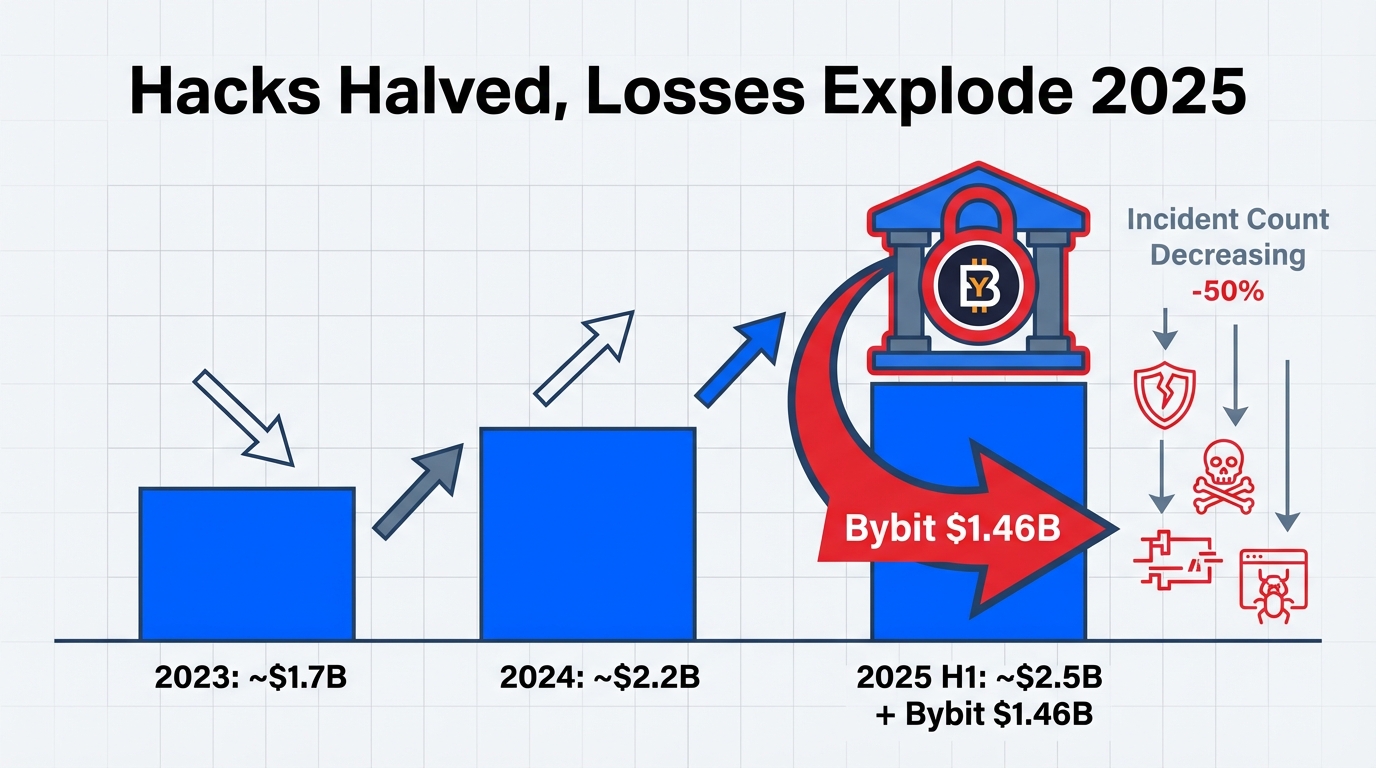
Jon: Great question. Let’s peel back the layers. At its core, crypto security revolves around blockchain’s consensus mechanisms and how assets are stored and transferred. For instance, in a typical hack scenario, attackers exploit smart contract vulnerabilities or compromise private keys. But the “solution” emerging from 2025 data is a push toward more robust decentralized architectures, like multi-signature wallets and zero-knowledge proofs, to mitigate these risks. Consensus in blockchain—think Proof-of-Stake (PoS) or Proof-of-Work (PoW)—ensures transactions are validated by a network, not a single entity. However, centralized exchanges (CEXs) often bypass this by holding user funds in hot wallets, which are online and vulnerable.
Lila: Multi-signature wallets? Rephrase that for me—sounds like needing multiple keys to open a safe?
Jon: Spot on. A multi-sig wallet requires, say, 3 out of 5 authorized signatures to approve a transaction, distributing control and reducing single-point risks. Token mechanics come into play here too: in DeFi, tokens like governance ones (e.g., in protocols like Aave or Uniswap) allow community voting on security upgrades. The deadlier threats in 2025 involved state actors using on-chain analysis to trace and exploit patterns—Chainalysis reports show DPRK hackers moving stolen funds through consistent laundering paths. To counter this, projects are integrating behavioral monitoring and AI-driven anomaly detection. But it’s not foolproof; trade-offs include slower transaction speeds for added security layers.
Lila: That helps. So, how does this compare to past years? Maybe a quick table to visualize the evolution?
Jon: Absolutely, let’s compare 2024 vs. 2025 hack landscapes based on the data.
| Aspect | 2024 (High Volume) | 2025 (High Impact) |
|---|---|---|
| Number of Hacks | Over 600 incidents | Dropped by 50% to around 300 |
| Total Stolen | Approximately $2.5 billion | Record $3.4 billion |
| Primary Attackers | Opportunistic hackers, script kiddies | State-sponsored (e.g., DPRK), sophisticated groups |
| Common Methods | Smart contract bugs, phishing | Social engineering, access control failures, physical threats |
| Impact on Ecosystem | Widespread but smaller losses | Eroded trust, push for decentralization |
Jon: As you can see, the shift is toward quality over quantity in attacks, forcing the industry to evolve its defenses.
Lila: So who actually uses this? I mean, beyond the hackers, how do these security mechanics benefit everyday developers or users in crypto?
Jon: Fair point—it’s not just about defense; it’s about enabling practical applications. For developers, tools like multi-sig and zero-knowledge proofs allow building secure DeFi apps, such as lending platforms where users retain control of their assets without trusting a central party. Think of protocols like MakerDAO, where users collateralize loans via smart contracts—no bank involved. On the user side, this means safer wallets for holding tokens; apps like Argent use guardians (trusted contacts) for recovery, reducing hack risks. Institutions are adopting it too: after 2025’s breaches, more are using hardware security modules (HSMs) for cold storage. The technical benefit is resilience—blockchain’s immutability ensures once a transaction is confirmed, it’s tamper-proof, which is huge for cross-border payments or supply chain tracking. Even in non-financial uses, like NFTs for digital ownership, these mechanics prevent unauthorized transfers.
Lila: That broadens it out. Now, if someone’s interested in learning more without jumping into real risks, what’s an educational action plan? Start simple?
Jon: Definitely. Let’s break it into levels for safe, hands-on learning.
Lila: Level 1—research and observation?
Jon: Right. Begin by reading whitepapers from projects like Ethereum‘s security audits or Chainalysis reports on hack patterns. Use blockchain explorers like Etherscan to observe transaction flows—search for known hack addresses to see how funds move. Dashboards from DefiLlama or SlowMist provide real-time data on losses and recoveries. It’s all about understanding mechanics without any commitment; track how protocols respond to threats, like flash loan exploits.
Lila: And Level 2—testnet or hands-on? How to try safely?
Jon: Move to testnets for experimentation. Ethereum’s Sepolia testnet lets you deploy simple smart contracts using tools like Remix IDE—simulate a multi-sig wallet setup without real funds. Practice with minimal-risk learning: use faucets for test ETH, then audit your own code for vulnerabilities via tools like MythX. It’s like a sandbox; no financial downside, but you gain insight into why hacks happen and how to prevent them. Remember, this is for education—risks remain in live environments.
Lila: Solid plan. Wrapping up, what’s the future outlook here?
Jon: In summary, while hacks dropped in number, the escalating threats from state actors highlight the need for decentralized, robust security. The opportunity is in building more resilient systems, but limitations like regulatory hurdles and tech trade-offs persist. It’s worth watching how the industry adapts—perhaps with more AI monitoring or quantum-resistant cryptography.
Lila: Totally agree. Readers, remember crypto is volatile and uncertain; always approach with caution and continuous learning.
Jon: Well said. Here’s to smarter, safer Web3 explorations.
—
References
- Crypto hacks dropped by half in 2025, but the data reveals a much deadlier financial threat
- 2025 Crypto Theft Reaches $3.4 Billion – Chainalysis
- From Bybit to Coinbase: 2025’s Biggest Crypto Hacks and Breaches – Decrypt
- Biggest Crypto Hacks of 2025 – Coinspeaker