
Personally altcoin volatility seems to highlight significant maturity gaps in market liquidity#XRP #Solana
Quick Video Breakdown: This Blog Article
This video clearly explains this blog article.
Even if you don’t have time to read the text, you can quickly grasp the key points through this video. Please check it out!
If you find this video helpful, please follow the YouTube channel “BlockChainBulletin,” which delivers daily Crypto news.
https://www.youtube.com/@BlockChainBulletins
Read this article in your native language (10+ supported) 👉
[Read in your language]
Altcoin Volatility Reaches Critical Juncture as XRP and Solana Amplify Market Stress
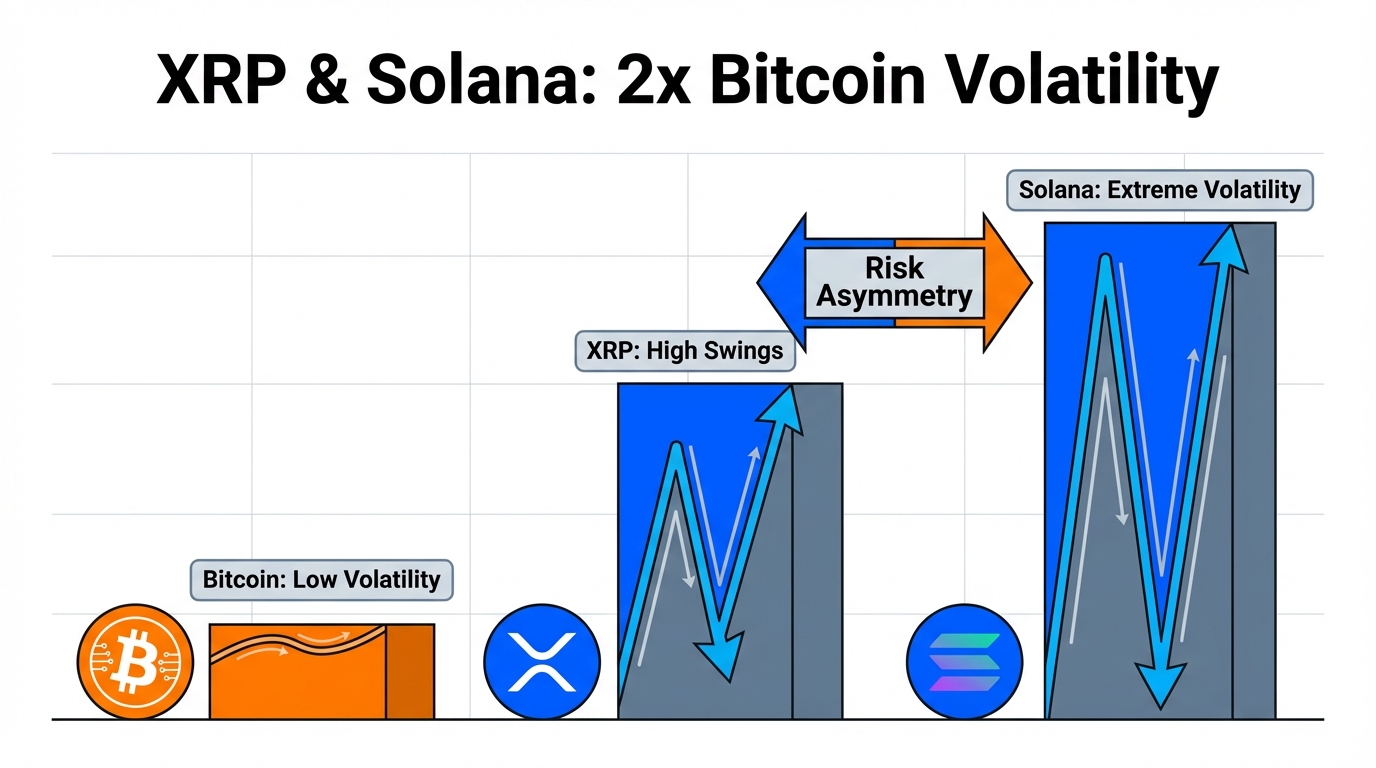
Jon: Hey Lila, happy new year—it’s 2026, and the crypto markets are already stirring things up. I came across this piece on Blockchain Magazine about altcoin volatility hitting a critical point, with XRP and Solana leading the charge in amplifying market stress. Essentially, as we roll into January 2026, data from late 2025 shows XRP and Solana experiencing volatility levels twice that of Bitcoin. For context, Solana’s hovering around $127, and XRP’s consolidation suggests cautious outlooks, with predictions ranging from $1.95 to $2.10 by year’s end, though some see it pushing beyond $3 under certain conditions. It’s not just price swings; it’s about how these altcoins are reacting to broader market forces like ETF inflows and macroeconomic pressures.
Lila: New year, same crypto drama, huh? That sounds intense. Why does this matter, especially for someone trying to understand the bigger picture without getting swept up in the hype?
Jon: Exactly—it’s a reminder that crypto isn’t just about moonshots; it’s a stress test for the entire ecosystem. This volatility juncture matters because it highlights maturity gaps in altcoins compared to Bitcoin. In 2025, XRP and Solana saw bumpy rides, with on-chain data showing their price actions twice as volatile as BTC‘s chill vibe. Think of it as altcoins still in their teenage phase, reacting wildly to news like regulatory shifts or ETF developments, while Bitcoin plays the steady adult. For instance, recent reports note Solana passing a “stress test” with stablecoin recoveries, but overall, altcoins are under pressure as capital rotates—Bitcoin and Ethereum ETFs saw outflows, while Solana and XRP recorded inflows. It underscores that macroeconomic forces, not just hype, drive the market. If you’re observing, it’s a great time to learn about risk without diving in headfirst.
Lila: Okay, that makes sense. So, what’s the core problem here? It feels like these altcoins are amplifying stress—can you break down why that’s happening structurally?
Jon: The problem boils down to liquidity, maturity, and external pressures creating a feedback loop of volatility. Altcoins like XRP and Solana don’t have the same deep liquidity pools as Bitcoin, so even moderate trades can cause big swings. In 2025, XRP surged but couldn’t spark a full altseason because macro factors—like interest rates or institutional moves—dominated. Solana, with its high-speed blockchain, attracts devs and users, but that same speed amplifies stress during network hiccups or market dumps.
Lila: Liquidity sounds key, but can you clarify with an analogy? I’m picturing something everyday to wrap my head around it.
Jon: Sure, think of the crypto market like a busy highway. Bitcoin is the wide, multi-lane expressway with steady traffic—bumps happen, but the flow absorbs them. Altcoins like XRP and Solana are more like narrow side roads: they’re faster for certain trips (like cross-border payments for XRP or DeFi on Solana), but a single accident—like a big sell-off or regulatory news—causes massive jams and volatility. In 2025, Solana’s road saw “crashes” like the USX stablecoin dipping to $0.10 before recovering, testing its resilience. XRP’s path is tied to Ripple’s legal battles and institutional adoption, making it sensitive to news. This amplifies market stress because when altcoins swing wildly, it shakes confidence across the board, potentially leading to broader sell-offs or rotations back to safer assets like BTC.
Lila: Got it—that highway analogy clicks. So, if volatility is the problem, how do these projects actually work under the surface to handle or maybe even thrive in this environment?
Under the Hood: How it Works
Jon: Let’s dive in. That diagram above illustrates the core architectures—click it to enlarge for a closer look. Starting with Solana: it’s built for speed, using a Proof-of-History (PoH) consensus mechanism combined with Proof-of-Stake (PoS). PoH is like a built-in clock that timestamps transactions before they’re validated, allowing the network to process up to 65,000 transactions per second (TPS) in theory. This contrasts with Ethereum’s slower PoS, making Solana ideal for high-throughput apps, but it comes with trade-offs like occasional outages during peak stress.
Lila: Proof-of-History? That’s new to me—mind rephrasing how it fits into the bigger picture?
Jon: No problem. Imagine PoH as a synchronized watch that every node on the network checks against, reducing the need for constant back-and-forth communication. For token mechanics, SOL is used for staking (locking up tokens to secure the network and earn rewards) and paying gas fees. Now, XRP operates differently—it’s not mined; all 100 billion tokens were pre-mined by Ripple. It uses the Ripple Protocol Consensus Algorithm (RPCA), where trusted validators agree on transactions in seconds, focusing on cross-border payments via RippleNet. XRP acts as a bridge currency, reducing liquidity costs in transfers.
Lila: Okay, so Solana’s about raw speed for DeFi, and XRP’s geared toward efficient payments. How do they stack up against each other and Bitcoin in terms of handling volatility?
Jon: Precisely. Here’s a quick comparison to clarify:
| Aspect | Bitcoin | XRP | Solana |
|---|---|---|---|
| Consensus Mechanism | Proof-of-Work (PoW) | Ripple Protocol Consensus Algorithm (RPCA) | Proof-of-History (PoH) + Proof-of-Stake (PoS) |
| Transaction Speed | ~7 TPS | 1,500+ TPS | Up to 65,000 TPS |
| Volatility Factor (2025 Data) | Relatively low, mature market | Twice BTC’s volatility | Twice BTC’s volatility, stress-tested |
| Primary Use | Store of value | Cross-border payments | High-speed DeFi and apps |
This table shows why XRP and Solana can amplify stress: their designs prioritize speed and efficiency, but without Bitcoin’s liquidity depth, they swing harder during market events.
Lila: So who actually uses this? I mean, beyond traders, what’s the real-world application for XRP and Solana that makes this volatility worth watching?
Jon: Great question. For Solana, developers build decentralized apps (dApps) like DeFi protocols, NFT marketplaces, and even gaming ecosystems. Users benefit from low fees and fast transactions—think swapping tokens in seconds without Ethereum’s gas wars. Institutions are eyeing Solana ETFs for exposure to this high-throughput chain. XRP shines in finance: banks and payment providers use it via RippleNet for cross-border transfers, reducing costs and settlement times from days to seconds. It’s not just hype; it’s solving real inefficiencies in global remittances. The technical benefit is clear—faster, cheaper operations—but volatility means these use cases are still maturing.
Lila: That focuses on the tech side nicely. If someone’s interested in learning more without risks, what’s an educational action plan? Start with basics?
Jon: Absolutely, let’s break it into levels. Level 1: Research and Observation. Begin by reading official docs—Solana’s whitepaper explains PoH in detail, and Ripple’s site covers XRP Ledger mechanics. Use explorers like Solana Beach or XRP Scan to observe live transactions and network stats. Dashboards on CoinDesk or Crypto.com can track volatility metrics without any commitment. It’s like window-shopping to understand the mechanics.
Lila: Sounds safe. What about Level 2—how can I try this hands-on without real stakes?
Jon: Level 2: Testnet Experimentation. Both projects have testnets—Solana’s Devnet lets you deploy smart contracts or simulate staking with fake SOL. For XRP, the Testnet faucet gives free test XRP to experiment with wallet transfers. It’s minimal-risk learning: tinker with code on platforms like Remix for Solana or Ripple’s developer tools. Focus on understanding trade-offs, like Solana’s speed vs. decentralization debates. Remember, this is for education—volatility in mainnets can be unpredictable.
Jon: Wrapping up, this volatility juncture for XRP and Solana highlights opportunities in efficient blockchains but also limitations like liquidity risks and macro dependencies. As 2026 unfolds, watch for ETF developments and network upgrades—they could stabilize things.
Lila: Yeah, and a reminder: crypto’s volatile and uncertain. Always approach with caution and continuous learning.
Jon: Well said—here’s to informed exploration in the year ahead.
References
- Altcoin Volatility Reaches Critical Juncture as XRP and Solana Amplify Market Stress
- Official Solana Website
- Official XRP Ledger Website
- Volatility in Ripple-Linked XRP and Solana Was Twice as Bumpy as Bitcoin’s in 2025 – CoinDesk
- XRP Price Prediction: What To Expect From XRP In 2026? – BeInCrypto