
Personally, Bitcoin seems heavily reliant on power grids, making physical costs a major factor.#Bitcoin #Energy
Quick Video Breakdown: This Blog Article
This video clearly explains this blog article.
Even if you don’t have time to read the text, you can quickly grasp the key points through this video. Please check it out!
If you find this video helpful, please follow the YouTube channel “BlockChainBulletin,” which delivers daily Crypto news.
https://www.youtube.com/@BlockChainBulletins
Read this article in your native language (10+ supported) 👉
[Read in your language]
Bitcoin Just Lost $90,000: Energy Markets Surge and What It Means for Crypto in 2025
Jon: Hey Lila, have you seen the latest headlines? Bitcoin’s been on a wild ride—according to CryptoSlate, it just “lost $90,000,” which is their dramatic way of saying the price dipped below that key level amid broader market pressures. And there’s this quiet surge in energy markets that’s hinting at more turbulence ahead for crypto. As a Web3 researcher, I thought we should unpack this objectively, without the hype.
Lila: Hey Jon, yeah, I caught that article. It sounds alarming, but I’m not sure I get the full picture. Bitcoin losing $90,000? Isn’t that just a price drop from its highs? And how do energy markets tie into all this? Walk me through it at a high level.
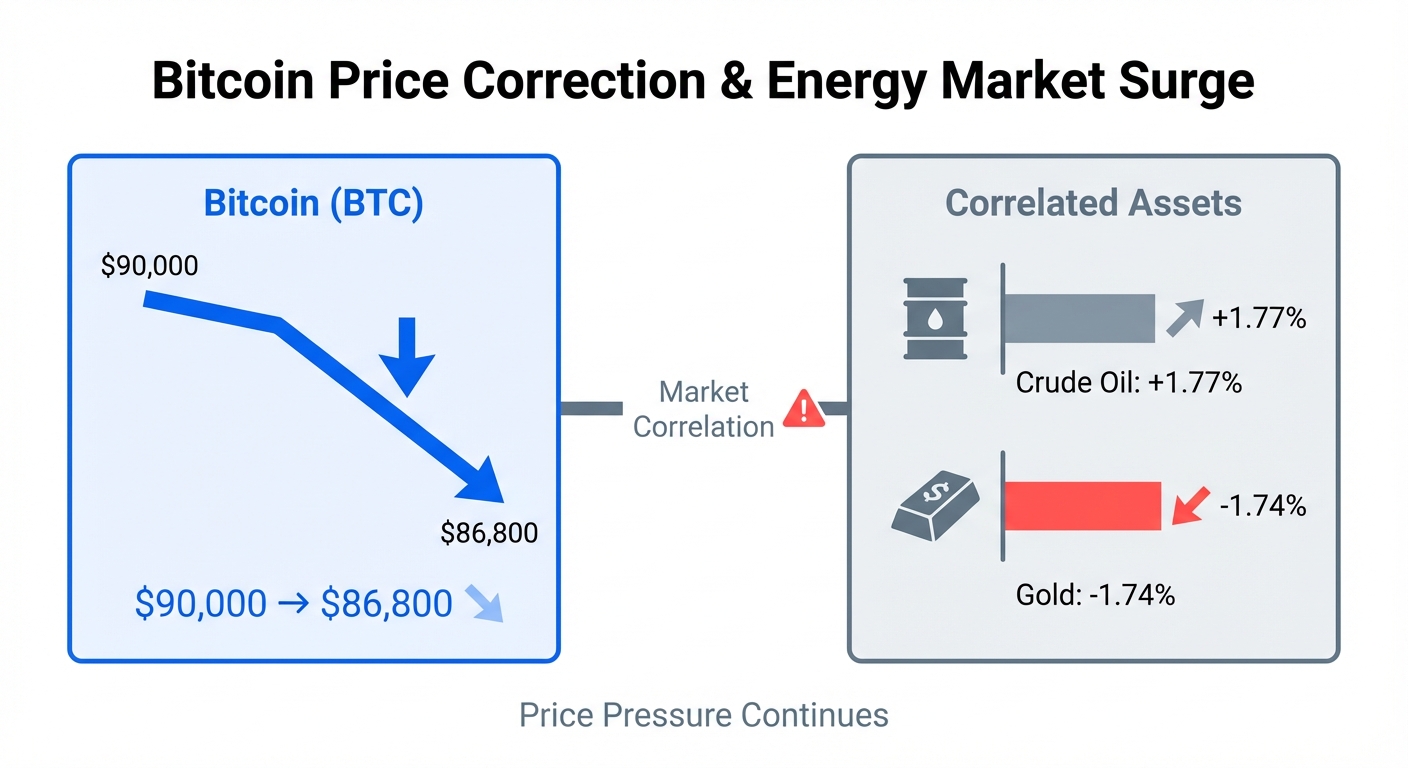
Jon: Exactly—it’s not like Bitcoin misplaced a stack of cash; it’s referring to the price falling from above $90,000 per BTC, wiping out some of the gains we’d seen earlier in 2025. Recent reports show Bitcoin reversing early gains, dropping below $88,000 as Nasdaq futures wilted, and there’s talk of it potentially trembling below $90,000 into 2026. The energy angle? Crude oil is rallying while gold dumps, creating a toxic mix that tightens financial conditions. For crypto, which is energy-intensive due to mining, this could mean higher costs and squeezed profitability. It’s all interconnected—think macro economics meets blockchain tech.
Lila: Okay, that makes sense as a snapshot. But why does this matter? For someone like me, who’s curious about crypto but not day-trading, what’s the bigger lesson here?
Jon: Great question. It matters because it highlights how Bitcoin and the broader crypto market aren’t isolated—they’re influenced by global factors like energy prices, which directly impact mining operations. Bitcoin mining requires massive electricity, so surging energy costs could slow hash rates or force miners to sell holdings, adding selling pressure. Plus, with predictions varying from a rally to $105K in January 2026 to bearish drops as low as $10,000, it’s a reminder of crypto’s volatility. Understanding this helps us appreciate the real-world mechanics behind the prices, not just the memes.
Lila: Volatility aside, it feels like there’s a structural issue here. You mentioned energy costs squeezing miners—what’s the core problem with Bitcoin in this scenario?
Jon: The problem boils down to Bitcoin’s proof-of-work (PoW) consensus mechanism, which is energy-hungry by design. When energy markets surge—like the recent oil rallies tied to Russia-Ukraine tensions—mining becomes more expensive. Miners need cheap power to stay profitable, but if costs rise, smaller operations might shut down, reducing network security or leading to capitulation where they dump BTC to cover bills. It’s not just a price blip; it’s a structural vulnerability where external markets can ripple into crypto’s core operations.
Lila: That sounds intense. Can you break it down with an analogy? I’m picturing something everyday to make it stick.
Jon: Sure—think of Bitcoin mining like running a fleet of delivery trucks in a city. Each truck (miner) competes to deliver packages (validate transactions) and gets paid in BTC for successful deliveries. But the fuel (electricity) is the big cost. If gas prices surge due to global events—like a supply chain snag in oil markets—some trucks might park indefinitely because it’s not worth the expense. The whole delivery network slows, packages pile up, and the system feels the strain. In crypto terms, higher energy costs mean fewer active miners, potentially weaker network security, and more BTC hitting the market as miners sell to pay the bills. It’s a classic case of real-world economics clashing with decentralized tech.
Lila: Ah, the truck analogy clicks—it’s not abstract anymore. So, if energy surges are the problem, how does Bitcoin actually handle this under the hood? I know it’s proof-of-work, but let’s dive deeper.
Under the Hood: How it Works
Jon: Alright, let’s get technical but keep it accessible. At its core, Bitcoin uses proof-of-work to secure the network and validate transactions. Miners solve complex mathematical puzzles—essentially guessing a number that, when hashed with the block data, produces a result below a target difficulty. This requires enormous computational power, which guzzles electricity. The diagram above illustrates how mining rigs connect to pools, consume energy, and contribute to the blockchain’s hash rate. When energy prices rise, as we’re seeing with oil climbing amid geopolitical tensions, the cost per hash increases. Bitcoin’s difficulty adjustment every 2016 blocks tries to stabilize this, but it can’t offset massive external cost spikes.
Lila: So, the network self-adjusts? That sounds smart. But how does that play into token mechanics, like supply and halvings?
Jon: Precisely. Bitcoin’s tokenomics are built around a fixed supply of 21 million coins, with new ones minted as block rewards. The halving event every four years cuts rewards in half, making mining less rewarding unless prices rise. In an energy surge, like the current one where crude oil is rallying, miners’ margins shrink. Some might switch to cheaper energy sources or renewables, but globally, it pressures the ecosystem. To compare, let’s look at how Bitcoin stacks up against other assets in energy-sensitive scenarios.
| Aspect | Bitcoin (PoW Crypto) | Traditional Assets (e.g., Gold Mining) | Proof-of-Stake Crypto (e.g., Ethereum) |
|---|---|---|---|
| Energy Dependency | High—mining rigs consume ~150 TWh annually, vulnerable to surges. | Moderate—physical extraction uses fuel, but less computational intensity. | Low—staking requires minimal energy, no puzzles to solve. |
| Response to Energy Surge | Miners may sell BTC or shut down, increasing sell pressure. | Operations scale back, but physical output can stockpile. | Little impact; validators stake tokens without energy costs. |
| Security Model | Work-based; high energy ensures decentralization. | Physical/Regulatory; centralized companies control supply. | Stake-based; economic penalties deter attacks. |
| Long-Term Adaptation | Shifting to renewables; e.g., hydro in China or solar in Texas. | Diversify sources or hedge fuel costs. | Inherently efficient; focuses on scalability upgrades. |
Lila: That table really highlights the trade-offs. Bitcoin’s energy hunger is a double-edged sword—secure but sensitive. So, rephrasing to confirm: In a surge, PoW makes Bitcoin more volatile than PoS alternatives?
Jon: Spot on. It’s why some predict Bitcoin could outshine precious metals in 2026 if it adapts, but bearish voices warn of drawdowns. The mechanics reward efficiency, pushing innovation in green mining.
Lila: So who actually uses this? I mean, beyond traders watching prices, what are the real technical benefits and applications for Bitcoin in an energy-volatile world?
Jon: Good pivot—Bitcoin’s not just a speculative asset; it’s a decentralized store of value and payment system. Developers use it for building layer-2 solutions like Lightning Network for faster, cheaper transactions. Users in high-inflation countries treat it as digital gold, hedging against currency devaluation. Technically, its energy use ensures tamper-proof security—worth watching for how miners integrate renewables, reducing vulnerability to surges. On the application side, it’s powering remittance services, NFTs on Ordinals, and even DeFi protocols. The key benefit is censorship resistance: no central authority can freeze your funds, which is huge in unstable economies. But remember, risks remain with volatility.
Lila: That shifts my view—it’s more utility than just price charts. For someone wanting to learn more without jumping in headfirst, what’s an educational action plan? Start simple?
Jon: Absolutely, let’s structure it as levels for safe exploration. Level 1: Research and Observation. Dive into Bitcoin’s whitepaper at bitcoin.org—it’s the original doc explaining the mechanics without fluff. Use block explorers like Blockchain.com to track real-time transactions and hash rates. Watch dashboards on sites like Glassnode for metrics on miner revenue and energy estimates. This builds understanding of how energy impacts the network, like seeing hash rate drops during cost surges.
Lila: Observation sounds low-risk. What about Level 2—something hands-on but safe?
Jon: Level 2: Testnet and Hands-on Learning. Bitcoin has a testnet where you can experiment with fake BTC—no real money involved. Set up a wallet like Electrum, get testnet coins from faucets, and practice sending transactions. To grasp mining, try solo mining on testnet with open-source software like CGMiner—it’s minimal risk and shows the energy computation in action. Focus on learning the architecture: understand how blocks link via hashes. This demystifies the tech without exposure to live market volatility.
Lila: Perfect—experimentation without the gamble.
Jon: Wrapping up, this Bitcoin dip and energy surge underscore the network’s resilience but also its limitations. Opportunities lie in adaptations like greener mining, potentially stabilizing it for 2025 and beyond. Predictions range from $1M by 2033 to short-term pains, but the tech’s core value—decentralized, secure value transfer—endures.
Lila: True, but let’s remind everyone: Crypto’s volatile, and external factors like energy markets add uncertainty. Approach with curiosity, not expectations. Risks remain, so learn thoughtfully.
Jon: Well said—here’s to informed exploration in 2025.
References
- Bitcoin just lost $90,000, and a quiet surge in energy markets suggests the pain isn’t over
- Official Bitcoin Website
- Cryptocurrency slump erases 2025 financial gains and Trump-inspired optimism | The Guardian
- Bitcoin (BTC) tops $90,000, oil rises as Russia-Ukraine peace hopes falter – CoinDesk