Personally, seeing Bitmine stake ETH is notable. Corporate treasuries are evolving fast.
—#Bitmine #Ethereum
—
Quick Video Breakdown: This Blog Article
This video clearly explains this blog article.
Even if you don’t have time to read the text, you can quickly grasp the key points through this video. Please check it out!
If you find this video helpful, please follow the YouTube channel “BlockChainBulletin,” which delivers daily Crypto news.
https://www.youtube.com/@BlockChainBulletins
Read this article in your native language (10+ supported) 👉
[Read in your language]
Bitmine Immersion Technologies Stakes $219 Million in Ethereum as Institutional Treasury Strategy Accelerates
Jon: Hey Lila, have you caught wind of the latest from Bitmine Immersion Technologies? They’re making waves in the crypto space by staking a whopping $219 million worth of Ethereum. This isn’t just a random move—it’s part of their broader institutional treasury strategy, accelerating how companies treat crypto as a core asset. According to recent reports, Bitmine now holds over 4 million ETH tokens, positioning them as one of the largest public Ethereum treasuries out there.
Lila: Wow, Jon, that sounds massive. Staking $219 million? That’s like a corporation betting big on a single horse, but in the blockchain world. Why does this matter, especially for someone just dipping their toes into crypto?
Jon: Great question. It matters because it signals a shift in how institutions view cryptocurrencies—not as speculative toys, but as serious treasury assets. Bitmine, originally a mining tech firm, has pivoted to building an Ethereum war chest. They’ve accumulated ETH worth around $12 billion in total crypto and cash holdings, and this staking move locks in yields while supporting Ethereum’s network security. It’s like a company diversifying its reserves beyond stocks and bonds, but with blockchain’s twist of earning passive income through staking. No hype here—it’s about understanding the mechanics of institutional adoption in a volatile market.
Lila: Okay, that makes sense at a high level. But let’s break it down: what’s the underlying problem this is solving in the crypto ecosystem?
Jon: The core problem is how traditional treasuries handle volatility and yield in an uncertain economy. Companies sit on cash piles that earn peanuts in interest, especially with inflation eating away at value. Crypto, particularly Ethereum, offers an alternative, but it’s risky—prices swing wildly. Bitmine’s strategy addresses this by not just holding ETH but staking it, which generates rewards while contributing to the network’s proof-of-stake consensus. Think of it like a plumbing system: old pipes (traditional finance) leak value through low yields, while new ones (staking) efficiently recycle and reward the flow of assets.
Lila: Plumbing analogy? That’s helpful. So, Ethereum staking is like upgrading to energy-efficient pipes that pay you back over time?
Jon: Exactly. In traditional finance, you’d park money in bonds or savings accounts for modest returns. Here, staking ETH means locking it up to validate transactions on the Ethereum network, earning around 3-5% annual yield in more ETH. But it’s not without clogs—staking locks your assets for a period, and if ETH’s price drops, your treasury takes a hit. Bitmine’s move shows institutions are willing to navigate that for long-term potential.
Under the Hood: How it Works
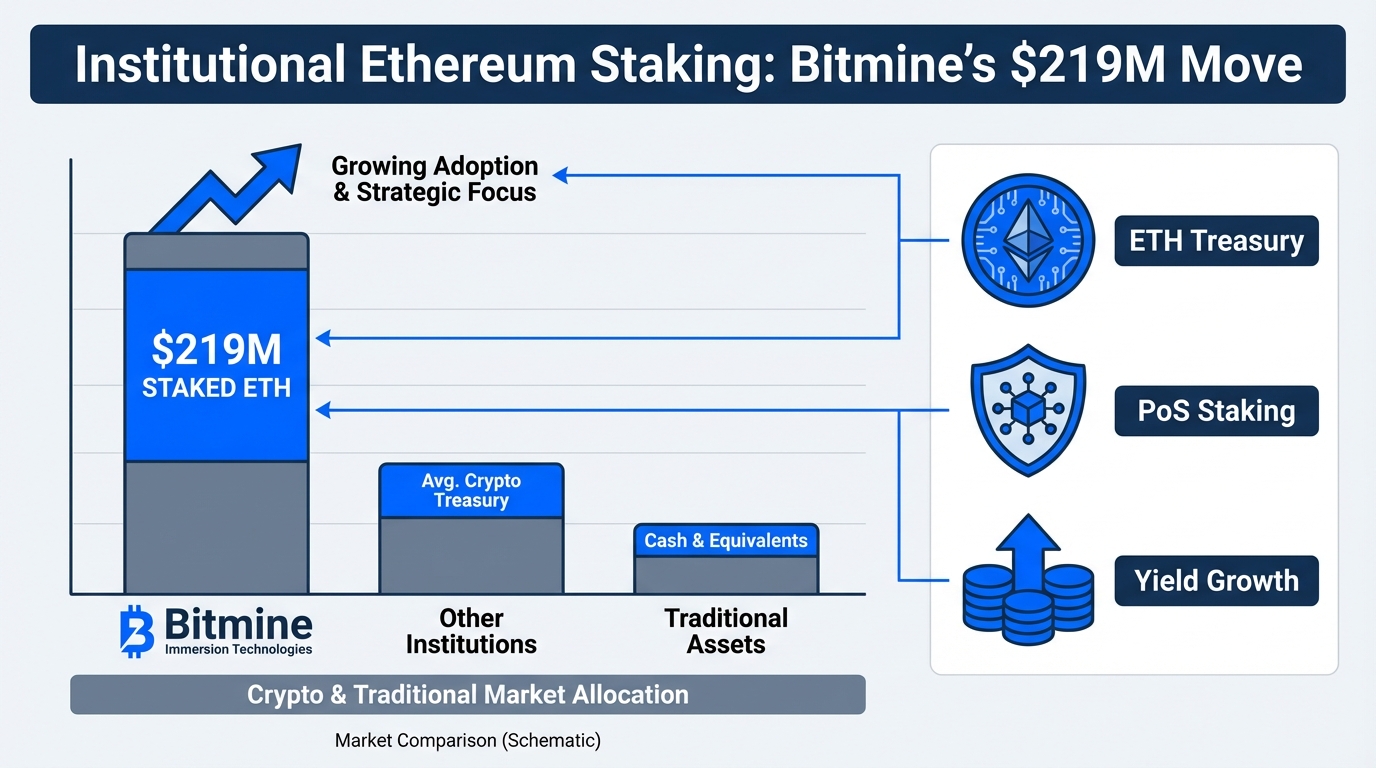
Jon: Alright, let’s pop the hood on Ethereum staking and Bitmine’s role in it. Ethereum switched to proof-of-stake (PoS) in 2022, moving away from energy-hungry proof-of-work mining. In PoS, validators stake ETH to secure the network—it’s like putting down a security deposit to run a polling station in an election. Bitmine deposited 74,880 ETH into the staking contract, worth that $219 million, marking their first major staking activity after building a treasury of over 4 million ETH.
Lila: So, staking isn’t mining? Can you clarify the mechanics without the jargon overload?
Jon: Sure. In proof-of-stake, you don’t solve puzzles with computers like in Bitcoin mining. Instead, you stake at least 32 ETH to become a validator node. The network randomly selects validators to propose and attest to blocks, rewarding them with new ETH. Bitmine, as an institutional player, likely uses pooled staking or services to manage this at scale, avoiding the need to run their own nodes. It’s efficient but comes with slashing risks—if you go offline or act maliciously, you lose some staked ETH. Their total holdings now represent about 3.37% of ETH’s supply, which is huge for influence without centralization fears.
Lila: Got it—that’s like being a shareholder who also votes and gets dividends. How does this compare to other treasury strategies?
Jon: Spot on. Let’s compare it to traditional and other crypto approaches.
| Aspect | Traditional Treasury (e.g., Bonds) | Bitcoin Treasury (e.g., MicroStrategy) | Ethereum Staking Treasury (e.g., Bitmine) |
|---|---|---|---|
| Yield Mechanism | Fixed interest from government bonds, low volatility. | No native yield; relies on price appreciation. | Staking rewards (3-5% APR in ETH) plus potential price upside. |
| Risks | Inflation erosion, low returns. | High volatility, no income generation. | Volatility, slashing penalties, lock-up periods. |
| Network Benefit | Supports government debt, no direct tech contribution. | Increases BTC scarcity and adoption. | Secures Ethereum network, earns rewards for participation. |
| Example Holdings | Apple’s $200B in cash equivalents. | MicroStrategy’s 250K+ BTC. | Bitmine’s 4M+ ETH, with recent $219M staked. |
Jon: As you can see, Bitmine’s approach adds a yield layer that Bitcoin treasuries lack, but it’s more complex due to Ethereum’s smart contract ecosystem.
Lila: So who actually uses this? I mean, beyond big firms like Bitmine, what are the real-world applications?
Jon: At the developer level, Ethereum staking powers decentralized apps (dApps) by ensuring a secure base layer. Think DeFi protocols where users borrow, lend, or trade without banks—staking underpins that trust. For users, it’s about earning passive income; individuals can stake via pools like Lido or Rocket Pool without needing 32 ETH. Institutionally, companies like Bitmine use it for treasury management, hedging against fiat devaluation. Even non-crypto firms might dip in for diversification. The technical benefit? It scales Ethereum without massive energy use, supporting things like layer-2 networks for faster, cheaper transactions.
Lila: Fascinating—it’s not just holding; it’s actively participating. Now, if someone’s curious, how can they learn more without jumping into the deep end?
Jon: Let’s map out an educational action plan. Start at Level 1: Research and Observation. Dive into Ethereum’s official docs at ethereum.org to understand PoS basics. Check block explorers like Etherscan.io to track Bitmine’s wallet addresses—search for their recent staking transactions. Whitepapers on staking mechanics are gold; read Vitalik Buterin’s writings for context. Watch dashboards on Dune Analytics for staking stats, like total ETH staked globally.
Lila: That’s accessible. What about hands-on? Level 2?
Jon: For Level 2: Testnet Experimentation. Use Ethereum’s Sepolia or Holesky testnets—these are free playgrounds where you get fake ETH to practice staking. Set up a wallet like MetaMask, request testnet ETH from faucets, and simulate staking via tools like the Beacon Chain deposit contract. It’s minimal risk—no real money lost. Experiment with small-scale pooling on testnets to see rewards accrue. Remember, this is for learning the mechanics, not production. Tools like Remix IDE can help you interact with smart contracts safely.
Lila: Perfect—keeps it educational and safe.
Jon: Wrapping up, Bitmine’s $219 million stake highlights Ethereum’s maturing role in institutional treasuries. It’s a smart way to generate yield and support the network, but limitations abound—market volatility, regulatory scrutiny, and tech risks like network upgrades. Analysts like Tom Lee see ETH hitting $7K–$9K by 2026, but that’s speculative.
Lila: Absolutely, Jon. Readers, remember crypto is volatile and uncertain. Approach with education first—risks remain high. Worth watching how this evolves, though.
Jon: Indeed. Stay curious, stay informed.
—
References & Further Reading
- Bitmine Immersion Technologies Stakes $219 Million in Ethereum as Institutional Treasury Strategy Accelerates
- Bitmine Immersion (BMNR) Announces ETH Holdings Reach 4.066 Million Tokens
- Ethereum Official Staking Guide
- BitMine Immersion: The Ethereum Treasury Play Trading Below Book Value