
From experience, XRP stability suggests the market is waiting for external clarity.
#XRP #Ripple
Quick Video Breakdown: This Blog Article
This video clearly explains this blog article.
Even if you don’t have time to read the text, you can quickly grasp the key points through this video. Please check it out!
If you find this video helpful, please follow the YouTube channel “BlockChainBulletin,” which delivers daily Crypto news.
https://www.youtube.com/@BlockChainBulletins
Read this article in your native language (10+ supported) 👉
[Read in your language]
XRP Faces Sideways Trading Through First Half of 2026 as Analysts Await Bullish Catalysts
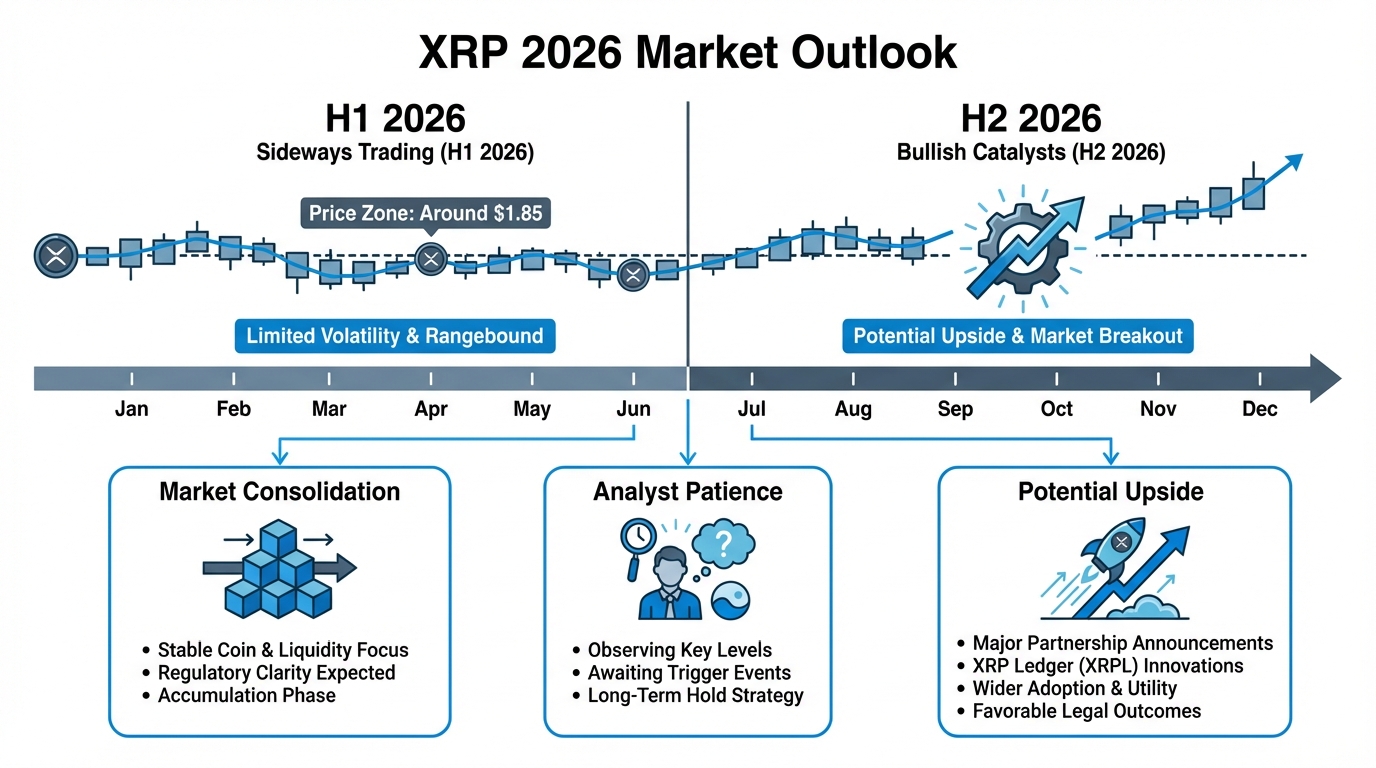
Jon: Hey Lila, I came across this recent piece on Blockchain Magazine about XRP potentially trading sideways through the first half of 2026. Analysts are saying it’s going to stay range-bound until some bullish catalysts kick in. It’s based on market trends and expert forecasts, and it ties into broader crypto predictions for the year ahead.
Lila: Sideways trading? That sounds a bit boring for crypto, Jon. I’ve heard XRP has been in the spotlight with Ripple’s legal wins and all, but why the flatline prediction now? And what’s this about catalysts?
Jon: Fair point—crypto rarely does “boring” well, but that’s the analytical take here. Essentially, XRP’s price has been hovering around $1.80 to $2.00 lately, and experts like those from TradingView and CoinTelegraph suggest it might not break out significantly until mid-2026. They’re pointing to factors like regulatory clarity, potential ETF approvals, and broader market adoption as the sparks that could ignite upward movement. Without those, it’s like a car idling in neutral—lots of potential energy, but no real direction.
Lila: Why does this matter? For someone just getting into crypto, is this a red flag or just par for the course?
Jon: It matters because it highlights the maturity phase crypto is entering. XRP isn’t just a token; it’s tied to Ripple’s payment network, which aims to make cross-border transactions faster and cheaper than traditional systems. Sideways trading could mean stability for real-world use, but it also underscores risks like market volatility. Analysts are optimistic long-term—some predict prices up to $5-$8 by 2026 if catalysts like the CLARITY Act or ETF inflows hit—but it’s all contingent. Worth watching if you’re interested in blockchain’s role in finance, but remember, crypto is unpredictable.
Lila: Got it. So, before we dive deeper, what’s the core problem here that’s leading to this sideways prediction?
Jon: The problem boils down to a lack of immediate momentum drivers in a maturing market. XRP has faced regulatory hurdles, like the ongoing SEC case with Ripple, which has kept investors cautious. Even with partial wins, the token’s price is influenced by broader crypto sentiment—Bitcoin’s dips affect altcoins like XRP. Without fresh catalysts, such as widespread adoption or new tech integrations, it’s stuck in a consolidation phase, where buying and selling pressures balance out, leading to flat price action.
Lila: That makes sense, but can you break it down with an analogy? I’m picturing something everyday to wrap my head around it.
Jon: Sure, think of it like traffic on a highway during rush hour. The cars (investors and traders) are all there, engines revving (market interest), but there’s a bottleneck—maybe construction or an accident (regulatory uncertainty or lack of big news). Everything moves slowly, inching forward without real progress. Catalysts would be like clearing the road or adding lanes: suddenly, traffic flows, and you get that speedup. For XRP, those “lane additions” could be ETF approvals or partnerships that boost liquidity and confidence. Without them, it’s just… crawling along.
Lila: Haha, yeah, I’ve been in that traffic jam. So, if sideways trading is the problem, how does XRP actually function to potentially overcome this?
Under the Hood: How it Works
Jon: Alright, let’s pop the hood on XRP and the XRP Ledger. At its core, XRP is a digital asset built on the XRP Ledger, a decentralized blockchain designed for fast, low-cost payments. Unlike Bitcoin’s proof-of-work, which is like mining gold with pickaxes, XRP uses a consensus protocol called Ripple Protocol Consensus Algorithm (RPCA). It’s efficient—transactions settle in 3-5 seconds, with fees often under a cent.
Lila: RPCA? Simplify that for me—I’m not a blockchain engineer yet.
Jon: No worries. RPCA is basically a voting system among trusted nodes (validators) to agree on transaction validity. It’s not energy-intensive like proof-of-work; instead, it’s like a group of reliable accountants quickly cross-checking ledgers. This makes XRP great for cross-border transfers, where speed matters. Ripple, the company, uses XRP in products like On-Demand Liquidity to bridge currencies without pre-funding accounts—think instant money wiring without the bank delays.
Lila: Okay, that sounds practical. How does this compare to other cryptos? A table might help visualize the differences.
Jon: Good call. Let’s compare XRP to Bitcoin and Ethereum, focusing on key mechanics. This highlights why XRP might be poised for catalysts but is currently sideways.
| Aspect | XRP | Bitcoin | Ethereum |
|---|---|---|---|
| Consensus Mechanism | RPCA (Efficient voting among validators) | Proof-of-Work (Energy-intensive mining) | Proof-of-Stake (Staking-based validation) |
| Transaction Speed | 3-5 seconds | 10 minutes average | 12-15 seconds (post-merge) |
| Fees | Fractions of a cent | Variable, often $1-10+ | Variable, $0.50-5+ depending on gas |
| Primary Use | Cross-border payments | Store of value | Smart contracts and dApps |
| Supply | 100 billion (pre-mined, escrowed releases) | 21 million cap (mined over time) | No hard cap, inflationary |
Jon: See how XRP stands out for efficiency? That’s why analysts are bullish on catalysts like ETF approvals—similar to Bitcoin’s ETF boost—which could integrate it more into traditional finance.
Lila: So who actually uses this? Beyond the hype, what’s the real-world application?
Jon: Great question. On the user side, financial institutions like banks use RippleNet with XRP for remittances—think sending money from the US to Mexico without high fees or delays. Developers build on the XRP Ledger for things like tokenized assets or DeFi protocols. For example, it’s used in micropayments or even CBDC pilots in some countries. The technical benefit is scalability: it handles 1,500 transactions per second, making it viable for enterprise-level payments, not just speculation.
Lila: That sounds useful. If someone’s curious, how can they learn more without jumping into the deep end?
Jon: Let’s break it into levels for safe exploration. Start with Level 1: Research and Observation. Dive into the official XRP Ledger docs at xrpl.org—they explain everything from transaction types to validator setups. Use explorers like xrpscan.com to watch live transactions; it’s like peeking into a public ledger without touching anything. Read whitepapers or analyst reports from sources like The Motley Fool or Coinpedia for context on predictions.
Lila: And for hands-on? Level 2, I assume?
Jon: Exactly. Level 2: Testnet Hands-On. The XRP Ledger has a testnet where you can experiment with fake XRP—no real money involved. Set up a wallet via tools like the XRPL Testnet Faucet, send test transactions, or even code simple scripts using their APIs. It’s a sandbox for understanding mechanics, like how consensus works in practice, without any financial risk. Focus on learning the tech, not trading.
Lila: Smart way to build skills. Wrapping up, what’s the big picture here?
Jon: In summary, XRP’s sideways trading into 2026 reflects a waiting game for catalysts like regulatory wins or ETF launches, which could unlock its payment-focused potential. The tech is solid—fast, cheap, and enterprise-ready—but limitations include centralization concerns around Ripple’s influence and market dependencies.
Lila: Right, and remember, crypto is volatile. Prices can swing wildly, so approach with education first. Uncertainty is part of the game.
Jon: Precisely. It’s an evolving space—stay informed, but always critically. Who knows, by late 2026, those catalysts might change everything, or not. That’s the thoughtful thrill of blockchain tech.
Author Profiles
Jon is a Web3 researcher and practitioner with years of experience in blockchain architecture and token mechanics.
Lila is a rational learner bridging complex tech for beginners, ensuring clear explanations.
References
- XRP Faces Sideways Trading Through First Half of 2026 as Analysts Await Bullish Catalysts
- Official XRP Ledger Site
- 4 Reasons to Buy XRP before 2030 | The Motley Fool
- XRP price prediction 2026: Potential highs & market outlook
- XRP may trade sideways in 2026 until bullish catalysts emerge: Analysts