
Recent data shows Bitcoin missed a key target. This deviation highlights shifting market dynamics. Follow for updates.#Bitcoin #CryptoAnalysis
Quick Video Breakdown: This Blog Article
This video clearly explains this blog article.
Even if you don’t have time to read the text, you can quickly grasp the key points through this video. Please check it out!
If you find this video helpful, please follow the YouTube channel “BlockChainBulletin,” which delivers daily Crypto news.
https://www.youtube.com/@BlockChainBulletins
Read this article in your native language (10+ supported) 👉
[Read in your language]
Bitcoin Just Missed Its $95k Boxing Day Record: A Signal Worth Noting
Jon: Hey Lila, have you seen the latest on Bitcoin? It just missed hitting that anticipated $95k mark on Boxing Day, dropping instead to around $88,500. According to reports from CryptoSlate, this deviation from historical patterns is triggering a signal that’s got traders paying close attention as we head into 2025.
Lila: Oh, interesting. I caught a glimpse of the headlines, but I’m not sure what the big deal is. Boxing Day isn’t exactly a crypto holiday I mark on my calendar. Why does this matter?
Jon: Fair point—it’s not about festive sales, but about patterns in Bitcoin’s price behavior. Historically, Bitcoin has shown certain trends around year-end, especially on Boxing Day, which is December 26th. Analysts look at these for signals on momentum. This year, missing the $95k record isn’t just a random dip; it’s highlighting how institutional factors, like risk budgets tightening, could influence 2025. Think of it as a weather vane for the market— not a prediction, but a data point worth understanding.
Lila: Okay, that makes sense at a high level. But why specifically $95k? And what’s this “historical signal” all about?
Jon: The $95k was a target based on past Boxing Day highs and recent rallies. When it missed, it activated a signal from historical data showing deviations like this often precede shifts in volatility or positioning. No hype here—it’s about data patterns, not guarantees.
The Problem: Why Year-End Misses Like This Stand Out
Jon: The core issue here is how Bitcoin’s price can be influenced by a mix of market forces, especially at year-end. Things like options expiries, low holiday liquidity, and institutional adjustments create these pivotal moments. In this case, Bitcoin failing to break $95k on Boxing Day isn’t isolated—it’s part of a pattern where such misses have historically signaled tightening conditions for the next year.
Lila: Tightening conditions? Can you break that down? It sounds a bit abstract.
Jon: Sure. Imagine Bitcoin’s price as traffic on a highway. Normally, it’s flowing based on supply and demand—cars (traders) entering and exiting. But at year-end, especially around holidays like Boxing Day, the road gets narrower due to lower liquidity (fewer cars on the road). Add in big events like a massive options expiry—think of it as a toll booth where a bunch of contracts (bets on price) all hit at once. This year, over $27 billion in Bitcoin and Ethereum options expired on Deribit, the largest ever. That can cause sudden jams or accelerations. The miss at $95k suggests the traffic is bottlenecking, possibly because institutions are recalibrating their risk budgets for 2025, leading to outflows from ETFs and more conservative plays.
Lila: Ah, the analogy helps. So it’s like holiday traffic chaos revealing underlying road issues. But how does this tie into a “historical signal”?
Jon: Exactly. Historically, when Bitcoin deviates from expected year-end highs like this, it often precedes periods of heightened volatility or reassessment. Data from past cycles shows similar patterns in 2018 or 2021, where misses correlated with institutional pullbacks. It’s not causal, but it’s a signal demanding attention because it exposes how macro factors—like new U.S. crypto laws or ETF growth—might play out.
Under the Hood: How it Works
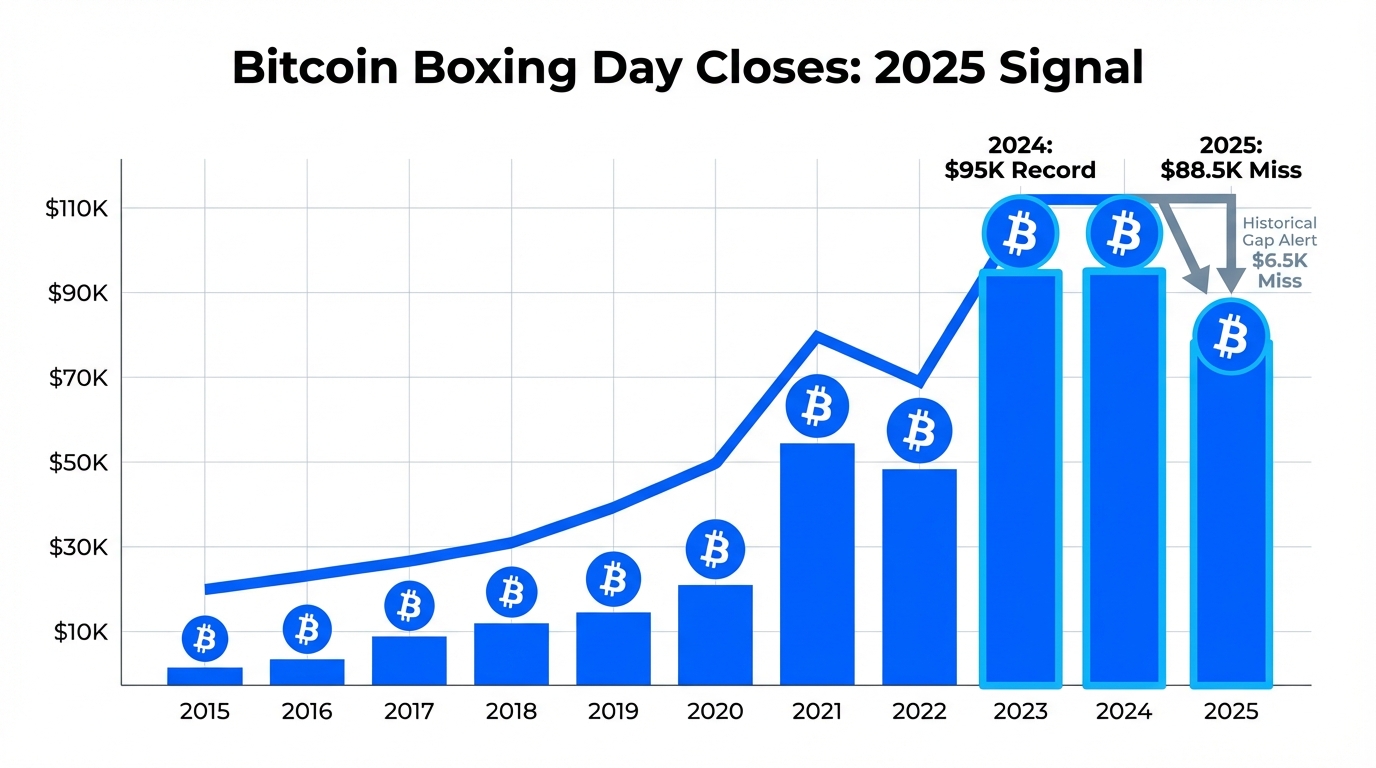
Jon: Let’s dive deeper into the mechanics. At its core, this signal stems from Bitcoin’s decentralized architecture and how market derivatives interact with it. Bitcoin operates on a proof-of-work consensus mechanism, where miners validate transactions and secure the network. But price signals like this one aren’t about the blockchain itself—they’re about layered financial instruments. Options, for instance, are contracts allowing buyers to purchase or sell Bitcoin at a set price by a certain date. The Boxing Day expiry was massive, with a put-call ratio of 0.38 indicating a bullish bias overall, but the miss at $95k flipped that narrative slightly.
Lila: Proof-of-work I get—it’s like digital mining for security. But put-call ratio? Simplify that for me.
Jon: No problem. Puts are bets that the price will drop, calls are bets it’ll rise. A low ratio like 0.38 means more calls, suggesting optimism. When reality misses the mark, it can trigger unwinding of positions, increasing volatility. Under the hood, this interacts with Bitcoin’s halving cycles and supply mechanics—every four years, rewards halve, historically boosting scarcity and price. For 2025, models suggest a 70% chance of a breakout if trends hold, but only if compounding rates align.
Lila: Got it. So it’s like balancing optimism with reality checks.
Jon: Precisely. To illustrate differences, here’s a quick comparison of traditional stock market signals versus crypto ones.
| Aspect | Traditional Markets | Bitcoin/Crypto |
|---|---|---|
| Year-End Signals | Influenced by fiscal year closes, less volatility from derivatives. | Amplified by massive options expiries and low liquidity holidays. |
| Historical Patterns | Tied to economic reports, predictable seasonality. | Linked to halvings and crypto-specific events like ETF approvals. |
| Volatility Impact | Moderated by regulations and circuit breakers. | Higher due to 24/7 trading and global decentralization. |
| Institutional Role | Dominant but slower-moving. | Growing via ETFs, with rapid risk budget shifts. |
Jon: As you can see, crypto’s setup makes signals like this more pronounced. The diagram above visualizes how options expiries can create gamma squeezes, where dealers hedge positions, amplifying price moves.
Lila: That table clarifies a lot—crypto is like the wild west version of stocks.
Use Cases & Applications
Lila: So who actually uses this kind of signal? Is it just for day traders, or does it have broader applications?
Jon: Good question. At the developer level, blockchain analysts and quant devs use these signals to build predictive models or risk management tools. For instance, integrating historical data into smart contracts for automated hedging. On the user side, it’s valuable for understanding market health—worth watching if you’re building on Bitcoin’s network, like with Lightning for payments. Institutionally, firms adjust portfolios based on these, but the technical benefit is in data-driven insights, not speculation. It helps in stress-testing systems against volatility.
Lila: Like using weather forecasts to plan a road trip, not to bet on rain.
Jon: Spot on. Applications extend to DeFi protocols that reference Bitcoin prices for oracles, ensuring accurate feeds during events like this.
Educational Action Plan
Jon: If you’re interested in learning more, start with Level 1: Research and Observation. Dive into whitepapers on Bitcoin.org or explorers like Blockchain.com to track historical prices. Check dashboards on CoinMarketCap for options data—observe patterns without any commitment.
Lila: That sounds low-risk. What about hands-on? How can someone try this safely?
Jon: Level 2: Testnet Experimentation. Use Bitcoin’s testnet to simulate transactions and see how price feeds integrate via APIs from sources like Chainlink. Build a simple script to monitor signals—it’s about learning mechanics, emphasizing minimal-risk play to grasp volatility without real exposure.
Conclusion & Future Outlook
Jon: In summary, this Boxing Day miss is a reminder of Bitcoin’s dynamic ecosystem—opportunities in understanding signals, but limitations like unpredictable macro shifts persist.
Lila: Absolutely, and remember, markets are volatile and uncertain. Always approach with caution.
Jon: Well said. It’s about informed curiosity, not certainties.
References
- Bitcoin just missed its $95k Boxing Day record, triggering signal that demands immediate attention
- Official Bitcoin Website
- $27 Billion Options Expiry Looms: Is Bitcoin’s $95K About to Snap?
- Bitcoin has 70% chance of a massive 2026 breakout, but only if this trend holds