Asset mobility matters during global shifts. Tokenized gold provides modern utility without physical borders.#tokenizedgold #commodities
Quick Video Breakdown: This Blog Article
This video clearly explains this blog article.
Even if you don’t have time to read the text, you can quickly grasp the key points through this video. Please check it out!
If you find this video helpful, please follow the YouTube channel “BlockChainBulletin,” which delivers daily Crypto news.
https://www.youtube.com/@BlockChainBulletins
Read this article in your native language (10+ supported) 👉
[Read in your language]
Gold Surges to $4,400 Amid Venezuela Blockade: Tokenized Gold and the Crypto Shift
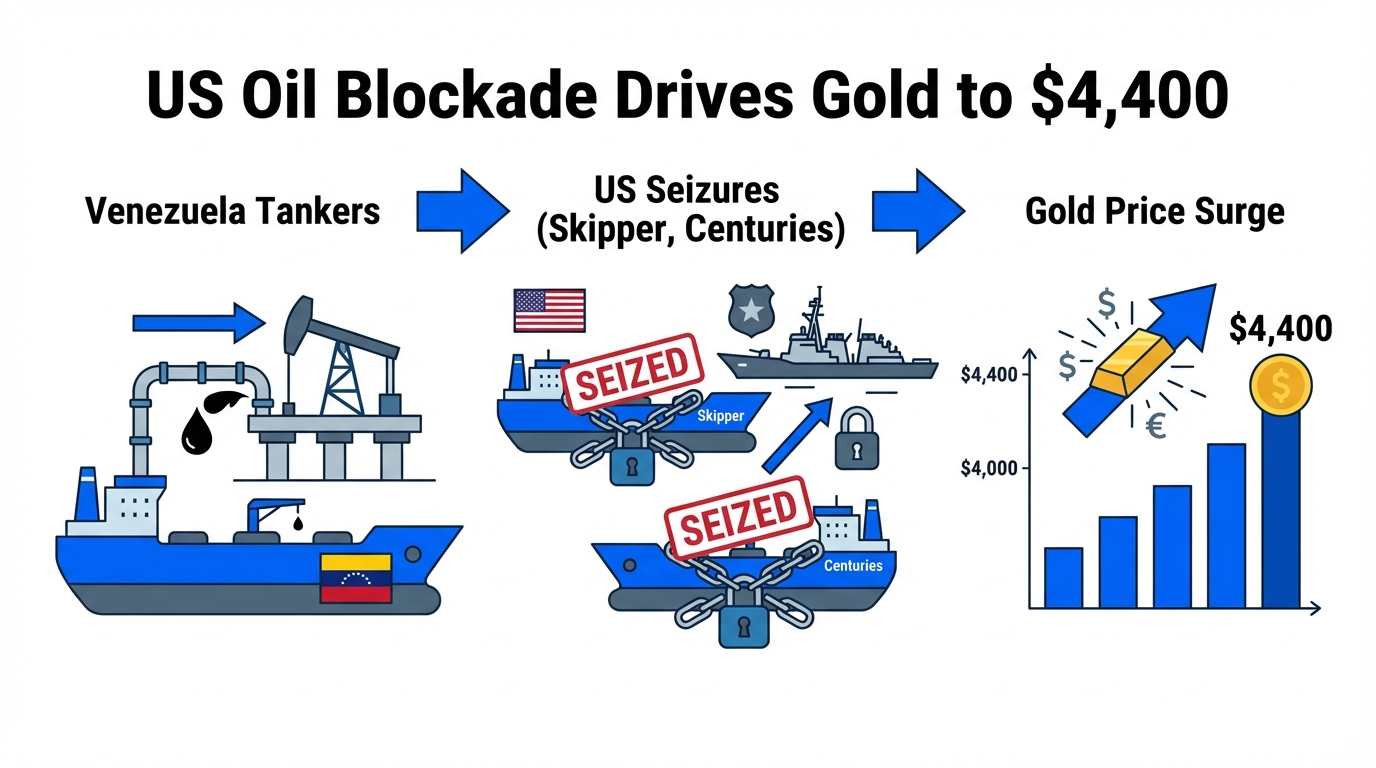
Jon: Hey Lila, have you seen the latest on gold prices? According to this CryptoSlate article, gold has hit $4,400 per ounce as the US blockade on Venezuela tightens, disrupting oil supplies and pushing investors toward safe havens. But what’s interesting is the quiet shift toward tokenized gold—basically, gold ownership digitized on blockchains like those backing Bitcoin alternatives. It’s changing how people trade hard assets without the usual hassles.
Lila: Whoa, $4,400? That’s a massive jump. I’ve heard about tokenized assets, but with all this geopolitical tension, it sounds timely. Why does this matter, especially in the crypto world?
Jon: Good question. It matters because traditional gold trading can be clunky—think physical storage, shipping, and verification costs. The Venezuela situation is amplifying demand for gold as a hedge against instability, with prices up over 1.6% in a single day recently. But tokenized gold lets you own a fraction of real gold via blockchain tokens, tradable 24/7 like crypto. It’s not just hype; it’s a practical evolution, especially when Bitcoin is lagging behind metals in this rally. Reports show tokenized commodities nearing $4 billion in market cap. This could redefine asset ownership in uncertain times.
Lila: Okay, that makes sense at a high level. But let’s dig into why this surge is happening now and what problems it’s solving.
Jon: Absolutely. The core problem here is accessibility and liquidity in hard asset markets. With the Venezuela blockade ramping up—US restrictions on oil tankers and government pressure—global markets are feeling the pinch. Oil disruptions lead to inflation fears, and gold has always been the go-to for preserving value. But owning physical gold? It’s like trying to store a vault in your garage: secure but immobile, expensive to move, and hard to divide for small trades.
Lila: So, the blockade is basically a catalyst, making people scramble for alternatives. Can you break down the structural issue with a simple analogy?
Jon: Sure, think of traditional gold trading like an old-school library system. You want a book (gold bar), but you have to physically go to the library, check it out, carry it home, and hope no one steals it. If you only need a chapter, tough luck—you take the whole thing. Tokenized gold is like digitizing that library into an e-book app: the “book” is backed by real gold in a vault, but you can own a page (a token) instantly, trade it globally, and verify ownership via blockchain. No shipping, lower fees, and it’s divisible down to tiny amounts. This shift is quietly happening because events like the blockade expose how rigid old systems are in a fast-moving world.
Lila: That analogy clicks—it’s about making gold as fluid as email instead of snail mail. But how does the Venezuela angle tie in specifically?
Jon: Venezuela’s oil is a big deal; the blockade disrupts supply chains, spiking energy costs and inflation worries. Investors flock to gold, pushing prices to records like $4,540 recently. Bitcoin was supposed to be “digital gold,” but it’s stumbling while metals soar—silver up 7.6% in a session. Tokenized gold bridges this: it’s crypto-native but tied to real metal, offering stability without abandoning blockchain efficiencies.
Under the Hood: How it Works
Jon: Alright, let’s peel back the layers. Tokenized gold typically works through platforms that issue tokens representing real gold stored in audited vaults. For example, a token like PAXG or Tether Gold is backed 1:1 by physical gold. The architecture involves blockchain for transparency—Ethereum or similar for smart contracts that handle minting, burning, and transfers. When you buy a token, it’s like claiming a digital certificate of ownership, verifiable on-chain.
Lila: So, it’s not just a fancy IOU? How does the blockchain ensure it’s real?
Jon: Exactly, not just an IOU—it’s enforced by smart contracts and regular audits. The process starts with a custodian vaulting physical gold. Then, tokens are minted on the blockchain, each representing, say, one gram. Consensus mechanisms like Proof-of-Stake (on Ethereum) secure the network, preventing double-spending. If geopolitical tensions rise, like in Venezuela, demand for these tokens spikes because you can trade them instantly without borders.
Lila: Got it. And compared to traditional gold or even Bitcoin, what’s the difference mechanically?
Jon: Let’s compare them side by side to clarify.
| Aspect | Traditional Gold | Bitcoin | Tokenized Gold |
|---|---|---|---|
| Backing | Physical metal in vaults or personal storage | Decentralized network, no physical asset | Physical gold in audited vaults, tokenized on blockchain |
| Liquidity | Limited to market hours, high transaction costs | 24/7 trading, but volatile | 24/7, fractional ownership, low fees via DeFi |
| Verification | Assays and certificates, trust in intermediaries | Blockchain explorers, transparent ledger | Blockchain + third-party audits, on-chain proof |
| Geopolitical Resilience | Vulnerable to seizures or transport issues (e.g., blockades) | Censorship-resistant, but regulatory risks | Digital transfer avoids borders, backed by real asset |
| Risks | Theft, storage costs, illiquidity | High volatility, no intrinsic value | Custodian trust, smart contract bugs |
Jon: As you can see, tokenized gold combines the best of both worlds: the stability of gold with crypto’s speed. In the context of 2025’s tensions, like the Venezuela blockade, it’s a way to hedge without physical headaches.
Lila: That table really highlights the trade-offs. So who actually uses this?
Jon: Great pivot. On the developer side, blockchain devs integrate tokenized gold into DeFi apps for yield farming or collateralized loans—think using gold tokens as stable collateral in protocols like Aave. Users? Retail investors in volatile regions use it for borderless savings; institutions for portfolio diversification without logistics. Technically, it enables fractional ownership, so someone in a sanctioned area could access gold value via tokens, bypassing some traditional barriers. The benefit is efficiency: instant settlements via smart contracts, reducing counterparty risk.
Lila: Makes sense for hedging in uncertain times. And for Bitcoin holders, this could be a way to pivot during slumps?
Jon: Precisely, without hype—it’s about understanding the mechanics for better-informed decisions. Now, if you’re curious about exploring this educationally…
Lila: Yeah, what’s a safe way to learn more without jumping in headfirst?
Jon: Let’s break it into levels. Level 1: Research and observation. Start by reading whitepapers from projects like Paxos Gold (PAXG)—their docs explain token issuance and audits. Use blockchain explorers like Etherscan to track token supplies and verify reserves. Dashboards on Dune Analytics can show trading volumes during events like the gold surge. It’s all about observing patterns, like how tokenized gold volumes spiked with the $4,400 hit.
Lila: Observation first—smart. What about hands-on without real risks?
Jon: Level 2: Testnet experimentation. Many platforms have testnets where you can mint fake tokens and simulate trades. For Ethereum-based tokenized assets, use Goerli testnet with tools like MetaMask to interact with sample contracts. It’s minimal-risk learning: deploy a simple smart contract via Remix IDE to understand token mechanics. Focus on the tech—how oracles feed real gold prices into the chain for accurate pegging. Remember, this is for education; real markets have volatility.
Lila: Perfect, keeps it practical and safe.
Jon: To wrap up, this gold surge amid the Venezuela blockade highlights tokenized gold’s potential as a bridge between traditional assets and crypto. It’s efficient for ownership shifts, but limitations persist—like reliance on custodians and regulatory hurdles. Worth watching as markets evolve into 2026, with analysts eyeing $5,000 gold.
Lila: Absolutely, but let’s remind everyone: crypto and commodities are volatile. Geopolitical events add uncertainty, so approach with caution and continuous learning.
Jon: Well said. It’s an intriguing space, but always prioritize understanding over speculation.
References
- Gold hits $4,400 as Venezuela blockade bites, but a quiet ownership shift is changing how winners trade
- Paxos Gold Official Site
- Gold and Silver Smash Records Again as Rally Gathers Momentum – Yahoo Finance
- Bitcoin price news: BTC stumbles as gold, silver and copper soar to new records – CoinDesk