
Why are crypto prices stagnant despite huge wins? Discover the paradox of extreme fear overpowering Bitcoin‘s structural progress.#CryptoFear #BitcoinSentiment #MarketWins
Quick Video Breakdown: This Blog Article
This video clearly explains this blog article.
Even if you don’t have time to read the text, you can quickly grasp the key points through this video. Please check it out!
If you find this video helpful, please follow the YouTube channel “BlockChainBulletin,” which delivers daily Crypto news.
https://www.youtube.com/@BlockChainBulletins
Read this article in your native language (10+ supported) 👉
[Read in your language]
Crypto Sentiment is Trapped in Extreme Fear Because the Industry’s Biggest Structural Wins Are Failing to Move Prices
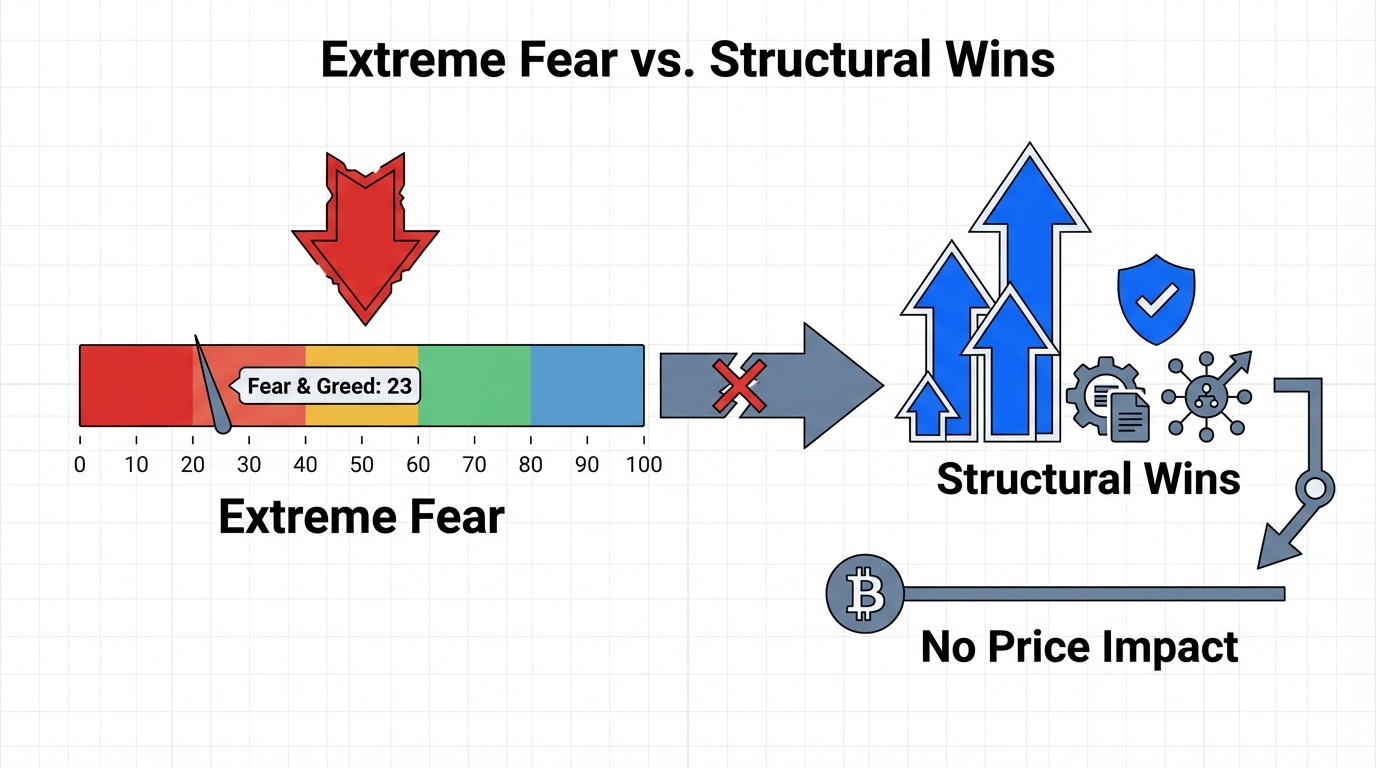
Jon: Hey Lila, I came across this piece on CryptoSlate about the crypto market’s current mood. It’s titled “Crypto sentiment is trapped in extreme fear because the industry’s biggest structural wins are failing to move prices.” Basically, even though Bitcoin and the broader crypto space hit some major milestones in 2025—like regulatory nods, ETF approvals, and institutional adoption—the prices aren’t reflecting that progress. Sentiment is stuck in “extreme fear” mode, with Bitcoin down over 22% in Q4, marking one of its worst quarters since 2018.
Lila: Interesting, Jon. I’ve been seeing headlines about Bitcoin struggling around $88,000 lately. But why is sentiment so low despite these so-called structural wins? It sounds counterintuitive.
Jon: Exactly. The article points out that while the industry has achieved things like better infrastructure for scalability, more secure protocols, and even mainstream integration, the market isn’t pricing them in. Prices are stagnant or dropping, leading to this prolonged fear. It’s like the market is ignoring the fundamentals.
Lila: Why does this matter? For someone new to crypto, is this just another dip, or is there something deeper going on?
Jon: It matters because it highlights a disconnect between real progress and market perception. In crypto, sentiment drives a lot—fear can lead to sell-offs, while greed fuels rallies. But here, even positive developments aren’t moving the needle, suggesting underlying issues like macroeconomic pressures or overhyping past wins. It’s a reminder that crypto isn’t immune to broader economic cycles. Think of it as a reality check for the industry in 2025.
Lila: Got it. So, let’s dive into the problem behind this.
Jon: The core problem is this performance gap. Bitcoin hit milestones like widespread ETF adoption and regulatory clarity in places like the US, which should theoretically boost prices by attracting more capital. But instead, we’re seeing the Crypto Fear & Greed Index stuck at 20 out of 100 for 14 straight days—extreme fear territory. Structural wins, like improved network security or faster transaction layers, aren’t translating to price action because of factors like high interest rates, geopolitical tensions, or simply market fatigue after the 2024 bull run.
Lila: Can you clarify what these “structural wins” even are? It sounds vague.
Jon: Sure. Structural wins refer to foundational improvements: things like Bitcoin’s Lightning Network for quicker payments, or the approval of spot ETFs that make it easier for institutions to invest without holding actual BTC. But prices are failing to move because sentiment is poisoned by recent crashes and external pressures. To analogize, imagine a city’s traffic system. You’ve upgraded the roads (structural wins like better protocols), added more lanes (scalability), and even got government funding (regulatory approval). But if there’s a massive storm (economic downturn) or everyone decides to stay home out of fear (market sentiment), the traffic doesn’t flow, and the upgrades feel pointless. That’s crypto right now—great infrastructure, but no drivers on the road.
Lila: That analogy helps. So the roads are built, but fear is keeping people from using them. Makes sense why prices aren’t budging.
Under the Hood: How it Works
Jon: Alright, let’s get into the mechanics of Bitcoin, since that’s at the heart of this sentiment discussion. Bitcoin operates on a decentralized blockchain, which is essentially a public ledger secured by cryptography. The key is its proof-of-work consensus mechanism—miners compete to solve complex puzzles to validate transactions and add blocks to the chain. This ensures security but can be energy-intensive. In 2025, structural wins include upgrades like Taproot for better privacy and efficiency, yet sentiment remains low because these don’t immediately fix price volatility.
Lila: Proof-of-work— that’s where computers race to hash data, right? But how does that tie into why wins aren’t moving prices?
Jon: Spot on. The hashing secures the network against attacks, making Bitcoin’s architecture robust. Token mechanics are simple: BTC is mined as rewards for miners, with a halving every four years reducing supply issuance— that’s a structural win for scarcity. But prices aren’t responding because external factors like fear override this. Let me break it down further with a comparison to traditional assets.
| Aspect | Bitcoin (Crypto) | Traditional Gold |
|---|---|---|
| Supply Mechanism | Fixed 21M cap, halvings reduce new issuance | Mined from earth, supply grows slowly |
| Security | Proof-of-work hashing | Physical storage and vaults |
| 2025 Structural Wins | ETFs, Layer-2 scaling, regulatory clarity | N/A – stable but not innovative |
| Sentiment Impact | Extreme fear despite wins, leading to price stagnation | Stable during crises, less volatile |
Lila: The table clarifies why Bitcoin is often called “digital gold,” but also shows where sentiment derails it. So, even with these mechanics, fear wins out.
Jon: Precisely. The architecture is sound—decentralized nodes maintain the ledger, and smart contracts on layers like Lightning enable fast, cheap transactions. But in extreme fear, adoption slows, and prices reflect that psychology more than tech.
Lila: So who actually uses this? Beyond traders, I mean.
Jon: Great question. Developers use Bitcoin’s base layer for building secure applications, like ordinal inscriptions for NFTs or sidechains for DeFi. Users benefit from its store-of-value properties—think remittances in volatile economies, where Bitcoin’s fixed supply offers stability. Institutionally, firms like MicroStrategy hold it as a treasury asset for inflation hedging. The technical benefit is immutability: once a transaction is confirmed, it’s tamper-proof, which is huge for trustless systems. No hype here—just reliable tech for borderless value transfer.
Lila: And for payments? I’ve heard Lightning makes it practical.
Jon: Yes, Lightning Network creates off-chain channels for instant, low-fee transactions, settling back to the main chain. It’s used in apps for microtransactions, like tipping on social platforms or gaming economies. The focus is on efficiency, not quick riches—risks like network congestion remain, but it solves real scalability issues.
Lila: Okay, that sounds useful. Now, if someone’s interested in learning more without jumping in headfirst, what’s an educational action plan?
Jon: Let’s break it into levels. Start with Level 1: Research and Observation. Dive into Bitcoin’s whitepaper at bitcoin.org—it’s short and explains the basics. Use block explorers like Blockchain.com to watch live transactions; see how blocks are added every 10 minutes. Check dashboards like the Fear & Greed Index on Alternative.me to track sentiment data. It’s all about understanding without any commitment.
Lila: That seems low-risk. What about Level 2 for hands-on learning?
Jon: For Level 2, experiment on testnets. Bitcoin has a testnet where you can get free test BTC to practice sending transactions via wallets like Electrum. Build a simple script using libraries like bitcoinjs to interact with the network—learn about addresses, keys, and signing without real funds. It’s minimal-risk, emphasizes learning the mechanics, and helps you grasp why structural wins matter technically. Remember, this is for education; volatility means real markets can be unpredictable.
Lila: Perfect—safe ways to explore.
Jon: To wrap up, this sentiment trap in 2025 shows Bitcoin’s strengths—like its unchangeable supply and secure architecture—are real, but they’re overshadowed by fear. Future outlook? Analysts predict a potential rebound in 2026 if macro conditions improve, with themes like AI integration or stablecoins playing a role. But limitations persist: energy use, scalability caps, and regulatory hurdles.
Lila: Yeah, it’s a reminder of crypto’s volatility and uncertainty. Readers, always approach with caution—markets can swing wildly, and past performance isn’t indicative of future results. Thanks for breaking this down, Jon.
Jon: Anytime, Lila. Stay curious, stay informed.
—
References
- Crypto sentiment is trapped in extreme fear because the industry’s biggest structural wins are failing to move prices
- Official Bitcoin Website
- Crypto Sentiment Stuck in Extreme Fear Zone for Two Weeks – CoinTelegraph
- Bitcoin Price News: BTC Heads to Its Worst Quarter Since 2018 – CoinDesk
- Crypto Fear & Greed Index – Alternative.me