
Bitcoin hit $126,000 in 2025. How did crypto shift from speculative to finance infrastructure? Find out!
—#CryptoFinance #Blockchain2025 #DigitalInfrastructure
—
Quick Video Breakdown: This Blog Article
This video clearly explains this blog article.
Even if you don’t have time to read the text, you can quickly grasp the key points through this video. Please check it out!
If you find this video helpful, please follow the YouTube channel “BlockChainBulletin,” which delivers daily Crypto news.
https://www.youtube.com/@BlockChainBulletins
Read this article in your native language (10+ supported) 👉
[Read in your language]
10 Stories That Rewired Digital Finance in 2025: The Year Crypto Became Infrastructure
Jon: Hey Lila, I just came across this piece on CryptoSlate titled “10 stories that rewired digital finance in 2025 – the year crypto became infrastructure.” It’s a roundup of how crypto shifted from being a speculative toy to something more like the plumbing of global finance. We’re talking stablecoins turning into everyday money rails, regulations finally catching up, and big banks dipping toes into tokenization. What do you think—does this feel like the year everything clicked?
Lila: Sounds intriguing, Jon. I’ve been following some of the headlines, like Bitcoin hitting new highs and that massive Bybit hack, but infrastructure? That’s a big claim. Break it down for me—what are the key stories here?
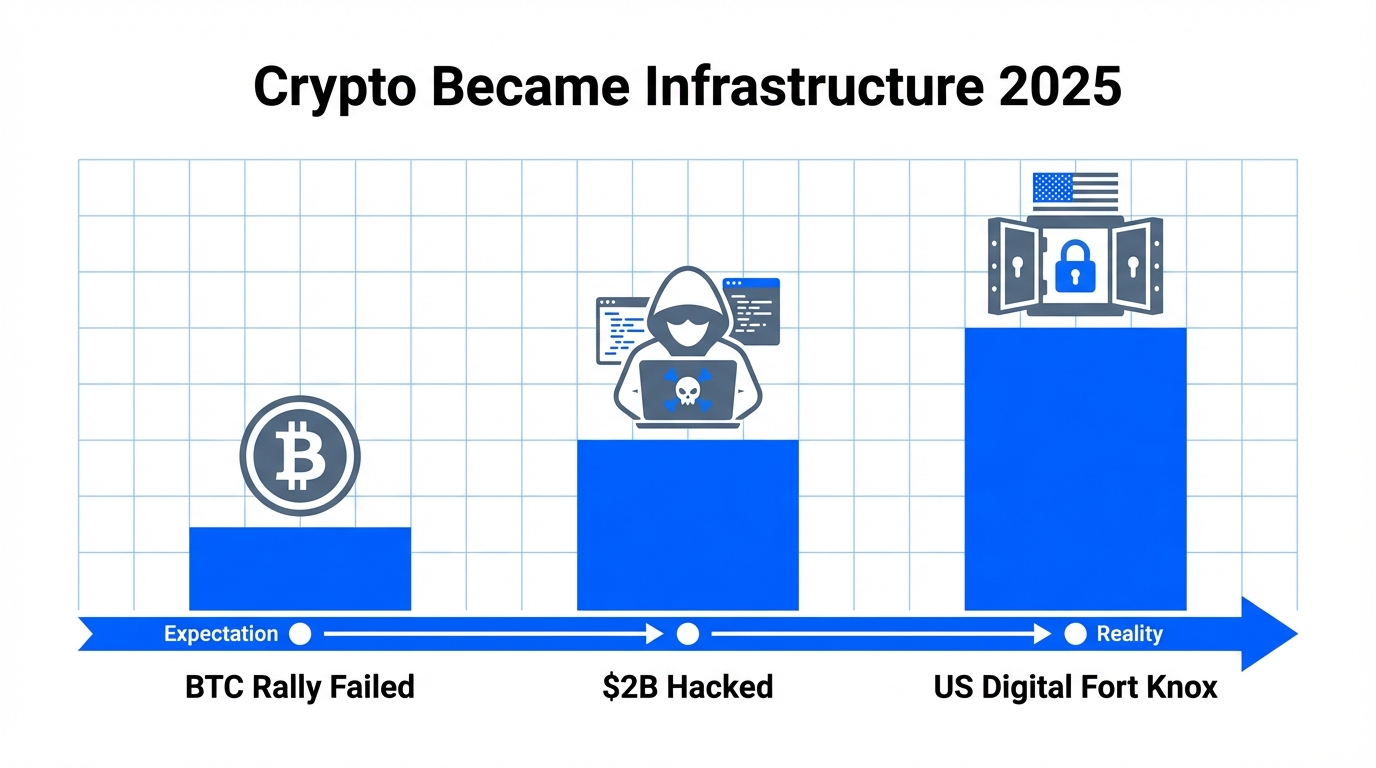
Jon: Fair enough. The article highlights 10 pivotal moments. For starters, there’s the rise of stablecoins as global infrastructure—think Tether and USDC handling trillions in volume, outpacing even some traditional payment networks. Then, Trump’s policies pushing pro-crypto regulations, leading to things like the GENIUS Act that integrated crypto into federal frameworks. We saw record institutional inflows, with Bitcoin ETFs pulling in billions, and real-world assets (RWAs) like tokenized bonds becoming a thing. Oh, and don’t forget the $1.4 billion Bybit hack that exposed vulnerabilities in centralized exchanges, forcing better security standards. There was also a craze around decentralized autonomous trading (DAT) protocols, and China’s tariffs sparking a shift in global crypto liquidity. Prices? Bitcoin peaked at $126,000, but it wasn’t all roses—there was a $19 billion liquidation event that wiped out leveraged positions. Overall, it’s about crypto embedding itself into finance’s backbone, from payments to compliance.
Lila: Wow, that’s a lot. Why does this matter? Is it just hype, or is there real substance to crypto becoming ‘infrastructure’?
Jon: It’s more substance than hype, though the industry loves its buzzwords. This matters because finance has always relied on trusted intermediaries—banks, clearinghouses—to move value securely. Crypto in 2025 started replacing or augmenting those with decentralized protocols. Imagine if your bank’s transfer system went global and permissionless. It opens doors for faster, cheaper cross-border payments, but also introduces new risks like smart contract bugs. Worth watching how this evolves, especially with regulations stabilizing the space.
Lila: Okay, that high-level view helps. But let’s dig into the ‘why’—what problems were these stories solving in digital finance?
Jon: Great question. The core problem is inefficiency in traditional finance. Think slow settlements—days for international transfers—high fees, and exclusion for the unbanked. Crypto’s stories in 2025 addressed this by turning protocols into infrastructure. For instance, stablecoins solved volatility by pegging to fiat, enabling reliable value transfer. Regulations fixed the Wild West vibe, making it safer for institutions. But the structural issue? Centralization vs. decentralization. Banks control flows, but crypto distributes them, which can reduce single points of failure but amps up complexity.
Lila: That makes sense, but clarify: how does that play out in practice? Give me an analogy.
Jon: Sure, picture global finance as a busy highway system. Traditional banks are tollbooths: they check IDs, collect fees, and direct traffic, but they cause backups and exclude non-drivers. Crypto in 2025 built automated express lanes—stablecoins as the fuel, blockchains as the roads—where anyone with a wallet can zoom along without stopping. Stories like RWA tokenization are like adding smart tolls that self-audit. The catch? If a lane (protocol) gets hacked, it’s a multi-car pileup. That’s why the Bybit story rewired security thinking.
Lila: Haha, love the highway bit—makes it click. So, these stories aren’t isolated; they’re fixing systemic jams.
Jon: Exactly. Now, to understand the mechanics behind this shift…
Under the Hood: How it Works
Jon: Alright, let’s pop the hood. That diagram above visualizes the layers: at the base, blockchains like Ethereum or Solana provide the consensus—think proof-of-stake, where validators stake tokens to secure the network instead of mining. On top, stablecoins act as the stable value layer, pegged via algorithms or reserves. Then, protocols for tokenization turn real assets into digital tokens, using smart contracts—self-executing code on the blockchain. The infrastructure angle? In 2025, integrations with banks via APIs made this hybrid: crypto rails for speed, tradfi for compliance.
Lila: Slow down—consensus? Rephrase that for me.
Jon: Consensus is how a decentralized network agrees on truth without a central boss. Proof-of-stake: nodes ‘stake’ crypto as collateral; if they misbehave, they lose it. It’s energy-efficient compared to Bitcoin’s proof-of-work mining. Token mechanics? Utility tokens power transactions, governance ones let holders vote on upgrades. In 2025’s stories, this enabled things like decentralized finance (DeFi) protocols handling trillions in value locked.
Lila: Got it. So, how does this compare to traditional systems?
Jon: Let’s break it down in a table for clarity.
| Aspect | Traditional Finance | 2025 Crypto Infrastructure |
|---|---|---|
| Settlement Speed | Days for cross-border | Seconds via blockchains |
| Accessibility | Requires bank account, KYC | Wallet-based, permissionless |
| Security Model | Centralized vaults, regulations | Decentralized consensus, but hack risks |
| Cost | High fees (2-5%) | Low gas fees on L2s (fractions of a cent) |
| Regulation | Established but siloed | Evolving, with 2025 acts like GENIUS |
Jon: See? Crypto isn’t replacing everything; it’s rewiring the inefficient parts. But risks remain—volatility, exploits. The Bybit hack showed that even ‘infrastructure’ needs robust audits.
Lila: That table nails it. So who actually uses this? Beyond traders, I mean.
Jon: Good pivot. Developers build on it for apps like decentralized exchanges (DEXs) or yield farms, using tools like Solidity for smart contracts. Users? Remittances—migrants sending money home cheaply via stablecoins. Businesses tokenize assets for liquidity, like real estate fractions on blockchain. Fintechs integrate for instant payments. Technically, it shines in composability: protocols stack like LEGOs, creating new financial primitives without permission. Think automated lending where code enforces terms, no lawyers needed. But it’s not for everything—high-risk scenarios still favor tradfi stability.
Lila: Practical. Now, if someone’s curious, how do they learn more without jumping in blind?
Jon: Let’s structure an educational plan. Start with Level 1: Research and observation. Dive into whitepapers—CryptoSlate has summaries, or check Chainalysis reports on regulations. Use explorers like Etherscan to watch transactions in real-time; it’s like peeking at the highway traffic. Track dashboards on Dune Analytics for stablecoin volumes. Understand mechanics by reading about proof-of-stake on Ethereum’s site—no hype, just facts.
Lila: That’s beginner-friendly. What about hands-on? Level 2?
Jon: Level 2: Testnet experimentation. Most blockchains have testnets—free playgrounds with fake tokens. Set up a wallet like MetaMask, connect to Ethereum’s Sepolia testnet, and deploy a simple smart contract via Remix IDE. Simulate stablecoin transfers or even a basic DeFi interaction. It’s minimal-risk learning—focus on how consensus works under the hood. Tools like Hardhat let you test locally. Remember, this is for education; real networks have gas fees and irreversibility.
Lila: Smart—keeps it safe. Wrapping up, what’s the big takeaway?
Jon: In summary, 2025’s stories turned crypto into infrastructure by solving real finance pains: speed, access, efficiency. Opportunities abound in tokenization and stablecoins, but limitations like scalability issues and regulatory hurdles persist. It’s evolving, not perfected.
Lila: Right, and a reminder: markets are volatile, uncertainty high. Approach with curiosity, not assumptions.
Jon: Precisely. Here’s to thoughtful exploration.
Author Profiles
Jon is a Web3 researcher with years in blockchain architecture. Lila bridges complex topics for newcomers.
References
- 10 stories that rewired digital finance in 2025 – the year crypto became infrastructure
- Stablecoins in 2025: How Regulation, Banks, and Fintechs Turned Digital Money Into a Global Infrastructure
- 2025 Crypto Regulatory Round-Up
- Crypto’s 12 biggest stories of 2025