
Worried about crypto security? Recent events reveal institutional moves, flash crashes, and wallet hacks. Learn how regulations are adapting.#CryptoNews #BlockchainSecurity #Web3Regulations
Quick Video Breakdown: This Blog Article
This video clearly explains this blog article.
Even if you don’t have time to read the text, you can quickly grasp the key points through this video. Please check it out!
If you find this video helpful, please follow the YouTube channel “BlockChainBulletin,” which delivers daily Crypto news.
https://www.youtube.com/@BlockChainBulletins
Read this article in your native language (10+ supported) 👉
[Read in your language]
Understanding Recent Developments in Crypto and Blockchain: Implications for Digital Infrastructure and Regulation
Jon: Today’s news in crypto and blockchain highlights important shifts in how traditional finance integrates with digital assets, the vulnerabilities in trading platforms, security risks for users, and evolving regulations. These stories matter because they reveal ongoing challenges and opportunities in building secure, compliant digital infrastructure that could impact global financial systems and user trust in the long term.
Lila: That sounds significant, but as someone new to this, I’m wondering how these events affect everyday people or developers trying to navigate the space responsibly. Can we break it down step by step?
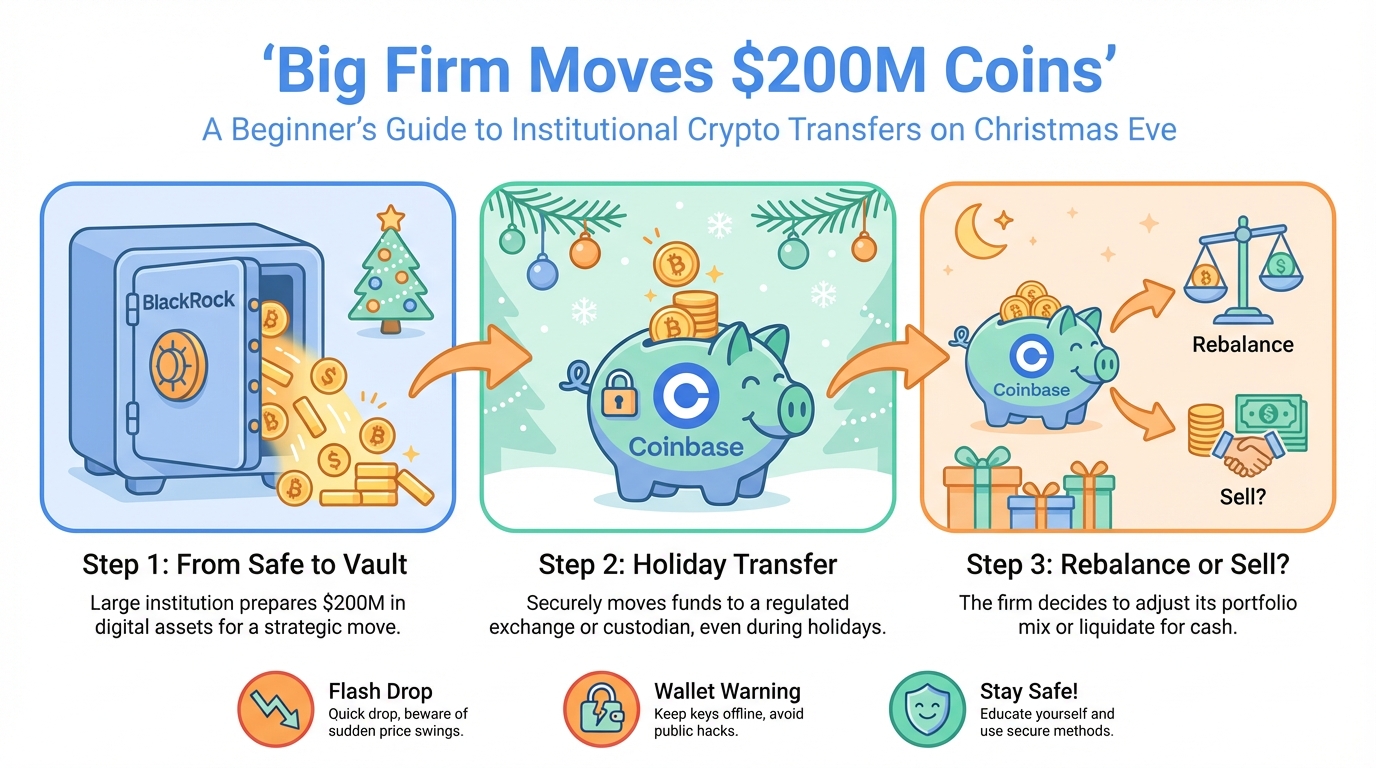
BlackRock Transfers $200M in BTC and ETH to Coinbase on Christmas Eve
Jon: One key story involves BlackRock, a major asset management firm, moving about 2,292 Bitcoin (BTC) and 9,976 Ethereum (ETH) to Coinbase Prime on December 24, 2025. This transfer was worth over $200 million at the time. Fact-checking against recent reports, this seems accurate based on on-chain data from blockchain explorers, and it aligns with institutional activities during low-liquidity holiday periods. It’s not necessarily a sell-off; it could be routine rebalancing or custody adjustments.
Lila: Okay, so BlackRock is handling these digital assets like traditional investments. But what are Bitcoin and Ethereum exactly? And why does moving them to Coinbase matter?
Jon: Good questions. Bitcoin is a decentralized digital currency using a proof-of-work consensus mechanism, where computers solve complex puzzles to validate transactions and secure the network, with a fixed supply of 21 million coins. It’s a Layer 1 blockchain, meaning it’s the base network without relying on others. Ethereum, on the other hand, uses proof-of-stake, where validators stake their coins to participate in securing the network, making it more energy-efficient since the Merge upgrade in 2022. Ethereum is also a Layer 1 but supports smart contracts, enabling applications like decentralized finance (DeFi), which is basically financial services without intermediaries.
Lila: So, proof-of-work is like mining for gold with energy-intensive tools, while proof-of-stake is more like voting with your shares. Got it. What about governance or regulations here?
Jon: Exactly. Governance in Bitcoin is community-driven through proposals and miner consensus, while Ethereum has a more formal process via improvement proposals. Regulatorily, this transfer shows how institutions like BlackRock are using custodians like Coinbase, which must comply with rules from bodies like the SEC in the US. It highlights growing adoption but also risks, as cryptocurrency involves significant uncertainty and potential for volatility.
Lila: So what does this change for users, developers, or society?
Jon: For users, it means more secure custody options through institutional-grade services, reducing some risks of self-management. Developers benefit from increased liquidity and integration tools on platforms like Coinbase. Societally, it points to blockchain’s role in modernizing finance, but with the reminder that market movements can amplify during low-activity times, emphasizing the need for caution.
Binance BTC/USD1 Pair Flash Crash to $24,100 on Christmas Day
Jon: Another event was a flash crash on Binance’s BTC/USD1 perpetual futures pair on December 25, 2025, where the price dropped over 70% to $24,100 before quickly recovering. This was isolated to the USD1 stablecoin pair, linked to World Liberty Financial, and didn’t affect major pairs like BTC/USDT. Fact-checking confirms this as a liquidity issue in a niche market, consistent with reports of thin trading during holidays.
Lila: A flash crash sounds dramatic. What’s a perpetual futures pair, and why did it happen only there?
Jon: Perpetual futures are contracts that let you bet on an asset’s price without an expiration date, settled in stablecoins like USD1 here. USD1 uses an algorithmic stabilization mechanism to maintain its peg to the US dollar, unlike overcollateralized stablecoins such as USDT or USDC. This happened on Binance, a centralized exchange, due to low liquidity—few buyers and sellers—in that specific pair. It’s not on a blockchain like a decentralized exchange (DEX) such as Uniswap, which operates on Ethereum’s Layer 1.
Lila: So, it’s like a sudden empty highway causing a traffic jam? What about the chain type and consensus?
Jon: Apt analogy. Binance uses its own infrastructure, but the underlying assets like BTC are on their native Layer 1 chains with proof-of-work. Governance for stablecoins like USD1 involves the issuing entity’s rules, which can be less transparent. Regulatorily, this raises questions about oversight for emerging stablecoins, especially those with political ties, as it could fall under frameworks like the EU’s MiCA for market stability.
Lila: Does this change anything for users or developers?
Jon: For users, it underscores the risks of trading in low-liquidity instruments, where prices can swing wildly—cryptocurrency is inherently uncertain. Developers might focus on building more robust liquidity pools in DeFi to avoid such issues. Societally, it highlights the need for better education on exchange risks and potential for regulatory scrutiny to protect retail participants.
Trust Wallet Hack Drains $7M from Users Amid Chrome Exploit
Jon: On December 26, 2025, Trust Wallet, a non-custodial mobile wallet, saw users lose $7 million due to a vulnerability in its Chrome browser extension. This wasn’t a breach of the wallet’s core protocol but an exploit via malicious extensions. Fact-checking aligns with reports of no direct impact on the wallet’s security model, but it exposed integration risks.
Lila: Non-custodial means users control their own keys, right? How does this exploit work?
Jon: Yes, in non-custodial wallets like Trust, you manage your private keys via a seed phrase, using hierarchical deterministic (HD) derivation for generating addresses. It supports multiple chains, including Ethereum (Layer 1, proof-of-stake) and Binance Smart Chain (a Layer 1 compatible with Ethereum’s virtual machine). The exploit likely used Web3 APIs to trick users into approving transactions, contrasting with hardware wallets that keep keys offline.
Lila: So, it’s like leaving your house key under the mat versus in a safe. What governance or regulatory angles?
Jon: Precisely. Governance in these ecosystems is decentralized, but wallet providers like Trust (backed by Binance) handle updates. Regulatorily, this could prompt calls for better consumer protections, similar to data privacy laws, emphasizing user education on security practices amid rising hacks.
Lila: What does this mean for users, developers, or society?
Jon: Users face direct risks of fund loss, reinforcing the importance of cold storage. Developers should prioritize secure integrations and audits. Societally, it shows blockchain’s security is only as strong as its weakest link, with significant uncertainties in protecting against exploits.
Hong Kong Advances Virtual Asset Trading and Custody Regulations
Jon: Hong Kong’s authorities released consultation conclusions on December 25, 2025, for regulating virtual asset (VA) trading and custody, focusing on licensing, asset segregation, and cybersecurity. This builds on prior rules for stablecoins and over-the-counter services, aiming to make Hong Kong a hub for compliant innovation.
Lila: Virtual assets are things like cryptocurrencies, right? How does this differ from other places?
Jon: Yes, VAs include tokens on blockchains like Ethereum. The proposals require proofs-of-reserves (PoR), where custodians verify holdings transparently. This applies to platforms on EVM-compatible chains (Ethereum Virtual Machine, allowing smart contracts). It’s a Layer 1 focus but could extend to Layer 2 solutions, which are scaling layers on top of base chains for faster, cheaper transactions using mechanisms like optimistic rollups.
Lila: Like adding express lanes to a highway. Consensus and governance?
Jon: Spot on. Consensus varies by chain, but regulations emphasize centralized oversight for custodians. Governance implications include higher barriers for smaller players, potentially favoring established ones, while aligning with global standards like Singapore’s or the EU’s MiCA for investor protection.
Lila: So, changes for users and society?
Jon: Users get more protections but might see higher costs. Developers gain clearer rules for building compliant apps. Societally, it promotes responsible adoption, balancing innovation with risks like non-compliance penalties.
| Story Topic | Key Impact | Relevance to Users/Developers/Society |
|---|---|---|
| BlackRock BTC/ETH Transfer | Highlights institutional integration and custody practices | Encourages secure storage options; shows finance evolution with risks |
| Binance Flash Crash | Exposes liquidity risks in niche trading pairs | Warns of volatility; pushes for better DeFi liquidity tools |
| Trust Wallet Hack | Reveals vulnerabilities in wallet extensions | Stresses security best practices; impacts trust in tools |
| Hong Kong Regulations | Advances licensing and protections for VA services | Fosters compliant innovation; balances growth with safeguards |
Jon: Overall, these stories point to a maturing ecosystem where institutional involvement, security challenges, and regulatory frameworks are shaping blockchain’s infrastructure. The trend is toward greater integration with traditional systems, but with persistent uncertainties in technology and governance.
Lila: Thanks for explaining. It reminds me to approach this space cautiously, stay informed on regulations, and always do my own research without assuming any outcomes.
👨💻 Author: SnowJon
A researcher sharing practical insights on Web3 and AI based on academic study and real-world observation.
His focus is on translating complex technologies into clear, responsible explanations for a general audience.
*AI tools may assist drafting, but all factual verification and editorial judgment are performed by the author.*
⚠️ Risk & Education Notice
Cryptocurrency and blockchain technologies involve legal, technical, and financial risks.
This article is provided strictly for educational and informational purposes and does not constitute financial advice.
Readers are encouraged to conduct independent research and comply with local laws and regulations.