
Why is Bitcoin stuck at $90K? Uncover the hidden inflation data error keeping prices flat. Macro factors explained.#Bitcoin #Inflation #CryptoMarket
Quick Video Breakdown: This Blog Article
This video clearly explains this blog article.
Even if you don’t have time to read the text, you can quickly grasp the key points through this video. Please check it out!
If you find this video helpful, please follow the YouTube channel “BlockChainBulletin,” which delivers daily Crypto news.
https://www.youtube.com/@BlockChainBulletins
Read this article in your native language (10+ supported) 👉
[Read in your language]
Bitcoin Stalled at $90,000: Unpacking the “Perfect” Inflation Report’s Hidden Data Flaw
Jon: Hey Lila, have you seen this latest piece from CryptoSlate? It’s titled “Bitcoin stalled at $90,000 because that “perfect” inflation report hides a massive data error.” Basically, it dives into why Bitcoin’s price has been hovering around $90,000 despite what looked like stellar economic news—inflation dropping to 2.7% and the Fed cutting rates three times. The twist? The CPI data might be contaminated, leading to misleading signals that aren’t pumping the crypto market as expected.
Lila: Oh, interesting. I thought lower inflation and rate cuts were supposed to be rocket fuel for Bitcoin. So, what’s the catch here?
Jon: Exactly. On the surface, it seems perfect: inflation cooling means easier money, which historically boosts risk assets like Bitcoin. But the article points out issues like 1.9% real yields still being high, depleted order books, and this big data error in the inflation report. It’s like the market’s celebrating a win, but there’s a typo in the scorecard.
Lila: Why does this matter? For someone like me who’s trying to understand crypto without getting lost in the weeds, how does a flawed inflation report stall Bitcoin at $90,000?
Jon: Great question. It matters because Bitcoin’s price isn’t just about hype or tech—it’s deeply tied to macroeconomics. If investors think the inflation data is off, they hesitate, leading to thin trading volumes and no breakout. Think of it as the market’s trust meter dipping, keeping prices stuck. We’ll unpack this more, but first, let’s look at the problem behind it.
Jon: So, the core issue here is what the article calls a “massive data error” in the CPI report. CPI, or Consumer Price Index, measures inflation by tracking price changes in a basket of goods. But if that data is contaminated—maybe from flawed collection methods or outliers—it paints a rosier picture than reality. This leads to Bitcoin stalling because traders expect more aggressive Fed actions based on “perfect” data, but when errors surface, confidence wanes. We’ve seen Bitcoin poke near $90,000 and retreat, with order books (those lists of buy/sell orders) looking depleted, meaning less liquidity to push prices up.
Lila: Contaminated data? That sounds vague. Can you clarify what that means in practice?
Jon: Sure. Imagine CPI as a giant accounting ledger for the economy. If someone’s been fudging the numbers—say, underreporting price hikes in housing or energy due to sampling errors— the whole ledger is off. The article suggests this error hides underlying pressures, so even with rate cuts, real yields (interest rates minus inflation) stay at 1.9%, which is high enough to make safer investments like bonds more appealing than volatile crypto. It’s like traffic on a highway: a “clear road” sign based on bad data leads to jams when reality hits.
Lila: Ah, the analogy helps. So, it’s not just Bitcoin being picky; it’s the market reacting to unreliable signals. That makes sense for why prices are stuck.
Jon: Precisely. And this ties into broader crypto dynamics—Bitcoin isn’t isolated; it’s influenced by these macro factors. Now, to really get it, let’s dive under the hood of how Bitcoin’s price mechanics interplay with economic data like this.
Under the Hood: How it Works
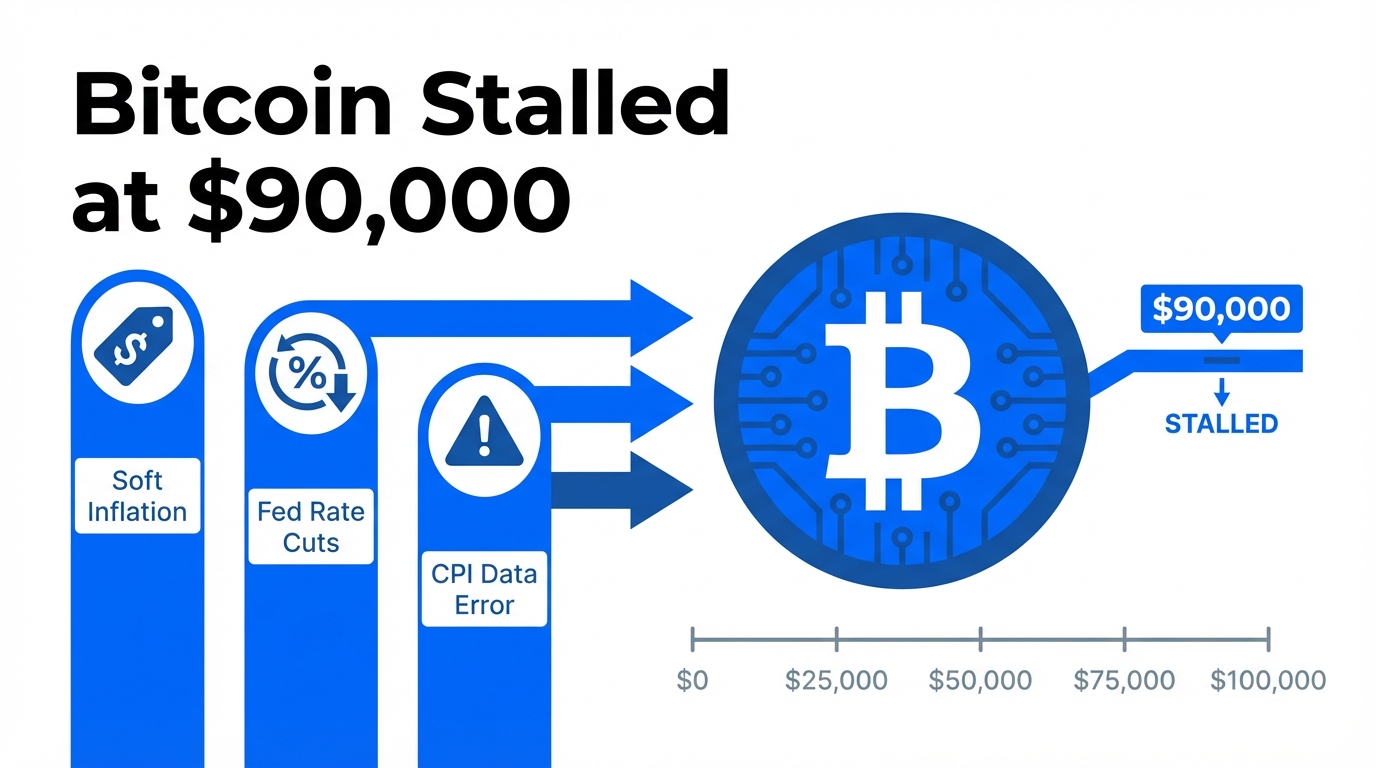
Jon: Alright, looking at this diagram, it illustrates how Bitcoin’s price is influenced by factors like inflation data, liquidity, and on-chain metrics. At its core, Bitcoin operates on a blockchain—a decentralized ledger secured by proof-of-work consensus. Miners compete to solve puzzles, adding blocks of transactions, which keeps the network secure. But price? That’s driven by supply-demand dynamics, amplified by external econ data. In this case, the “perfect” inflation report suggested low inflation, but the hidden error means actual inflation might be higher, eroding purchasing power and making Bitcoin’s nominal gains less impressive.
Lila: Proof-of-work— that’s the energy-intensive mining, right? But how does a data error in CPI directly mess with Bitcoin’s mechanics?
Jon: Spot on. Proof-of-work ensures scarcity—only 21 million Bitcoins ever. But price stalls when demand weakens. The error creates uncertainty: if CPI is off, Fed policies might tighten unexpectedly, scaring off buyers. On-chain, we see depleted order books and low inter-exchange flows, as per the article. It’s like a plumbing system with clogged pipes—liquidity can’t flow freely, pinning prices below $93,000.
Lila: Okay, that rephrases it nicely. So, for comparison, how does this stack up against, say, Bitcoin’s behavior in past inflation scenarios?
Jon: Good pivot. Let’s break it down in a table to compare nominal vs. inflation-adjusted Bitcoin prices, highlighting why this stall feels different.
| Metric | Nominal Price (2025) | Inflation-Adjusted (2020 Dollars) | Impact of Data Error |
|---|---|---|---|
| Peak Price | $90,000+ (stalled) | $99,848 max, but effectively lower | Hides true inflation, reducing real gains and demand |
| Liquidity Factor | Depleted order books | Adjusted yields at 1.9% deter risk | Uncertainty thins trading, no breakout |
| Historical Comparison (2021 Bull Run) | $69,000 peak | Higher real value due to lower inflation | No major data errors; cleaner macro signals |
Jon: As you can see, the data error amplifies the gap between what looks good on paper and real-world purchasing power. Bitcoin’s halving cycles normally boost scarcity, but macro glitches like this can override that.
Lila: That table clarifies a lot—it’s not just about the number on the ticker.
Lila: So who actually uses this? I mean, beyond traders staring at charts, how does understanding Bitcoin’s tie to inflation data benefit real people or developers?
Jon: Fair point. On the user side, Bitcoin serves as a hedge against inflation—when data is accurate, it’s a store of value like digital gold. Developers build on it for things like decentralized finance (DeFi) protocols or Lightning Network for fast payments, where economic stability affects adoption. Institutions use it in portfolios to diversify against fiat volatility. The technical benefit? Its immutable ledger means transactions are verifiable without trusting banks, which is huge in uncertain econ times. Worth watching how this evolves, but risks remain—volatility can swing both ways.
Lila: Got it. So, it’s more about resilience than quick wins.
Jon: Exactly. Now, if you’re curious to learn more hands-on, let’s talk an educational action plan. No financial moves here—just pure learning.
Jon: Start with Level 1: Research and Observation. Dive into whitepapers like Satoshi’s original Bitcoin paper—it’s a quick read on Bitcoin.org. Use explorers like Blockchain.com to track on-chain data, such as transaction volumes or hashrate, which show network health. Dashboards from Glassnode or CryptoQuant can reveal metrics like “underwater supply” mentioned in related articles, helping you spot patterns without any commitment.
Lila: Sounds straightforward. What about getting hands-on safely for Level 2?
Jon: For Level 2, try testnets. Bitcoin has a testnet where you can experiment with transactions using fake BTC—no real money involved. Tools like Electrum wallet let you set this up easily. It’s great for understanding mechanics like wallet addresses or simple scripts, mimicking real scenarios. Emphasize: this is for learning token mechanics and architecture, not trading. Experiment minimally to grasp concepts like consensus without risks.
Lila: Perfect—safe and educational.
Jon: To wrap up, this stall at $90,000 highlights Bitcoin’s strengths in scarcity and decentralization, but also its vulnerabilities to macro data flaws. The opportunity lies in its potential as a long-term asset, yet limitations like liquidity traps and external uncertainties persist. Industry analysts expect potential rebounds if data clears up, but it’s no sure thing.
Lila: Yeah, and remember, crypto’s volatile—prices can drop as easily as they rise. Always approach with caution and focus on understanding over speculation.
Jon: Well said. It’s a thoughtful space to explore, but stay informed and rational.
About the Authors
Jon is a Web3 researcher with over a decade in blockchain architecture. He’s built protocols for major DAOs and consults on token economics.
Lila is a developer advocate passionate about making crypto accessible. She bridges complex ideas to everyday learners through workshops and writing.
References
- Bitcoin stalled at $90,000 because that “perfect” inflation report hides a massive data error
- Official Bitcoin Website
- Why Bitcoin Price Can’t Clear $90K Even With “Perfect” Inflation – 99Bitcoins
- Fact check: Bitcoin never really hit $100,000 in 2025 when you apply real world data