
Did you know prediction markets are surging? Coinbase is making onchain forecasting mainstream, bringing transparency and efficiency to event outcomes.
—#Coinbase #PredictionMarkets #Blockchain
—
Quick Video Breakdown: This Blog Article
This video clearly explains this blog article.
Even if you don’t have time to read the text, you can quickly grasp the key points through this video. Please check it out!
If you find this video helpful, please follow the YouTube channel “BlockChainBulletin,” which delivers daily Crypto news.
https://www.youtube.com/@BlockChainBulletins
Read this article in your native language (10+ supported) 👉
[Read in your language]
Coinbase Expands Its Onchain Strategy as Prediction Markets Move Toward the Mainstream
⚠️ WARNING: Online gambling and casino-related activities are illegal or strictly regulated in many jurisdictions (including Japan). This article is for informational purposes regarding blockchain technology only. We do not recommend or endorse participation in gambling activities.
Jon: Hey Lila, have you caught the latest buzz from Coinbase? They’re doubling down on their onchain strategy, especially with prediction markets going mainstream. According to recent news, Coinbase just announced the acquisition of The Clearing Company, a startup focused on event-based trading systems. This move is set to scale their prediction markets on the blockchain, integrating it into what they’re calling the “Everything Exchange.” It’s all about blending crypto with regulated betting on real-world outcomes, like elections or sports events.
Lila: Oh, interesting. I’ve seen headlines about prediction markets exploding in 2025, with platforms like Polymarket and Kalshi making waves. But Coinbase jumping in big time? That sounds like a shift. Why does this matter?
Jon: It matters because it’s bridging traditional finance with blockchain in a way that’s practical and regulated. Prediction markets let people bet on future events—think of them as crowdsourced forecasts where the market price reflects the probability of something happening. Coinbase’s push, including this acquisition, is expected to bring onchain event trading to more users. For context, recent reports show prediction markets leveraged CFTC oversight to go mainstream this year, with volumes surging. One article noted a potential tax loophole under new laws that could steer gamblers toward these blockchain platforms, reducing IRS bills. But remember, this is about understanding the tech, not diving in headfirst.
Lila: Got it. So it’s not just hype—there’s real regulatory and tech evolution here. But let’s dig into the why behind it. What’s the problem Coinbase is trying to solve with this onchain expansion?
Jon: The core problem is fragmentation in financial systems. Traditional prediction markets, like those on betting apps, are often siloed—centralized, prone to manipulation, and limited by geography or regulations. Onchain strategies aim to fix that by moving everything to blockchain, where transparency and decentralization can make markets more efficient and accessible. But it’s not perfect; scalability and regulatory hurdles have kept them niche until now.
Lila: Fragmentation—can you break that down? Like, why is that such a big deal for something like prediction markets?
Jon: Sure, think of it like traffic in a big city. In the old system, each neighborhood has its own roads, tolls, and rules—getting from point A to B means dealing with checkpoints, delays, and maybe even getting lost. That’s traditional finance: banks, brokers, and betting houses all operating in their own lanes, with high fees and barriers. Onchain prediction markets are like building a superhighway system on blockchain—everyone uses the same transparent road, powered by smart contracts that automate settlements. No middlemen slowing things down, and the “traffic” (data) is verifiable by anyone. Coinbase’s strategy is essentially paving more of that highway, especially with acquisitions like The Clearing Company to handle the complex clearing of these event-based trades.
Lila: Ah, the traffic analogy clicks. So it’s about efficiency and trust. No wonder they’re pushing this in 2025, with crypto pullbacks testing strategies but prediction markets still gaining traction.
Under the Hood: How it Works
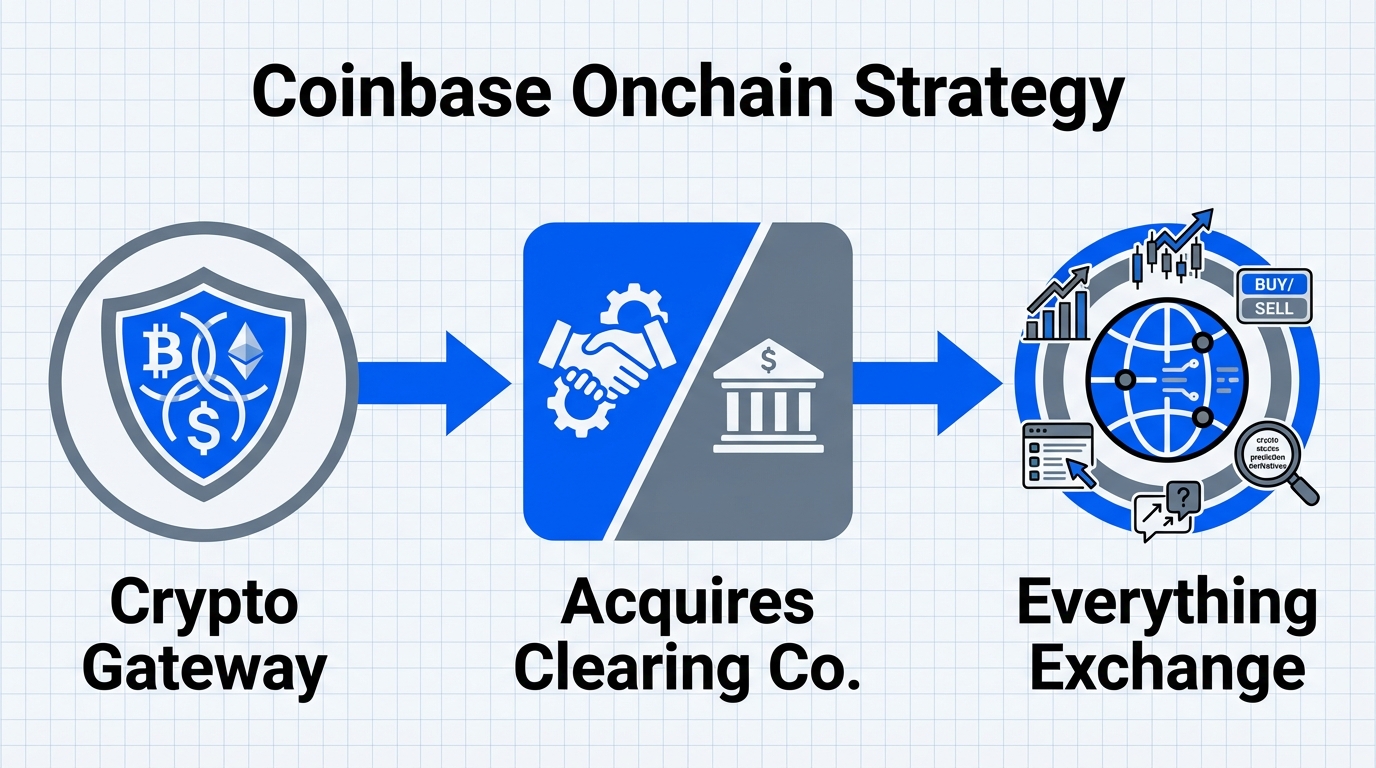
Jon: Alright, let’s pop the hood on this. At its core, Coinbase’s onchain strategy for prediction markets uses blockchain to create decentralized, verifiable betting pools. Users deposit crypto into smart contracts that define the event—like “Will Bitcoin hit $100K by end of 2025?”—and the contract automatically pays out based on the outcome, verified by oracles (trusted data feeds). The acquisition of The Clearing Company brings in tech for scaling this, including regulated clearing mechanisms to handle disputes and settlements onchain.
Lila: Oracles? You’re saying that’s like an external referee feeding real-world data into the blockchain?
Jon: Exactly—blockchains are isolated from the outside world, so oracles bridge that gap. For token mechanics, many of these markets use stablecoins for bets to avoid volatility, but some integrate native tokens like those from Polymarket for governance or fees. Coinbase is building on Ethereum-compatible layers for low-cost transactions, aiming for what they call a “unified, multi-asset” exchange. It’s not just crypto; they’re blending in stocks and prediction markets too.
Lila: Makes sense. But how does this compare to traditional betting systems? A table might help visualize the differences.
Jon: Good call. Here’s a quick comparison:
| Aspect | Traditional Prediction Markets | Coinbase’s Onchain Approach |
|---|---|---|
| Centralization | Run by central entities like betting companies, prone to single points of failure. | Decentralized on blockchain, with smart contracts handling logic automatically. |
| Transparency | Limited; users trust the operator’s books. | Fully auditable on the blockchain; every transaction is public. |
| Fees and Speed | High fees, slow settlements due to manual processes. | Lower fees via layer-2 scaling; instant settlements via smart contracts. |
| Regulation | Varies by jurisdiction, often restricted. | Leveraging CFTC oversight for mainstream adoption, as seen in 2025 expansions. |
| Risks | Operator fraud or insolvency. | Smart contract bugs or oracle failures, but mitigated by audits. |
Lila: That table really highlights the trade-offs. Onchain sounds more efficient, but those risks like smart contract bugs are worth noting.
Jon: Absolutely. And with Coinbase’s push, they’re integrating veterans from Polymarket and Kalshi to refine this—focusing on secure, scalable architecture.
Lila: So who actually uses this? Beyond just bettors, what’s the real-world application?
Jon: Great question. On the user side, it’s for anyone interested in forecasting events—researchers, analysts, or even businesses hedging risks, like predicting market trends without the hype of gambling. Technically, it provides accurate probability data; markets have historically outperformed polls in elections because money’s on the line. For developers, Coinbase’s onchain tools let them build apps on top, using APIs for integrating prediction contracts into DeFi or gaming. Think insurance protocols that payout based on event outcomes, all automated. The benefit is in the data integrity—blockchain ensures tamper-proof records, which is huge for sectors like supply chain or finance needing reliable forecasts.
Lila: So it’s not just betting; it’s a tool for better decision-making. That shifts my perspective from pure speculation to practical tech.
Jon: Precisely. And with 2025 seeing DraftKings and others entering the space, it’s becoming a broader ecosystem.
Lila: If someone’s curious to learn more hands-on, what’s a safe way to start? No financial risks, just education.
Jon: Let’s break it into levels. For Level 1: Research and Observation. Start by reading Coinbase’s official blog or whitepapers on their prediction markets. Use blockchain explorers like Etherscan to track sample contracts—search for addresses from public demos. Dashboards on sites like Dune Analytics can show market volumes without you interacting. It’s all about observing the mechanics in real-time.
Lila: That sounds low-pressure. What about Level 2, getting hands-on safely?
Jon: For that, dive into testnets. Ethereum’s Sepolia testnet or Base (Coinbase’s layer-2) have free faucets for fake ETH. You can deploy simple smart contracts mimicking prediction markets using tools like Remix IDE—no real money involved. Experiment with creating a mock event contract, simulate outcomes with test oracles, and see how settlements work. It’s pure learning: understand gas fees, contract interactions, and potential pitfalls like reentrancy attacks, all in a sandbox. Risks remain zero since it’s testnet.
Lila: Perfect—emphasizing experimentation without the hype.
Jon: To wrap up, Coinbase’s onchain expansion into prediction markets is a solid step toward mainstream blockchain adoption. It offers transparent, efficient forecasting tools, but limitations like regulatory changes and tech risks persist. Worth watching as the industry evolves.
Lila: Agreed, Jon. But let’s remind everyone: crypto and markets like this are volatile and uncertain. Always research thoroughly, and remember, this is about understanding tech, not chasing gains.
Jon: Well said. It’s an exciting space, but approach with eyes wide open.
—
About the Authors
Jon is a seasoned Web3 researcher with over a decade in blockchain architecture. He consults on decentralized systems and enjoys demystifying complex tech without the fluff.
Lila is a developer advocate focused on making crypto accessible. She bridges the gap between experts and newcomers, ensuring clarity in every explanation.
—
References
- Coinbase Expands Its Onchain Strategy as Prediction Markets Move Toward the Mainstream
- Official Coinbase Website
- Coinbase doubles down on prediction markets with deal for The Clearing Company | Reuters
- Coinbase (COIN) agrees to buy The Clearing Company to deepen prediction markets push – CoinDesk
- Prediction Markets Leveraged CFTC Oversight to Go Mainstream in 2025 | PYMNTS.com