
JPMorgan is exploring Bitcoin trading for institutions! What does this major move mean for crypto market stability and adoption?
—#JPMorganCrypto #BitcoinTrading #InstitutionalCrypto
—
Quick Video Breakdown: This Blog Article
This video clearly explains this blog article.
Even if you don’t have time to read the text, you can quickly grasp the key points through this video. Please check it out!
If you find this video helpful, please follow the YouTube channel “BlockChainBulletin,” which delivers daily Crypto news.
https://www.youtube.com/@BlockChainBulletins
Read this article in your native language (10+ supported) 👉
[Read in your language]
JPMorgan Weighs Bitcoin Trading for Institutional Clients
Jon: Hey Lila, have you seen the latest buzz in the crypto world? Bloomberg and other outlets are reporting that JPMorgan Chase, the biggest bank in the US with over $4 trillion in assets, is exploring ways to offer Bitcoin and crypto trading services directly to its institutional clients. This comes from sources close to the matter, and it’s all about spot trading and derivatives for big players like hedge funds and pensions. No official confirmation yet, but it’s stirring things up.
Lila: Whoa, Jon, that’s interesting. I remember JPMorgan’s CEO Jamie Dimon has been pretty vocal against Bitcoin in the past, calling it a fraud or something. So, what’s changed? And why is a traditional bank like this dipping toes into crypto now?
Jon: Fair point. Dimon has indeed been skeptical, but the bank itself has been quietly building in blockchain for years—they even have their own JPM Coin for internal settlements. This move seems driven by growing institutional demand, especially with regulatory clarity improving in the US. Reports from CoinDesk and The Block suggest they’re looking at products that could let clients trade Bitcoin without the bank taking on too much direct exposure. Think of it as Wall Street finally acknowledging crypto’s staying power.
Lila: Okay, that makes sense on a surface level. But why does this matter? Is it just another headline, or is there something deeper for the average person interested in crypto?
Jon: It matters because it signals a shift in how big money views Bitcoin. Institutional adoption could bring more liquidity and stability to the market—Bitcoin’s price has hovered around $90,000 lately, with some analysts predicting boosts from moves like this. But remember, it’s not hype; it’s about understanding the mechanics of how traditional finance might integrate with decentralized assets. Let’s dive into why this is happening and what it could mean.
Lila: Alright, lead the way. What’s the core problem here that JPMorgan is trying to solve?
Jon: The problem boils down to access and trust in a volatile space. Institutional investors—think pension funds managing billions—want exposure to Bitcoin’s potential as a store of value or hedge against inflation, but they’re wary of the risks. Traditional banking doesn’t easily handle crypto’s decentralized nature; there’s no central authority, and custody issues abound. Plus, regulations have been murky, making banks hesitant to dive in.
Lila: Murky regulations? Can you clarify that? And maybe give an analogy to make it relatable?
Jon: Sure. Imagine the financial world as a massive highway system. Traditional assets like stocks and bonds have well-paved roads with speed limits, toll booths (regulators), and service stations (banks). Crypto, especially Bitcoin, is like an off-road trail—exciting, but bumpy, with no guardrails and potential pitfalls like hacks or market swings. Institutions want to drive on that trail but need a sturdy vehicle from a trusted mechanic like JPMorgan to avoid getting stuck. The problem is bridging that gap without violating rules or exposing the bank to undue risk. Reports indicate JPMorgan is eyeing this amid competitors like Goldman Sachs already offering similar services.
Lila: Got it—that analogy helps. So, it’s about making crypto feel as safe as traditional investing for the big leagues.
Under the Hood: How it Works
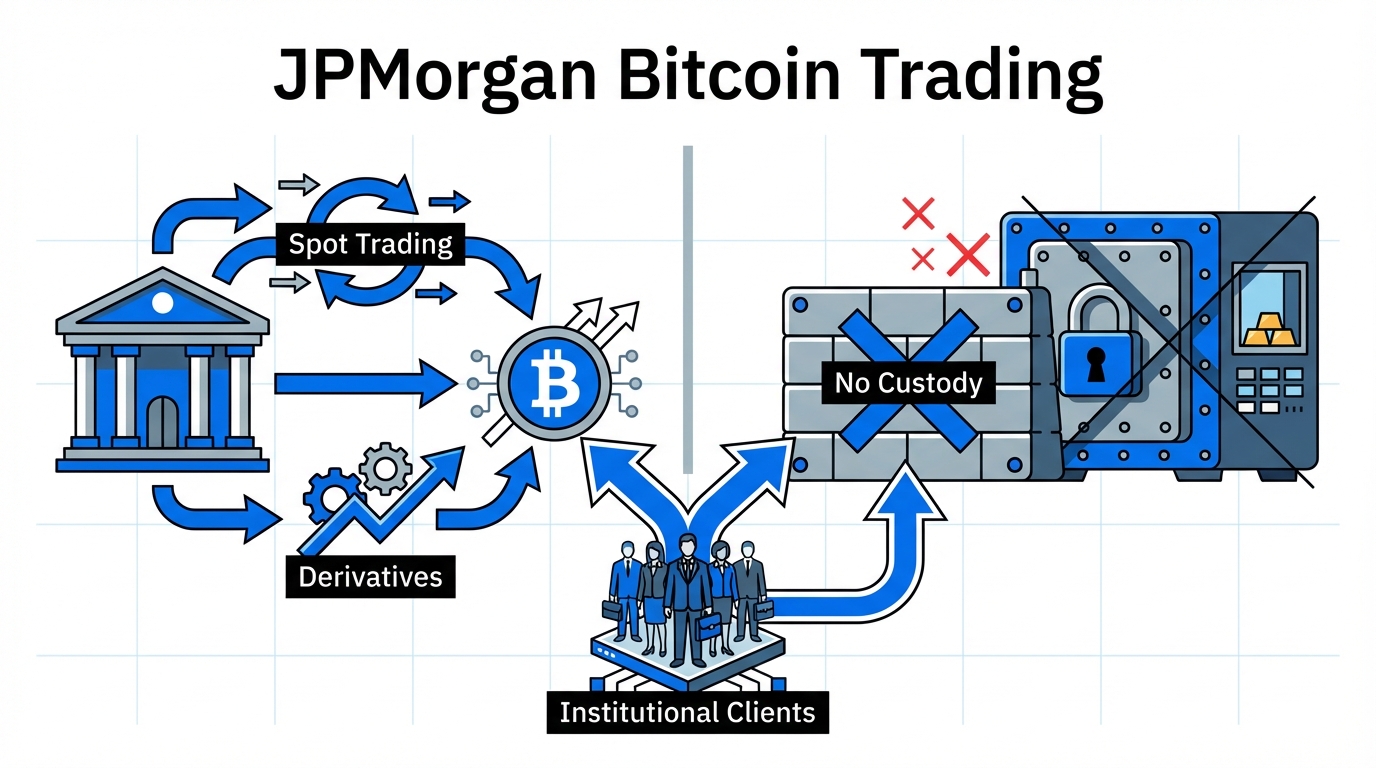
Jon: Exactly. Now, let’s peel back the layers. If JPMorgan rolls this out, it’d likely involve a trading desk handling spot Bitcoin trades—buying and selling the actual asset—and derivatives like futures or options, which are bets on price movements without owning the underlying crypto. This builds on their existing Onyx blockchain platform, which already processes billions in transactions. The key is custody: they’d use regulated custodians to hold the Bitcoin securely, complying with SEC and other rules.
Lila: Custody? Like a digital vault? And how does this differ from what retail investors do on exchanges?
Jon: Spot on. Custody means safely storing the private keys that control the Bitcoin. For institutions, it’s not just an app wallet; it’s enterprise-grade with multi-signature setups and insurance. Unlike retail, where you might use Coinbase directly, this would be integrated into JPMorgan’s ecosystem—clients could trade crypto alongside stocks without leaving the bank’s platform. It’s all about risk management: hedging positions, ensuring liquidity, and using blockchain for transparent settlements.
Lila: Okay, rephrasing to confirm: It’s like upgrading from a personal safe to a bank vault with armed guards for your digital gold?
Jon: Precisely. To illustrate the differences, here’s a quick comparison between traditional institutional trading and this potential crypto integration.
| Aspect | Traditional Finance | JPMorgan’s Potential Crypto Trading |
|---|---|---|
| Asset Handling | Centralized exchanges for stocks/bonds, with clearing houses. | Blockchain-based, with custodians for Bitcoin keys. |
| Risk Management | Regulated derivatives like options on NYSE. | Crypto derivatives, possibly via CME futures, with bank oversight. |
| Settlement Speed | T+2 days for stocks. | Near-instant on blockchain, reducing counterparty risk. |
| Regulatory Compliance | Strict SEC rules, audited regularly. | Emerging rules, but bank ensures KYC/AML for clients. |
Jon: This table highlights how JPMorgan could blend the best of both worlds—traditional reliability with crypto’s efficiency. Of course, it’s still exploratory, as per the reports.
Lila: That table is super helpful. So who actually uses this? I mean, beyond the headlines, what are the real-world applications?
Jon: Great question. Primarily, hedge funds and pension managers looking to diversify portfolios. For instance, a fund might allocate 1-5% to Bitcoin as an inflation hedge, using JPMorgan’s desk for seamless trading. On the technical side, developers in fintech could build apps that integrate with this, like automated trading bots leveraging blockchain data. Users benefit from increased market depth—more institutions mean tighter spreads and less volatility over time. It’s not about quick riches; it’s about maturing the ecosystem.
Lila: And for everyday developers or learners, how does this open doors?
Jon: Exactly—it could inspire more hybrid finance tools. Think decentralized apps (dApps) that connect to institutional liquidity pools, enhancing DeFi protocols without the wild west feel.
Lila: Alright, this is fascinating. If someone’s new to this, what’s an educational action plan? How can they learn more without jumping into risks?
Jon: Let’s break it down into levels. Start with Level 1: Research and Observation. Dive into whitepapers from Bitcoin.org or JPMorgan’s Onyx reports. Use blockchain explorers like Blockchain.com to track Bitcoin transactions—see how blocks are mined and confirmed. Follow reputable news like CoinDesk for updates on institutional moves. It’s all about building knowledge without any financial commitment.
Lila: Sounds safe. And for hands-on? Level 2?
Jon: Level 2: Testnet and Hands-on Learning. Experiment on Bitcoin’s testnet—it’s a sandbox where you can simulate transactions with fake BTC. Tools like Electrum wallet let you play around safely. Or, if you’re into coding, build a simple script using libraries like python-bitcoinlib to interact with the blockchain. Emphasize: this is for learning mechanics, not real trading. Risks remain in live environments, so stick to testnets to understand things like transaction fees and confirmations.
Lila: Perfect—no pressure, just exploration.
Jon: To wrap up, this JPMorgan news represents a potential milestone in crypto’s mainstreaming. It could bring more legitimacy and tools for efficient trading, but limitations persist—like regulatory hurdles and Bitcoin’s inherent volatility. Worth watching how it unfolds.
Lila: Absolutely. Remember, folks, crypto markets are unpredictable—prices can swing wildly, so approach with caution and focus on education over speculation.
Jon: Well said. It’s an evolving space; stay informed and think long-term.
References
- JPMorgan Weighs Bitcoin Trading for Institutional Clients
- JPMorgan Onyx Official Site
- JPMorgan Is Exploring Crypto Trading for Institutional Clients – Bloomberg
- JPMorgan Weighs Crypto Trading for Institutions – CoinDesk
- JPMorgan Weighs Offering Institutional Crypto Trading – The Block