
Are your stablecoins truly stable? Terraform’s $4B lawsuit against Jump Trading reveals how ‘shadow trading’ may prop up prices.#Stablecoin #ShadowTrading #Terraform
Quick Video Breakdown: This Blog Article
This video clearly explains this blog article.
Even if you don’t have time to read the text, you can quickly grasp the key points through this video. Please check it out!
If you find this video helpful, please follow the YouTube channel “BlockChainBulletin,” which delivers daily Crypto news.
https://www.youtube.com/@BlockChainBulletins
Read this article in your native language (10+ supported) 👉
[Read in your language]
Terraform’s $4 Billion Jump Lawsuit Exposes the Hidden “Shadow Trading” That May Be Artificially Holding Up Stablecoin Prices
👋 Hello, Crypto Curious! Still navigating the wild waves of the blockchain sea? If you’ve ever wondered why stablecoins seem as steady as a rock in a storm, buckle up—this one’s a doozy. We’re diving into the explosive $4 billion lawsuit filed by Terraform Labs’ bankruptcy administrator against Jump Trading. It’s not just courtroom drama; it’s a peek behind the curtain of “shadow trading” that could be propping up stablecoin prices in ways that aren’t exactly transparent. Think of it as the crypto world’s version of finding out your “stable” diet soda has hidden sugars keeping it sweet.
Let’s break it down simply: Back in 2022, Terraform Labs’ TerraUSD (UST) stablecoin spectacularly collapsed, wiping out $40 billion in value and shaking the entire crypto market. Now, the folks winding down Terraform’s estate are suing Jump Trading, a Chicago-based firm, for allegedly manipulating markets, making secret deals, and profiting big time from the chaos. According to reports from sources like CryptoSlate and Bloomberg, Jump is accused of “shadow trading”—backroom incentives and manipulations that kept UST pegged to $1, not through genuine reserves but through shady props. This isn’t just about one failed project; it raises eyebrows about how other stablecoins might be maintaining their “stability” artificially, potentially impacting the broader cryptocurrency market’s trust and volatility.
Why does this matter? Stablecoins are the anchors of crypto—used for trading, lending, and even everyday payments. If their prices are being held up by invisible hands rather than real economic forces, it could mean bigger risks for everyone involved. Worth watching how this lawsuit unfolds, as it might force more transparency in an industry that’s often as opaque as a foggy blockchain. Understand the risks: Crypto is volatile, and revelations like this can send shockwaves. But hey, knowledge is power—let’s unpack this responsibly and with a dash of humor to keep things light.
The Problem (The “Why”)
Okay, picture this: You’re at a carnival, and there’s a game where you have to keep a balloon floating in the air by blowing into it. That’s your stablecoin peg—supposed to stay at $1 no matter what. But what if, instead of honest puffs of air, someone’s secretly tying strings to the ceiling or using hidden fans? That’s “shadow trading” in a nutshell: undisclosed deals and manipulations that artificially maintain that $1 value, often without the full cash reserves you’d expect.
Analogy time—think of stablecoins like the shock absorbers on your car. They’re designed to smooth out the bumpy ride of crypto volatility, keeping things pegged to a stable asset like the US dollar. But in the case of TerraUSD, it wasn’t backed by actual dollars in a vault; it relied on an algorithmic mechanism tied to its sister token, LUNA. Enter Jump Trading, allegedly propping it up through secret agreements. Reports suggest they lent $1.5 billion in LUNA tokens in 2021 to help maintain the peg during a depeg event, but with hidden incentives that let them profit massively when things went south. The lawsuit claims this wasn’t just help—it was manipulation, concealment, and self-dealing that accelerated the 2022 crash.
The bigger “why” here is trust. If stablecoins are the gateway for beginners dipping toes into crypto, discovering they’re potentially held up by shadow trades is like finding out your bank’s vault is full of IOUs instead of cash. This could artificially inflate prices across the market, leading to false confidence and bigger falls. Humorously put, it’s like realizing the wizard behind the curtain is just a guy with smoke and mirrors—entertaining, but not exactly reassuring for your portfolio’s stability.
Under the Hood: How it Works
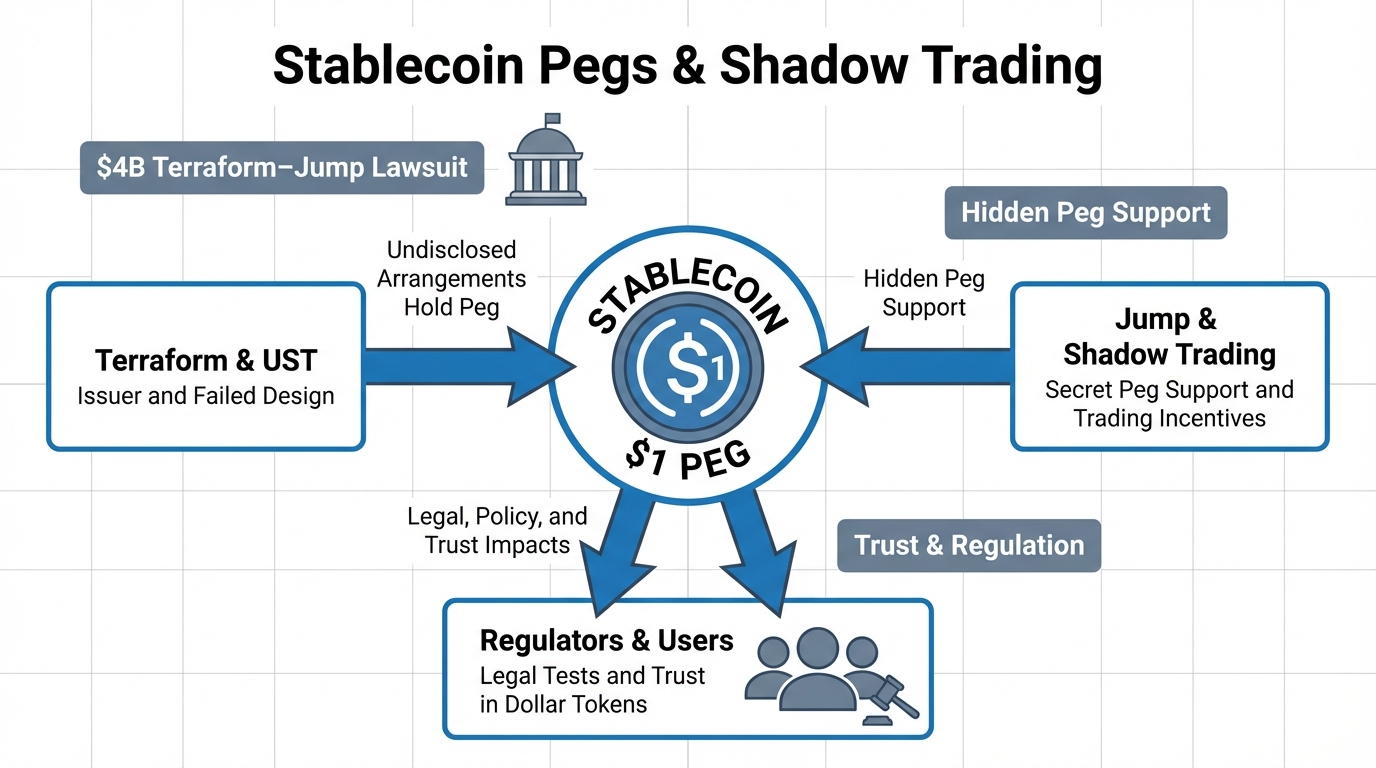
Alright, let’s pop the hood on stablecoins and this shadow trading business. At its core, a stablecoin like TerraUSD was meant to be an algorithmic stablecoin— no fiat reserves, just smart code balancing supply and demand between UST and LUNA. Burn one to mint the other, keeping the peg steady. Sounds elegant, right? Like a self-balancing seesaw. But when market pressure hits, that seesaw can tip wildly unless something—or someone—steps in.
Enter shadow trading: These are off-the-books arrangements where market makers like Jump Trading provide liquidity or props to maintain the peg, often in exchange for hidden perks. In Terraform’s case, the lawsuit alleges Jump had a secret deal from 2019, involving loans and trades that weren’t public. They reportedly manipulated UST’s price by trading massive volumes in ways that concealed the true instability. It’s not pure tech; it’s tech mixed with human (or corporate) intervention, which can distort market mechanics.
To explain the tech simply: Stablecoins generally use one of three mechanisms—fiat-collateralized (like USDT with actual dollars), crypto-collateralized (over-collateralized with other cryptos), or algorithmic (like UST, relying on arbitrage and incentives). Shadow trading blurs these lines by introducing undisclosed backroom deals, potentially violating the “trustless” ethos of blockchain. For beginners: Imagine a recipe where the ingredients are public, but the chef sneaks in extra spices without telling anyone—that’s how shadow trades can artificially “flavor” stability.
Now, for a clearer comparison, let’s stack TerraUSD’s model against some competitors. This table breaks down key aspects, highlighting why shadow trading might be a crutch for some.
| Stablecoin | Mechanism | Backing | Vulnerability to Shadow Trading | Market Cap (Approx. as of Dec 2025) |
|---|---|---|---|---|
| TerraUSD (UST) | Algorithmic | Tied to LUNA token arbitrage | High—alleged secret deals exposed in lawsuit | Negligible post-collapse |
| Tether (USDT) | Fiat-collateralized | Dollar reserves (audited) | Medium—past transparency issues | $100B+ |
| USD Coin (USDC) | Fiat-collateralized | Regulated reserves | Low—strong regulatory oversight | $50B+ |
| Dai (DAI) | Crypto-collateralized | Over-collateralized with ETH, etc. | Low—decentralized governance | $5B+ |
This comparison shows how algorithmic models like UST are more prone to external manipulations, while others rely on verifiable backing. The lawsuit highlights that even with tech, human elements can introduce risks—something to ponder as we explore stablecoin evolution.
Use Cases & Application
So, how does this all play out in the real world? For developers, understanding shadow trading exposes the underbelly of market making in DeFi. If you’re building a dApp that integrates stablecoins, this lawsuit is a wake-up call to audit liquidity providers. Technically, you could use tools like on-chain analytics (e.g., from Dune Analytics) to monitor trading volumes and detect unusual patterns that might indicate shadow props. A user benefits by choosing stablecoins with transparent reserves, reducing the risk of sudden depegs in trading or yield farming.
Scenario for a developer: You’re creating a lending protocol. Instead of blindly integrating UST-like assets, you now prioritize ones with audited reserves, ensuring your users’ collateral doesn’t vanish in a shadow trade scandal. For everyday users, it’s about safer remittances—sending money cross-border without the peg breaking due to hidden deals. Humorously, it’s like picking a bank that shows you the vault instead of one with a magician’s hat. In the broader market, this could lead to better regulations, making crypto more reliable for applications like micropayments or NFTs.
Educational Action Plan (How to Learn)
Focus on education here—no rushing into investments. Let’s level up your knowledge step by step.
Level 1 (Research/Observation): Start by tracking stablecoin charts on sites like CoinMarketCap or DefiLlama. Search for “TerraUSD depeg” to read whitepapers and post-mortems. Understand the risks by observing how pegs hold during market dips—it’s like watching a weather vane in a storm. Dive into the lawsuit details via reputable news like Bloomberg to see real market mechanics at play.
Level 2 (Testnet/Experience): Get hands-on without real stakes. Try MakerDAO’s testnet to mint DAI and see collateralization in action—emphasize using testnets for learning, not live networks with actual funds. Simulate a depeg scenario in a sandbox environment to grasp why shadow trading matters. Learn how it works by experimenting with small, educational amounts on platforms like Aave’s testnet, always prioritizing understanding over any potential gains.
Conclusion & Future Outlook
Whew, we’ve unpacked a lot—from the lawsuit’s bombshells to the tech behind stablecoins and the shadows lurking within. The potential rewards? More transparency could lead to robust, truly stable assets that bolster crypto’s utility. But risks abound: Volatility is crypto’s middle name, and lawsuits like this might trigger market dips or regulatory crackdowns. Always remember, the market can swing wildly, so approach with education first.
Looking ahead, if the lawsuit succeeds, it might set precedents for accountability, making “shadow trading” as outdated as floppy disks. Worth watching how this impacts stablecoin prices and the overall market—could be a turning point for trust in blockchain tech.

👨💻 Author: SnowJon (Web3 & AI Practitioner / Investor)
A researcher who leverages knowledge gained from the University of Tokyo Blockchain Innovation Program to share practical insights on Web3 and AI technologies. While working as a salaried professional, he shares research-driven insights and real-world experimentation across Web3 and AI.
His motto is to translate complex technologies into forms that anyone can use, fusing academic knowledge with practical experience.
*This article utilizes AI for drafting and structuring, but all technical verification and final editing are performed by the human author.
References
- Terraform’s $4 billion Jump lawsuit exposes the hidden “shadow trading” that may be artificially holding up stablecoin prices
- Terraform Labs Official Site
- Jump Trading Faces $4 Billion Terraform Administrator Suit – Bloomberg
- Terraform’s Bankruptcy Boss Sues Jump Trading for $4B Over Terra Crash – CoinDesk
- How Jump Trading Allegedly Propped Up TerraUSD – BeInCrypto