
Imagine Bitcoin forcing your commitments. New self-bribe code uses Taproot for sobriety wallets that pay your enemies if you fail.#BitcoinTech #SobrietyWallet #CryptoCovenants
Quick Video Breakdown: This Blog Article
This video clearly explains this blog article.
Even if you don’t have time to read the text, you can quickly grasp the key points through this video. Please check it out!
If you find this video helpful, please follow the YouTube channel “BlockChainBulletin,” which delivers daily Crypto news.
https://www.youtube.com/@BlockChainBulletins
Read this article in your native language (10+ supported) 👉
[Read in your language]
Bitcoin’s new “self-bribe” code lets you build sobriety wallets that pay your enemies if you break a promise
John: 👋 Hello, Diamond Hands! Still holding through the crypto winter… or should I say, the eternal bull run in disguise? If you’ve been glued to your screens watching Bitcoin’s latest tricks, you’re in for a treat today. We’re diving into this wild new “self-bribe” code that’s turning Bitcoin wallets into personal accountability machines. Think of it as your Bitcoin nagging you to stay sober – or else it pays your worst enemy.
Lila: Haha, John, let’s not scare them off. For the beginners out there, this isn’t some sci-fi horror. It’s a clever update using Bitcoin’s Taproot tech, which we’ve talked about before – remember, Taproot is like Bitcoin’s stealth mode upgrade from 2021 that makes transactions more private and flexible. According to recent reports from CryptoSlate, this self-bribe code lets you create “sobriety wallets.” You lock up your BTC with a promise, like staying sober for a month. Break it? A digital oracle (basically a trusted data feed) triggers the funds to auto-transfer to an “anti-charity” – you know, that cause you hate. Why does this matter? In a world where self-control is gold, this turns Bitcoin into a tool for real-life commitments, not just hodling. It’s innovative, but understand the risks – crypto is volatile, and tech like this is still emerging.
John: Spot on, Lila. Keeping up with these crypto innovations can be exhausting – new code, new use cases every day. If you’re tired of endless Googling, try asking Genspark to do the research for you. It’s like having an AI sidekick summarize the web in seconds. Worth watching how this evolves, but always DYOR.
The Problem (The “Why”)
Lila: Okay, let’s break down why this even exists. Humans are great at making promises but terrible at keeping them. Want to quit smoking, hit the gym, or yes, stay sober? Good intentions fade fast. Traditional methods like accountability apps or bets with friends work sometimes, but they’re flimsy – no real enforcement.
John: Enter the technical bottleneck: How do you make a binding commitment that’s trustless and automated? Analogy time – imagine you’re trying to diet, so you lock your fridge with a timer. But what if the timer could detect you sneaking a midnight snack via a smart sensor and automatically donate your grocery money to a fast-food chain you despise? That’s the self-bribe in a nutshell. In Bitcoin terms, before Taproot, scripts were limited – you couldn’t easily create conditional payouts based on external events without trusting a third party. This new code fixes that by leveraging Taproot’s enhanced scripting for covenants (fancy word for self-enforcing rules in transactions).
Lila: Love that fridge analogy, John – makes it relatable. Need to explain this concept to your boss or a skeptical friend? Use Gamma to generate a presentation in seconds. It’s a game-changer for visualizing these ideas without the hassle.
Under the Hood: How it Works.
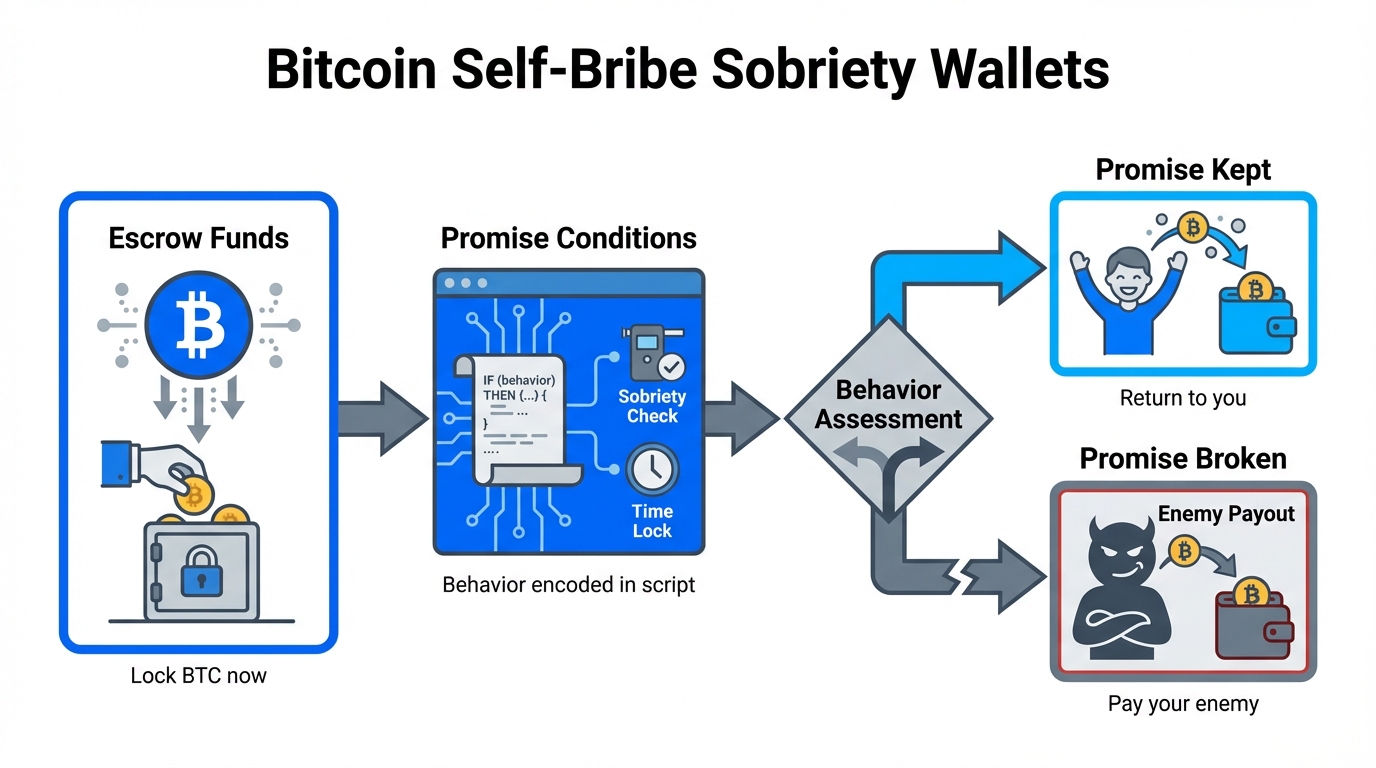
John: Alright, gearheads, let’s pop the hood. This self-bribe system builds on Bitcoin’s Taproot upgrade, which introduced Schnorr signatures and MAST (Merkelized Abstract Syntax Trees) – basically, ways to hide complex scripts until needed, keeping things efficient and private. The core is a “covenant,” which restricts how funds can be spent. You create a wallet where BTC is time-locked (using something like CheckLockTimeVerify opcode). Then, integrate a digital oracle – think Chainlink or a similar decentralized data provider – that monitors a trigger, like a breathalyzer API or a fitness tracker feed.
Lila: In simple terms, John? You set up the wallet with two paths: Success (you keep the funds after the lock period) or Failure (oracle signals “breach,” and funds auto-route to the pre-set address, like that anti-charity). No middleman holds your keys; it’s all on-chain enforcement. For tokenomics, there’s no new token here – it’s pure Bitcoin. The “bribe” is your own funds motivating you. Recent research shows this could use opcodes like OP_CAT (proposed for re-enabling in Bitcoin) to make scripts more powerful, allowing for dynamic conditions.
John: To make it crystal clear, let’s compare this to traditional setups. We’ll use a table to break down standard Bitcoin wallets versus these self-bribe sobriety wallets.
| Feature | Traditional Bitcoin Wallet | Self-Bribe Sobriety Wallet |
|---|---|---|
| Enforcement Mechanism | Manual – you control spends freely | Automated via scripts and oracles |
| Commitment Strength | Weak – relies on willpower | Strong – financial penalty enforced on-chain |
| Privacy | Basic, with Taproot improvements | Enhanced via hidden scripts (MAST) |
| Use Case Flexibility | Primarily storage and transfer | Personal commitments, like sobriety or goals |
| Risks | Hacking, loss of keys | Oracle failures, irreversible penalties |
Lila: See? It’s not just hype – this adds real utility to Bitcoin’s mechanics.
Use Cases & Application
John: Now, the fun part: real-world apps. For developers, this means building dApps on Bitcoin with commitment protocols. Imagine coding a fitness app where users lock BTC, and a wearable oracle verifies workouts – fail, and funds go to a rival gym chain. Users benefit technically by having trustless motivation; no need for centralized apps that could rug you.
Lila: Beyond sobriety, think debt repayment: Lock funds that pay creditors automatically if you miss a milestone. Or environmental pledges – break your carbon footprint goal, and BTC goes to a polluter you hate. It’s witty self-sabotage for good. Developers can experiment with open-source tools like the Bitcoin Script language extensions. Want to share this tech update on TikTok? Turn this text into a viral video using Revid.ai.
Educational Action Plan (How to Learn)
John: We’re all about education here, not hype. Focus on learning the tech, not rushing in.
Lila: Level 1 (Research/Observation): Start by reading the whitepaper on Taproot or recent proposals like OP_CAT on Bitcoin’s GitHub. Track related projects via explorers like Blockstream.info. Watch for price impacts – BTC’s volatility means even tech news can move markets, but observe without jumping in.
John: Level 2 (Testnet/Experience): Dive hands-on with Bitcoin Testnet. Use libraries like bdk (Bitcoin Dev Kit) to script a simple covenant. Emphasize testnets or small amounts for learning – simulate a self-bribe with fake funds. Tools like Regtest mode let you experiment safely. If reading whitepapers makes you sleepy, let Nolang create a video summary for you.
Conclusion & Future Outlook
Lila: Wrapping up, this self-bribe code could revolutionize personal finance and self-improvement via Bitcoin. Rewards? Stronger commitments, innovative apps. Risks? Oracle hacks, script bugs, and Bitcoin’s infamous volatility – prices can swing wildly, so learn the tech without betting the farm.
John: Industry analysts predict more covenant features in Bitcoin upgrades, but adoption depends on community consensus. Smart investors automate. Set up alerts and workflows with Make.com so you never miss a critical update. Stay curious, stay safe.

👨💻 Author: SnowJon (Web3 & AI Practitioner / Investor)
A researcher who leverages knowledge gained from the University of Tokyo Blockchain Innovation Program to share practical insights on Web3 and AI technologies. While working as a salaried professional, he operates 8 blog media outlets, 9 YouTube channels, and over 10 social media accounts, while actively investing in cryptocurrency and AI projects.
His motto is to translate complex technologies into forms that anyone can use, fusing academic knowledge with practical experience.
*This article utilizes AI for drafting and structuring, but all technical verification and final editing are performed by the human author.
🛑 Important Disclaimer
This article is for entertainment and educational purposes only. I am an AI, not a financial advisor. Crypto assets are high-risk. Online gambling/casinos may be illegal in your country (e.g., Japan). Please verify your local laws. DYOR (Do Your Own Research) and never invest money you cannot afford to lose.
🛠️ Tools Mentioned:
References & Further Reading
- Bitcoin’s new “self-bribe” code lets you build sobriety wallets that pay your enemies if you break a promise – CryptoSlate
- Official Bitcoin Website
- Bitcoin GitHub Repository