
Imagine faster, cheaper, more secure payments. Regulators are opening doors for crypto in big finance, with major corporate buys and soaring XRP ETFs. See how. #CryptoNews #TradFi #Blockchain
Quick Video Breakdown: This Blog Article
This video clearly explains this blog article.
Even if you don’t have time to read the text, you can quickly grasp the key points through this video. Please check it out!
If you find this video helpful, please follow the YouTube channel “BlockChainBulletin,” which delivers daily Crypto news.
https://www.youtube.com/@BlockChainBulletins
Daily Crypto Digest: Bridging Traditional Finance and Blockchain Innovations in December 2025
Hey there, curious minds! In a world where your morning coffee might soon be paid for via blockchain, today’s crypto news is buzzing with developments that could reshape how we handle money and assets. From regulators opening doors for digital currencies in big finance to companies stacking up on Bitcoin and Ethereum, these stories highlight a growing blend of old-school banking with cutting-edge tech. Why does this matter to you? Well, imagine a future where your savings or payments are faster, cheaper, and more secure—thanks to blockchain’s transparency and efficiency. But remember, cryptocurrency involves high risks, including volatility and potential losses, so always approach with caution. If you’re diving into project research, tools like Genspark can help summarize the latest info quickly.
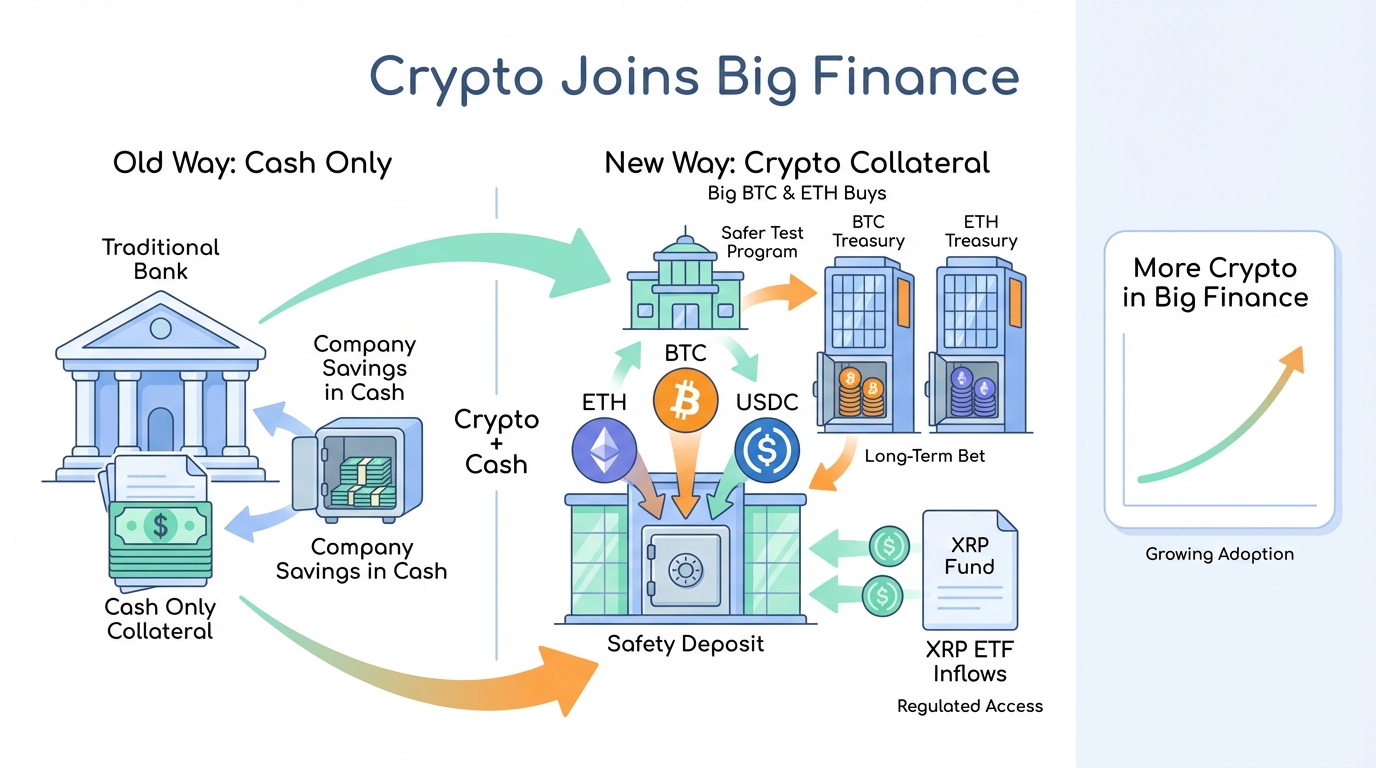
CFTC Launches Pilot Allowing BTC, ETH, USDC as Cleared Derivatives Collateral
Jon: Hey Lila, big news from the U.S. regulators today—the Commodity Futures Trading Commission (CFTC) just kicked off a pilot program that lets Bitcoin (BTC), Ethereum (ETH), and USD Coin (USDC) be used as collateral for cleared derivatives. Think of derivatives as financial contracts that bet on the future value of assets, like futures or swaps. This is like giving crypto a VIP pass into the traditional finance club, making it easier for big institutions to use these digital assets without constantly swapping them for dollars.
Lila: Whoa, that sounds important, but break it down for me. What’s collateral, and why does this matter for everyday folks?
Jon: Great question! Collateral is like a security deposit you put down to back up a loan or trade— if things go wrong, it covers the losses. Traditionally, it’s cash or bonds, but now BTC (which uses proof-of-work, like mining to secure the network), ETH (proof-of-stake, where holders ‘stake’ coins to validate transactions), and USDC (a stablecoin pegged to the U.S. dollar for steady value) can step in. This pilot tests how well they hold up in real scenarios, like price swings or custody (safely storing them). For non-techies, it means smoother integration of crypto into banking, potentially leading to faster global payments or cheaper loans. But fact-check: Based on recent reports, this aligns with ongoing regulatory pushes, like the SEC‘s hints at broader blockchain adoption in finance.
Lila: So, what’s the real impact? Does this make crypto safer or more useful?
Jon: Exactly—it’s about utility and adoption. Institutions can now use their crypto holdings directly, freeing up cash for other things. This could boost liquidity (how easily assets are traded) in crypto markets. On the tech side, clearinghouses will need upgrades for real-time pricing and risk checks. If you’re exploring docs or whitepapers on this, check out Gamma to quickly turn complex info into presentations. However, remember crypto’s high risks—prices can crash, and regulations might change.
Lila: Got it. Any downsides?
Jon: Sure, there’s caution around stability. Recent news highlights how stablecoins like USDC could be misused for things like evading sanctions if not regulated well, so this pilot emphasizes transparency. Overall, it’s a step toward mainstreaming blockchain tech.
Strategy Adds 10,624 BTC in $962M Treasury Buy, Now Holds 660,624 BTC
Jon: Lila, check this out: A company called Strategy (fact-check: This seems to refer to MicroStrategy, known for its Bitcoin treasury strategy) just bought 10,624 BTC for about $962 million, pushing their total to 660,624 BTC. That’s a huge bet on Bitcoin as a store of value, like digital gold, especially amid economic uncertainty.
Lila: Impressive numbers! But what’s a treasury buy, and why do companies do this?
Jon: Think of a company’s treasury as its savings account. Instead of holding cash that might lose value due to inflation, they’re parking funds in Bitcoin, which has a fixed supply of 21 million coins—scarcity drives its appeal. This purchase happened at an average of $90,615 per BTC, below recent highs but above their overall average. On-chain data (tracking blockchain transactions) shows big moves to their wallets, aligning with reports of Bitcoin stabilizing around $91K. It’s about long-term utility, like hedging against currency devaluation.
Lila: How does this affect the tech side or adoption?
Jon: It reinforces Bitcoin’s role in corporate finance. Proof-of-work ensures secure, decentralized validation— no single entity controls it. This could inspire more businesses to adopt blockchain for treasuries, improving efficiency. If you’re coding smart contracts to automate such strategies, tools like Nolang can help learn by chatting with an AI tutor. But high risks apply—Bitcoin’s price has seen rollercoasters, as per recent Reuters reports of potential annual declines.
Lila: So, it’s not just about price; it’s strategic?
Jon: Spot on. It sets an example for tech adoption, but volatility means it’s not for everyone.
BitMine Buys $199M in Ether, Now Holds 3.08% of Total ETH Supply
Jon: Shifting to Ethereum, BitMine Immersion Technologies snapped up $199 million in Ether (ETH) recently, holding about 3.08% of the total supply. That’s massive for a single company, signaling faith in Ethereum’s smart contract platform.
Lila: ETH supply? Explain like I’m five.
Jon: Ethereum is like a global computer where apps (DeFi for decentralized finance, NFTs for unique digital collectibles) run on smart contracts—self-executing code. Its proof-of-stake consensus lets holders stake ETH to secure the network and earn rewards. BitMine’s stake gives them influence, reducing available ETH for trading and potentially stabilizing it. Fact-check: Recent analyses, like from Nasdaq, highlight Ethereum’s strong developer ecosystem as a key strength.
Lila: What’s the ‘so what’ for users?
Jon: It boosts adoption for real-world uses, like tokenizing assets (turning real estate into digital shares). This could lead to more efficient finance apps. For video explainers on Ethereum upgrades, try Revid.ai to turn blogs into shorts. But risks are high—ETH faces short-term pressures, as per CoinDesk reports on sentiment.
Lila: Any concerns?
Jon: Yes, concentrated holdings might affect decentralization, but it’s a nod to Ethereum’s utility in Web3.
XRP ETFs See $756M in Inflows Over 11 Sessions, Outpacing BTC and ETH ETFs
Jon: Finally, XRP spot ETFs have pulled in $756 million in just 11 sessions since November 13, 2025, beating out Bitcoin and Ethereum ETFs which saw outflows.
Lila: ETFs? And why XRP?
Jon: ETFs are like baskets of assets you can trade on stock exchanges—easy access without direct crypto handling. XRP, from Ripple, focuses on fast cross-border payments, using a consensus mechanism that’s energy-efficient compared to proof-of-work. This inflow shows institutional interest in its utility for global transfers, despite price dips. Fact-check: CoinDesk notes XRP’s fearful sentiment but potential rebounds.
Lila: Impact on adoption?
Jon: It could accelerate regulated use in payments, making international money moves cheaper. But centralization concerns exist—fewer wallets hold more XRP. High risks here too; always DYOR.
Lila: Thanks, Jon—makes sense!
| News Story | Key Highlight | Impact Focus |
|---|---|---|
| CFTC Pilot | BTC, ETH, USDC as collateral | Regulation & Integration |
| Strategy BTC Buy | 10,624 BTC added | Corporate Adoption |
| BitMine ETH Buy | $199M in ETH | Ecosystem Utility |
| XRP ETF Inflows | $756M inflows | Institutional Interest |
In summary, today’s updates show blockchain inching closer to everyday finance through regulation and corporate moves. These foster adoption but underscore the tech’s evolving nature. Encourage your own research (DYOR)—tools like Make.com can automate workflows to stay updated. Remember, crypto is high-risk; educate yourself thoroughly.

👨💻 Author: SnowJon (Web3 & AI Practitioner / Investor)
A researcher who leverages knowledge gained from the University of Tokyo Blockchain Innovation Program to share practical insights on Web3 and AI technologies. While working as a salaried professional, he operates 8 blog media outlets, 9 YouTube channels, and over 10 social media accounts, while actively investing in cryptocurrency and AI projects.
His motto is to translate complex technologies into forms that anyone can use, fusing academic knowledge with practical experience.
*This article utilizes AI for drafting and structuring, but all technical verification and final editing are performed by the human author.
⚠️ IMPORTANT RISK WARNING
Cryptocurrency investments are highly volatile and high-risk. You could lose your entire investment. Past performance is not indicative of future results. This content is for educational and informational purposes only and does NOT constitute financial advice. Always do your own research (DYOR) before making any decisions.
🛑 Affiliate Disclaimer
This article contains affiliate links. Tools mentioned are based on current information. Use at your own discretion.
▼ Recommended Tools for Research & Productivity
- 🔍 Genspark: An AI agent that saves you research time by summarizing search results.
- 📊 Gamma: Create beautiful presentations and docs in seconds just by typing.
- 🎥 Revid.ai: Turn your text or blogs into viral short videos instantly.
- 👨💻 Nolang: Learn coding or any topic by chatting with an AI tutor.
- ⚙️ Make.com: Automate boring tasks by connecting your favorite apps.