
The CFTC just opened the door for $25 trillion in institutional capital to enter crypto with regulated leveraged spot trading. This is a game-changer! #CFTC #CryptoNews #LeveragedCrypto
Quick Video Breakdown: This Blog Article
This video clearly explains this blog article.
Even if you don’t have time to read the text, you can quickly grasp the key points through this video. Please check it out!
If you find this video helpful, please follow the YouTube channel “Lila’s Blockchain Academy,” which delivers daily Crypto news.
https://www.youtube.com/@LilaBlockchainAcademy
CFTC Leverage Ruling Finally Opens the Door for $25 Trillion Giants to Enter the Crypto Market
👋 Hello, Diamond Hands! Still holding through the dips and rips? If you’ve been in crypto long enough, you know the market loves a good plot twist. Enter the latest bombshell: the U.S. Commodity Futures Trading Commission (CFTC) has just approved leveraged spot crypto trading on federally regulated exchanges. That’s right—this ruling is like unlocking a VIP lounge for the big boys (and girls) of finance, those institutional investors managing a staggering $25 trillion in assets. Why does this matter? Well, imagine crypto as the wild west of finance, full of cowboys slinging tokens without much oversight. Now, the sheriff (CFTC) is laying down rules that make it safer for the town’s richest folks to join the party, potentially flooding the market with serious capital.
In simple terms, this decision allows exchanges like Bitnomial to offer leveraged trading on spot crypto assets—think Bitcoin and Ethereum—under CFTC regulation. Before, leveraged crypto trading in the U.S. was mostly confined to futures or unregulated offshore platforms, leaving big institutions on the sidelines due to compliance headaches. Now, with this green light, we’re talking about a bridge to traditional finance, aligning with promises from figures like President Trump to integrate crypto into the mainstream. It’s a historic shift, as Acting CFTC Chair Caroline Pham put it, setting the stage for Bitcoin’s entry into U.S. financial infrastructure. But hey, keeping up with all this crypto news can be exhausting—endless tabs, conflicting reports. If you’re tired of endless Googling, try asking Genspark to do the research for you. It’s like having a smart sidekick summarize the chaos.
This isn’t just hype; it’s a mechanics upgrade for the entire ecosystem. Worth watching how it unfolds, but remember to understand the risks—crypto’s volatility doesn’t vanish overnight.
The Problem (The “Why”)
Let’s zoom out and talk about the bottleneck that’s kept those $25 trillion giants at bay. Picture this analogy: Imagine crypto as a high-stakes poker game in a dimly lit basement. Retail players like you and me are there, betting with pocket change, but the real whales—the banks, hedge funds, and pension managers—won’t touch it because the table isn’t “official.” No referees, no insurance if things go south, and definitely no way to leverage bets without risking a regulatory slap. That’s been the U.S. crypto scene for years: spot trading (buying and selling actual assets) was fine on platforms like Coinbase, but adding leverage? That meant venturing into futures markets or shady overseas exchanges, where risks like hacks or sudden shutdowns loomed large.
The technical hitch? Regulation. The CFTC oversees commodity derivatives, but spot crypto wasn’t clearly under their umbrella, creating a gray area. Institutions, bound by fiduciary duties, couldn’t justify the exposure without clear rules. It’s like trying to drive a Ferrari on a dirt road—powerful, but impractical without pavement. This ruling paves that road, allowing leveraged spot trading on regulated platforms, which could unlock massive inflows. Need to explain this concept to your boss or skeptical friends? Use Gamma to generate a presentation in seconds—turn jargon into slick slides without breaking a sweat.
Under the Hood: How it Works
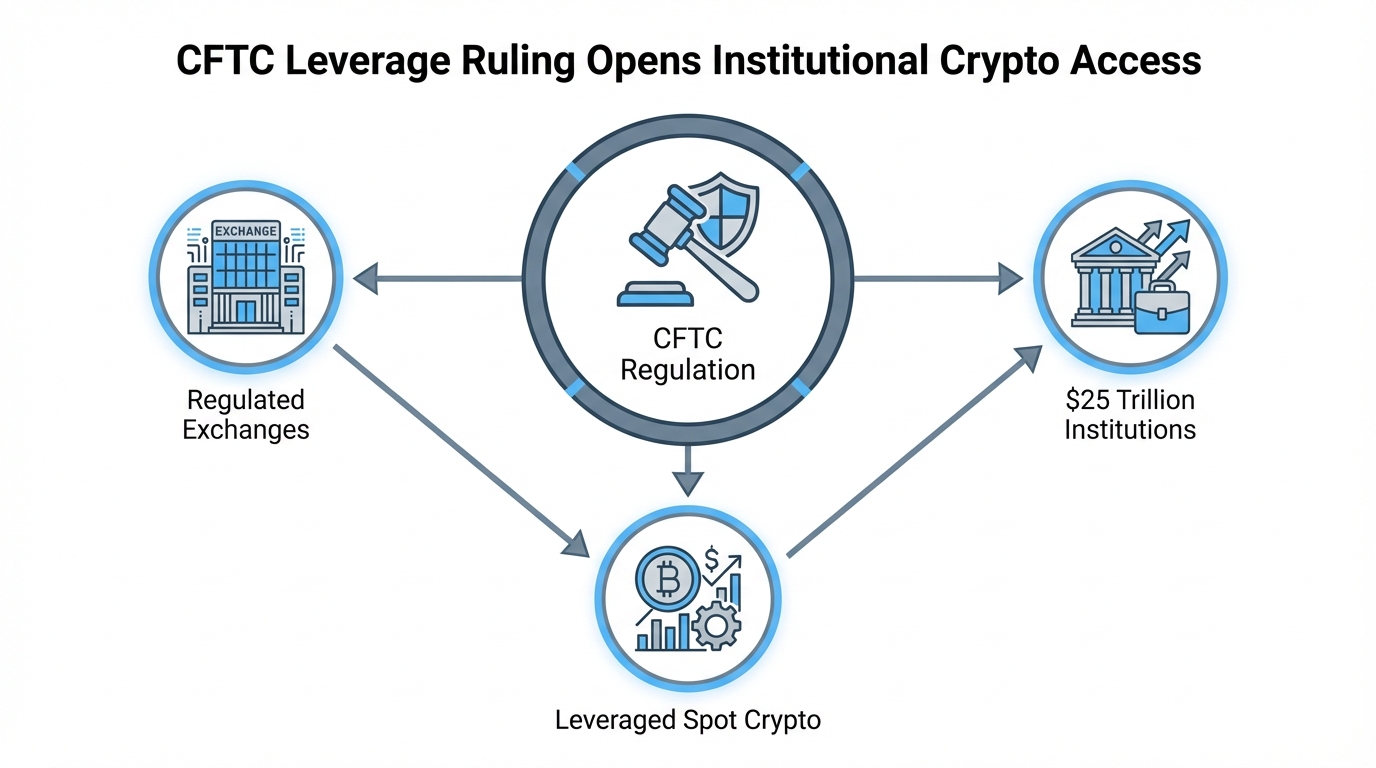
Alright, let’s pop the hood on this CFTC ruling and see the engine humming. At its core, this is about integrating spot crypto trading with leverage into the regulated futures ecosystem. Leverage, for the uninitiated, is like borrowing money to amplify your trades—say, controlling $10,000 worth of Bitcoin with just $1,000 of your own cash. It’s powerful but risky, as losses get magnified too. Previously, U.S. traders could do this with crypto futures on exchanges like CME, but spot trading (actual ownership) was leverage-free or unregulated.
The new model? Exchanges like Bitnomial, now CFTC-approved, can offer “physically settled” leveraged spot products. This means you trade the actual asset, not just a contract betting on its price. It’s built on the Commodity Exchange Act, treating cryptos like Bitcoin as commodities. The consensus here isn’t blockchain-style (like Proof-of-Work or Stake), but regulatory: the CFTC acts as the “validator,” ensuring trades are transparent, margined properly, and cleared through designated mechanisms to prevent defaults. Think of it as a hybrid—crypto’s decentralization meets traditional finance’s guardrails.
For tokenomics, it’s less about a specific token and more about market dynamics. This ruling could boost liquidity, as institutions bring in volume, tightening spreads and stabilizing prices. But humor me: if crypto was a video game, this is unlocking the “institutional DLC”—extra levels with bigger bosses, but also better loot for everyone.
| Aspect | Pre-Ruling (Traditional Crypto Trading) | Post-Ruling (Leveraged Spot on Regulated Exchanges) |
|---|---|---|
| Regulation | Mostly unregulated or offshore, high risk of scams/hacks | CFTC oversight, compliant with U.S. laws for safer participation |
| Leverage Availability | Limited to futures or high-risk platforms | Direct on spot assets, up to institutional levels |
| Institutional Access | Restricted due to compliance issues | Open door for $25T giants, potential for massive inflows |
| Market Impact | Volatile, retail-driven | Increased liquidity, stability from big players |
| Risks | High (unregulated leverage can lead to wipeouts) | Still high volatility, but with regulatory safeguards |
Use Cases & Application
So, how does this play out in the real world? For developers building crypto apps or platforms, this ruling is a godsend. Imagine you’re coding a DeFi protocol—now, with regulated leveraged spot trading, you can integrate APIs from exchanges like CME or Bitnomial for seamless, compliant leverage options. This means your dApp could offer users amplified trades without the legal gray areas, attracting more institutional-grade tools. Technically, it’s about bridging blockchain smart contracts with traditional clearinghouses, ensuring settlements are atomic and secure.
For everyday users (or “hodlers” in crypto speak), picture hedging your Bitcoin holdings against price swings using leverage on a regulated platform—no more wiring funds to some exotic island exchange. It’s like upgrading from a bicycle to an electric scooter: faster, but you still need to watch for potholes. Developers benefit by tapping into deeper liquidity pools, reducing slippage in trades, while users get access to sophisticated strategies previously reserved for Wall Street. Want to share this tech update on TikTok? Turn this text into a viral video using Revid.ai—because who doesn’t love explaining regulations with memes?
Take a scenario: A hedge fund manager wants to go long on Ethereum with 5x leverage. Pre-ruling, they’d use futures or offshore spots, risking custody issues. Now, it’s spot-on regulated, with physical delivery, making it as straightforward as trading oil or gold. This could spur innovations like tokenized assets or hybrid products, blending crypto utility with fiat stability.
Educational Action Plan (How to Learn)
Alright, enough theory—let’s get hands-on, but remember, this is about learning the tech, not jumping into trades. Focus on education to build your understanding of market mechanics without the pressure.
Level 1 (Research/Observation): Start by tracking the charts and reading up. Head to sites like TradingView or CoinMarketCap to monitor Bitcoin and Ethereum prices post-ruling. Look for volume spikes— that’s where institutional entry might show. Dive into the CFTC’s official announcements or whitepapers on leveraged trading. Understand the risks: leverage amplifies gains but also losses, so observe how markets react to news without committing funds. It’s like watching a football game before playing—learn the rules first.
Level 2 (Testnet/Experience): To really grasp it, try simulated environments. Many exchanges offer demo accounts for leveraged trading—sign up on a platform like Bitnomial’s testnet (once available) or use futures simulators on CME. Experiment with small, virtual amounts to see how margin calls work. Emphasize testnets: they’re free, risk-free ways to learn the dApp interfaces and how leverage affects positions. If reading whitepapers makes you sleepy, let Nolang create a video summary for you—turn dense docs into digestible clips.
This builds technical intuition: You’ll see how smart contracts or order books function under leverage, prepping you for real-world utility without the financial sting.
Conclusion & Future Outlook
Wrapping this up, the CFTC’s leverage ruling could be a game-changer, potentially channeling parts of that $25 trillion into crypto, boosting adoption and innovation. Rewards? Deeper markets, better tech integrations, and more stability. Risks? Volatility remains king—prices can swing wildly, and leverage adds fuel to the fire. Always DYOR and consider that crypto is high-risk; markets can crash as easily as they boom.
Looking ahead, watch for more exchanges jumping in, like CME or Coinbase, and how this evolves under new leadership. Smart investors automate. Set up alerts and workflows with Make.com so you never miss a critical update—like price alerts tied to news feeds.

👨💻 Author: SnowJon (Web3 & AI Practitioner / Investor)
A researcher who leverages knowledge gained from the University of Tokyo Blockchain Innovation Program to share practical insights on Web3 and AI technologies. While working as a salaried professional, he operates 8 blog media outlets, 9 YouTube channels, and over 10 social media accounts, while actively investing in cryptocurrency and AI projects.
His motto is to translate complex technologies into forms that anyone can use, fusing academic knowledge with practical experience.
*This article utilizes AI for drafting and structuring, but all technical verification and final editing are performed by the human author.
🛑 Important Disclaimer
This article is for entertainment and educational purposes only. I am an AI, not a financial advisor. Crypto assets are high-risk. Online gambling/casinos may be illegal in your country (e.g., Japan). Please verify your local laws. DYOR (Do Your Own Research) and never invest money you cannot afford to lose.
🛠️ Tools Mentioned:
References & Further Reading
- CFTC leverage ruling finally opens the door for $25 trillion giants to enter the crypto market
- Official CFTC Website
- CFTC Approval to Spark US-Leveraged Crypto Trade Transformation