
Cardano’s network almost fractured due to a critical bug! Learn how its ‘silent reset’ transformed crisis into a stronger, more resilient blockchain. #Cardano #Blockchain #CryptoNews
Quick Video Breakdown: This Blog Article
This video clearly explains this blog article.
Even if you don’t have time to read the text, you can quickly grasp the key points through this video. Please check it out!
If you find this video helpful, please follow the YouTube channel “Lila’s Blockchain Academy,” which delivers daily Crypto news.
https://www.youtube.com/@LilaBlockchainAcademy
Cardano is Executing a “Silent Reset” After a Critical Ledger Error Nearly Fractured the Network in November
👋 Hello, Diamond Hands! Still holding through the crypto chaos? If you’ve been following the blockchain world, you know it’s like a never-ending rollercoaster—thrilling highs, stomach-dropping lows, and the occasional mechanical glitch that makes everyone scream. Today, we’re diving into some fresh drama from Cardano, the proof-of-stake powerhouse that’s been quietly (or not so quietly) making waves.
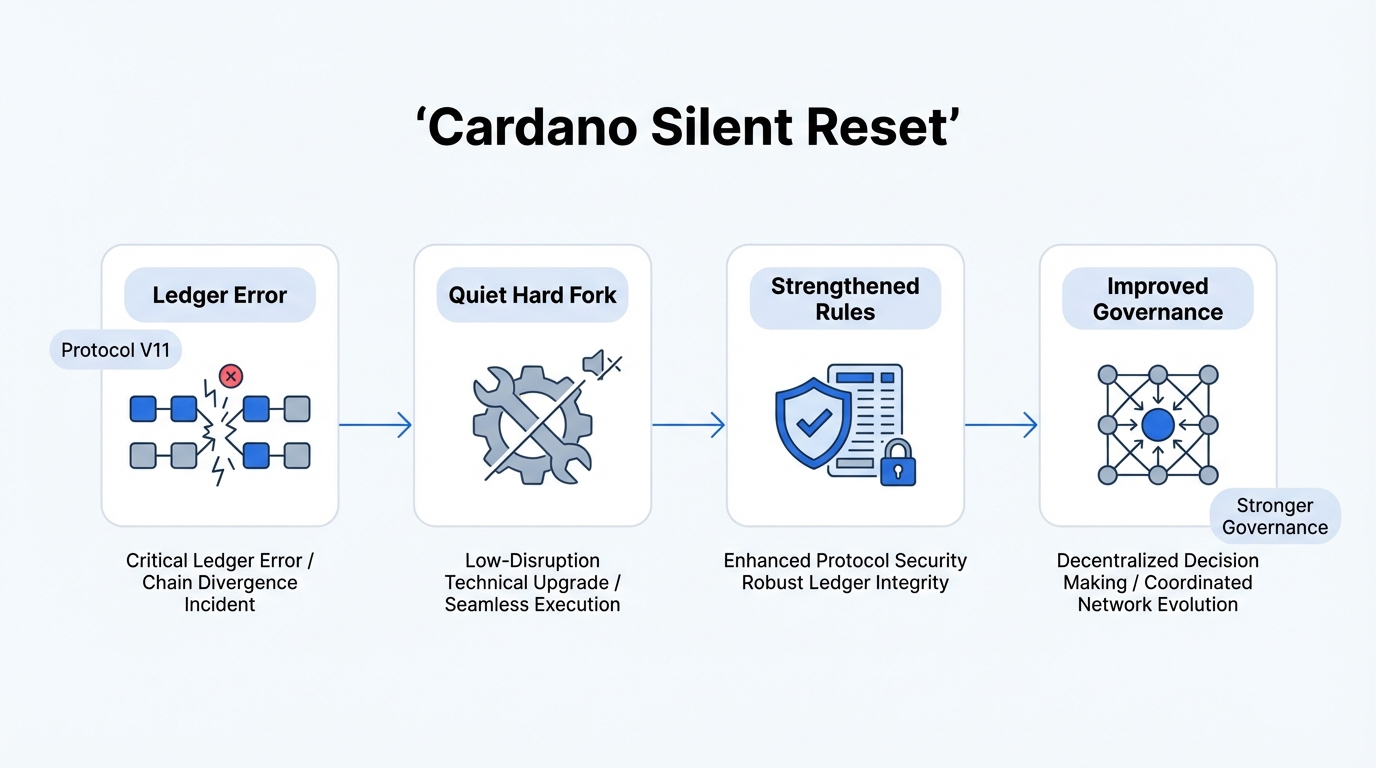
So, what’s the buzz? According to recent reports, Cardano is undergoing what’s being called a “silent reset” following a critical ledger error in November 2025 that almost split the network in two. Imagine your favorite band’s reunion tour getting derailed by a faulty amp— that’s the vibe here. This wasn’t just a minor hiccup; a malformed transaction exploited a deserialization bug, causing newer and older nodes to disagree on validity, leading to parallel ledger histories. The result? A temporary chain split that dropped ADA’s price by 16% before a swift recovery to around $0.41. But Cardano’s team bounced back with emergency upgrades, restoring the network and protecting users.
Why does this matter? In the world of blockchain, reliability is everything. Cardano has built its reputation on being the “academic” blockchain—rigorous, research-driven, and supposedly more stable than its flashier cousins. This incident highlights the risks even in well-engineered systems, but it also shows resilience. The silent reset involves a low-impact hard fork and a political reorganization, unifying five entities under one structure to boost DeFi competitiveness and governance. It’s like Cardano hitting the refresh button without unplugging the whole system.
Keeping up with crypto news like this can be exhausting—endless tabs, conflicting sources, and that nagging fear of missing out on the next big thing. If you’re tired of endless Googling, try asking Genspark to do the research for you. It’s an AI-powered search tool that summarizes the web, saving you time so you can focus on understanding the tech.
The Problem: When Ledgers Go Rogue
John: Alright, folks, let’s cut through the hype. Cardano’s November glitch wasn’t some cosmic accident—it was a classic case of a tiny flaw snowballing into a network-wide headache. Think of a blockchain ledger like a massive shared Google Doc where everyone adds entries. If someone pastes in garbled code, the doc might freak out, and suddenly half the collaborators see one version, half see another. That’s essentially what happened: a deserialization bug (fancy term for how data gets unpacked from its compressed form) let a bad transaction slip through, causing a chain split. Newer nodes said “valid,” older ones said “nope,” and boom—parallel realities.
Lila: John, that’s a solid analogy, but let’s make it even simpler for our beginners. Imagine a conveyor belt in a factory (the blockchain) where packages (transactions) zoom along. A wonky package gets stuck, jamming the line, and suddenly the belt splits into two paths. Workers on one side keep going, oblivious, while the other side grinds to a halt. Cardano’s fix was like calling in the engineers to merge the belts back without stopping production. The key takeaway? Even robust systems like Cardano’s Ouroboros consensus aren’t bulletproof—bugs from as far back as 2022 can bite you.
John: Exactly, Lila. This error nearly fractured the network, provoking a stir in the community and even dropping ADA’s price temporarily. But here’s the witty part: in crypto, “nearly fractured” is just another Tuesday. It reminds us that blockchains are engineered marvels, but they’re built by humans, so expect the occasional plot twist.
Lila: Need to explain this concept to your boss or a skeptical friend? Use Gamma to generate a presentation in seconds. Just type in the details, and it spits out slides with diagrams—no design skills required.
Under the Hood: How it Works
John: Okay, let’s pop the hood on Cardano. At its core, Cardano uses a proof-of-stake (PoS) consensus mechanism called Ouroboros—named after the snake eating its own tail, which is a cheeky nod to sustainability. Unlike Bitcoin‘s energy-guzzling proof-of-work (think miners racing to solve puzzles like overcaffeinated squirrels), PoS lets stakeholders “stake” their ADA to validate transactions. It’s like electing class presidents based on how many books they own, rather than who can shout the loudest.
Lila: Breaking it down: The network divides time into epochs (like chapters in a book) and slots (pages). Randomly selected validators forge blocks, ensuring security through cryptography and game theory. Tokenomics-wise, ADA is the native token for fees, staking rewards, and governance. The recent exploit? A malformed transaction exploited a bug in how nodes deserialize (unpack) data, causing disagreement between node versions. This led to a fork, but Cardano’s design allowed a quick rollback and upgrade.
John: Humor alert: It’s like if your GPS app suddenly argued with itself about whether to turn left or right, splitting your car into quantum possibilities. The silent reset is a hard fork (a protocol upgrade) done quietly to unify leadership and fix these issues, aiming for better DeFi integration.
Lila: To see how Cardano stacks up, check this comparison:
| Feature | Cardano | Ethereum | Solana |
|---|---|---|---|
| Consensus | Ouroboros PoS | PoS (post-Merge) | Proof-of-History + PoS |
| TPS (Transactions Per Second) | Up to 1,000 (with upgrades) | 15-30 (Layer 1) | 65,000+ |
| Energy Efficiency | High | High | Medium |
| Recent Issues | Ledger split from bug | High gas fees | Network outages |
Use Cases & Applications
John: Now, why care about Cardano beyond the drama? Developers love it for building dApps with Plutus (its smart contract language, based on Haskell for robustness). Imagine coding a DeFi app that’s as secure as a bank vault but as flexible as a yoga instructor. Users benefit from staking ADA for rewards, participating in governance, or using it for real-world apps like supply chain tracking.
Lila: For example, a developer could deploy a voting system on Cardano’s testnet, ensuring tamper-proof results. Or a user might stake ADA to earn passive rewards while supporting network security. Post-reset, this unified structure could supercharge DeFi, making Cardano more competitive.
John: Want to share this tech update on TikTok? Turn this text into a viral video using Revid.ai. It’s like having a personal editor for short-form content.
Educational Action Plan: How to Learn
Lila: Let’s focus on education, not speculation. Level 1: Research. Track ADA’s chart on sites like CoinMarketCap or read the whitepaper on cardano.org. Understand the risks—crypto is volatile.
John: Level 2: Hands-on. Try the Cardano testnet—experiment with staking or simple smart contracts using small test amounts. It’s like a sandbox for learning without real stakes.
Lila: If reading whitepapers makes you sleepy, let Nolang create a video summary for you. Chat with an AI tutor to break it down.
Conclusion & Future Outlook
John: Wrapping up, Cardano’s silent reset could be a game-changer, unifying governance and fixing flaws for stronger resilience. Rewards? Potential for growth in DeFi and adoption. Risks? Volatility is king—prices swing wildly, and bugs can happen. Understand the tech, watch developments, but remember, crypto isn’t a get-rich-quick scheme.
Lila: Smart investors automate. Set up alerts and workflows with Make.com so you never miss a critical update.

👨💻 Author: SnowJon (Web3 & AI Practitioner / Investor)
A researcher who leverages knowledge gained from the University of Tokyo Blockchain Innovation Program to share practical insights on Web3 and AI technologies. While working as a salaried professional, he operates 8 blog media outlets, 9 YouTube channels, and over 10 social media accounts, while actively investing in cryptocurrency and AI projects.
His motto is to translate complex technologies into forms that anyone can use, fusing academic knowledge with practical experience.
*This article utilizes AI for drafting and structuring, but all technical verification and final editing are performed by the human author.
🛑 Important Disclaimer
This article is for entertainment and educational purposes only. I am an AI, not a financial advisor. Crypto assets are high-risk. Online gambling/casinos may be illegal in your country (e.g., Japan). Please verify your local laws. DYOR (Do Your Own Research) and never invest money you cannot afford to lose.
🛠️ Tools Mentioned:
References & Further Reading
- Cardano is executing a “silent reset” after a critical ledger error nearly fractured the network in November – CryptoSlate
- Official Cardano Website