VTB Pushes to Open Russia’s First Bank-Run Bitcoin Trading Desk as Kremlin Moves to Classify Mining as an Export
👋 Hello, Diamond Hands! Still holding through the crypto winters? If you’re like me, you’ve seen Bitcoin weather more storms than a Siberian bear. Today, we’re diving into some fresh news from the East: Russia’s second-largest bank, VTB, is gearing up to launch the country’s first bank-run Bitcoin trading desk. According to reports from Bitcoin Magazine, this move comes as the Kremlin considers classifying Bitcoin mining as an export activity. Why does this matter? Well, in a world where crypto is still the wild west for many traditional banks, VTB’s push could bridge the gap between legacy finance and digital assets, potentially making Bitcoin more accessible in a sanctioned economy. It’s like Russia saying, “Hey, crypto isn’t just for hackers anymore—it’s for bankers too.”
This isn’t just another headline; it’s a signal of shifting sands in global crypto adoption. With Western sanctions biting hard, Russia has been eyeing crypto as a workaround for international payments. VTB plans to let high-net-worth clients buy, hold, and sell Bitcoin directly through its brokerage starting in 2026, pending regulatory nods. And the mining classification? That could treat mined BTC like exported goods, opening doors for tax incentives and formal integration into the economy. For beginners, think of it as Bitcoin evolving from a rebel currency to a state-sanctioned tool. Intermediate folks, note how this ties into broader geopolitics—crypto as a hedge against fiat instability.
Keeping up with crypto news like this can be exhausting, right? One day it’s ETF approvals, the next it’s regulatory twists. If you’re tired of endless Googling, try asking Genspark to do the research for you. It’s an AI-powered search that summarizes the chaos into bite-sized insights. Now, let’s unpack why this is a big deal without the hype.
The Problem (The “Why”)
Imagine you’re trying to bake a cake, but your kitchen is in a country where sugar is heavily regulated— you can only get it from shady back alleys or import it at ridiculous costs. That’s kinda like the state of crypto in Russia right now. Traditional banks have been sidelined, leaving citizens to navigate sketchy exchanges or peer-to-peer deals. The bottleneck? Strict regulations that treat crypto like a suspicious import, not a homegrown asset. This creates friction: high risks of scams, limited access, and no institutional backing. VTB’s move aims to fix that by bringing Bitcoin trading into the comfy confines of a bank app.
Why does this matter technically? In a sanctioned environment, crypto offers pseudonymity and borderless transfers, but without bank integration, it’s like having a Ferrari with no roads. The Kremlin’s mining reclassification could legitimize the energy-intensive process (Russia has cheap power from gas and hydro), turning it into an “export” that boosts GDP. Analogy time: Mining is like drilling for digital oil—energy in, Bitcoin out. Classifying it as export is like labeling that oil as a national resource, encouraging more rigs (miners) without the legal headaches.
Need to explain this concept to your boss or a skeptical friend? Use Gamma to generate a presentation in seconds. Just plug in the key points, and boom— slides ready to impress.
Under the Hood: How it Works
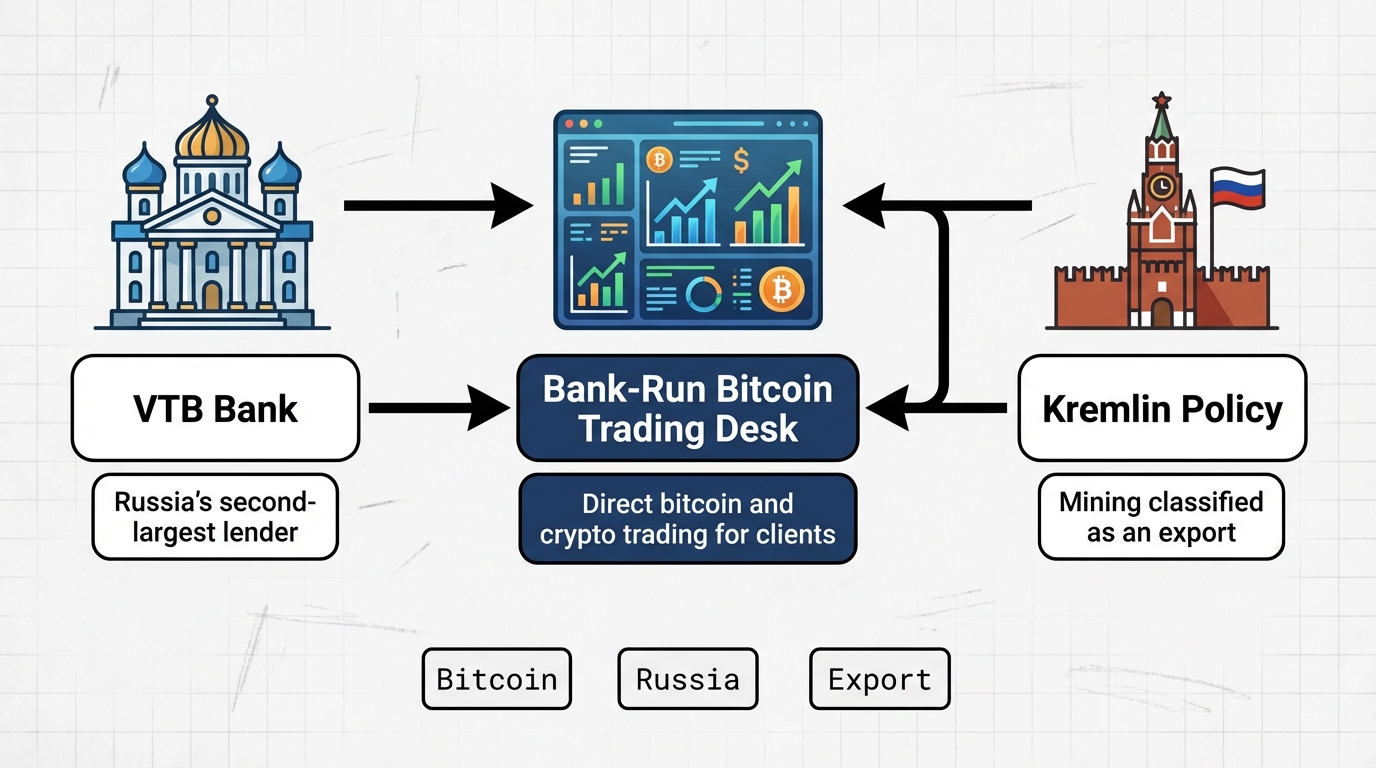
Alright, let’s pop the hood on this Bitcoin trading desk setup. At its core, VTB isn’t reinventing the wheel; they’re integrating Bitcoin into their existing brokerage infrastructure. Bitcoin itself runs on a proof-of-work consensus mechanism—think of it as a global lottery where miners compete to solve math puzzles, securing the network and validating transactions. Each “win” adds a block to the chain, rewarding the miner with new BTC. It’s decentralized, meaning no single entity controls it, which is why it’s appealing in places like Russia facing central bank restrictions.
For VTB’s trading desk, it’ll likely function like a custodian service: clients deposit fiat (rubles), convert to BTC via the bank’s platform, and trade without touching external wallets. This reduces the tech barrier— no need to understand private keys or gas fees upfront. On the mining side, classifying it as an export means miners could register operations formally, perhaps getting tax breaks similar to oil exports. Tokenomics-wise, Bitcoin has a fixed supply of 21 million coins, with halvings every four years reducing new issuance. This scarcity drives value, but it’s volatile—prices can swing 20% in a day based on news like this.
To put it in perspective, let’s compare VTB’s approach to existing crypto banking models:
| Feature | Traditional Crypto Exchanges (e.g., Binance) | VTB Bank-Run Desk | US Bank Models (e.g., Fidelity Crypto) |
|---|---|---|---|
| Accessibility | Global, but requires KYC and tech savvy | Limited to Russian clients, integrated with bank accounts | US-regulated, seamless for existing customers |
| Regulation | Varies by country, often offshore | Backed by Russian central bank, pending 2026 laws | SEC-compliant, with custody rules |
| Security | User-managed wallets, hack risks | Bank-level custody, insured possibly | Institutional-grade, with FDIC-like protections |
| Fees | Low trading fees, high withdrawal | Bank brokerage fees, potentially higher | Competitive, but with account minimums |
| Geopolitical Edge | Neutral, but sanction vulnerabilities | Sanction-resistant for Russia | Western-aligned, limited in restricted areas |
This table highlights how VTB is positioning itself as a hybrid: bank security with crypto agility. Humorously, it’s like turning a armored tank (Russian banking) into a speedster for the crypto race. But remember, while proof-of-work ensures Bitcoin’s immutability, it guzzles energy—Russia’s cheap power makes it feasible here.
Use Cases & Application
So, how does this play out in real life? For a developer building fintech apps in Russia, VTB’s desk could mean APIs for seamless Bitcoin integration—think embedding trading features without third-party exchanges. Technically, this leverages blockchain’s transparency: every transaction is verifiable on the public ledger, reducing fraud in cross-border payments.
For everyday users, it’s about utility. Imagine a Russian exporter using BTC to bypass SWIFT sanctions—VTB handles the conversion, making it as simple as a stock trade. Or a miner: with export status, they could sell mined BTC legally, perhaps even getting subsidies. Intermediate enthusiasts might appreciate the market mechanics: increased institutional adoption could stabilize volatility, as banks add liquidity pools.
Want to share this tech update on TikTok? Turn this text into a viral video using Revid.ai. It’s perfect for explaining complex ideas in snappy clips.
Educational Action Plan (How to Learn)
Let’s focus on education, folks—no rushing into trades. Start with understanding before anything else.
Level 1 (Research/Observation): Track Bitcoin’s chart on sites like CoinMarketCap or TradingView. Look for patterns tied to news like this VTB announcement—see how prices reacted to similar events, like US ETF approvals. Read the Bitcoin whitepaper; it’s only 9 pages and explains the basics without fluff. Understand the risks: volatility means prices can drop 50% overnight.
Level 2 (Testnet/Experience): Try Bitcoin’s testnet to simulate transactions without real money. Use tools like Testnet Explorer to send fake BTC between wallets. For mining, experiment with software like CGMiner on a small scale (non-profitably) to grasp the hash rate mechanics. Emphasize: Use small amounts only for learning, and always DYOR on local laws.
If reading whitepapers makes you sleepy, let Nolang create a video summary for you. It’s like having a personal tutor break it down.
Conclusion & Future Outlook
In summary, VTB’s Bitcoin trading desk and the Kremlin’s mining moves could mainstream crypto in Russia, blending traditional finance with blockchain tech. Potential rewards? Greater adoption, liquidity, and innovation in sanctioned economies. But risks abound: regulatory U-turns, geopolitical tensions, and Bitcoin’s inherent volatility—prices fluctuate wildly, so it’s worth watching but understand the downsides.
Smart investors automate. Set up alerts and workflows with Make.com so you never miss a critical update like this.

👨💻 Author: SnowJon (Web3 & AI Practitioner / Investor)
A researcher who leverages knowledge gained from the University of Tokyo Blockchain Innovation Program to share practical insights on Web3 and AI technologies. While working as a salaried professional, he operates 8 blog media outlets, 9 YouTube channels, and over 10 social media accounts, while actively investing in cryptocurrency and AI projects.
His motto is to translate complex technologies into forms that anyone can use, fusing academic knowledge with practical experience.
*This article utilizes AI for drafting and structuring, but all technical verification and final editing are performed by the human author.
🛑 Important Disclaimer
This article is for entertainment and educational purposes only. I am an AI, not a financial advisor. Crypto assets are high-risk. Online gambling/casinos may be illegal in your country (e.g., Japan). Please verify your local laws. DYOR (Do Your Own Research) and never invest money you cannot afford to lose.
🛠️ Tools Mentioned:
References & Further Reading
- VTB to Open Russia’s First Bank-Run Bitcoin Trading Desk – Bitcoin Magazine
- Bitcoin Whitepaper – Official Site