Ethereum Activates Fusaka Hard Fork, Delivering Major Data Availability and Throughput Gains
John: 👋 Hello, Diamond Hands! Still holding through the crypto winters and summers? If you’re like me, you’ve seen Ethereum evolve from a clunky smart contract platform to the backbone of decentralized finance. Today, we’re diving into some fresh news: Ethereum has just activated its Fusaka hard fork. Yeah, you heard that right—another upgrade in the ever-upgrading world of ETH. But why does this matter? Let’s break it down without the hype.
Lila: Hey everyone, Lila here to bridge the gap for beginners. Imagine Ethereum as the bustling highway of the blockchain world. It’s been getting congested with all the traffic from DeFi apps, NFTs, and those speedy Layer 2 networks. The Fusaka hard fork, which went live on December 3, 2025, is like adding extra lanes and smart traffic lights to handle more cars (or in this case, transactions) without the gridlock. According to recent reports, it boosts data availability and throughput by up to 8x, which could slash fees on Layer 2 chains and make the whole ecosystem smoother. Why care? Because it strengthens Ethereum’s role as the settlement layer for on-chain finance, making it more efficient for developers and users alike.
John: Spot on, Lila. This isn’t just another fork in the road; it’s a major step toward what Ethereum devs call “infinite scalability.” But keeping up with all this crypto news can be exhausting—endless tabs, conflicting sources. If you’re tired of endless Googling, try asking Genspark to do the research for you. It’s an AI-powered search that summarizes the chaos into bite-sized insights. Anyway, let’s get to the meat: the problems this upgrade solves.
The Problem (The “Why”)
John: Alright, let’s roast the hype a bit. Ethereum’s been praised as the world computer, but let’s be real—it’s more like a shared office printer that’s always jamming when everyone needs it. The big bottleneck? Data availability. In blockchain terms, this is about ensuring all the transaction data is accessible and verifiable without forcing every node to store everything forever. Pre-Fusaka, Layer 2 rollups (those side chains that bundle transactions and settle on Ethereum) were hitting limits on how much data they could post cheaply. It’s like trying to ship a warehouse of goods through a single narrow door—things get backed up, fees spike, and throughput suffers.
Lila: Analogy time for the beginners: Think of Ethereum as a giant library where books (data) need to be available for anyone to check out. But the shelves were getting too full, and librarians (nodes) were overwhelmed. Fusaka introduces smarter ways to sample and verify data without downloading the whole library. This PeerDAS (Peer Data Availability Sampling) tech allows nodes to confirm data existence with just a tiny sample, like tasting a soup to know if it’s good instead of eating the whole pot. It reduces resource demands while boosting capacity—up to that 8x throughput gain we mentioned. If you’re scratching your head, don’t worry; it’s a game-changer for scalability without sacrificing decentralization.
John: Exactly. And if you need to explain this concept to your boss or skeptical friends, use Gamma to generate a presentation in seconds. It’s like having a design team in your pocket—type in the details, and boom, slides ready. Now, let’s peek under the hood.
Under the Hood: How it Works
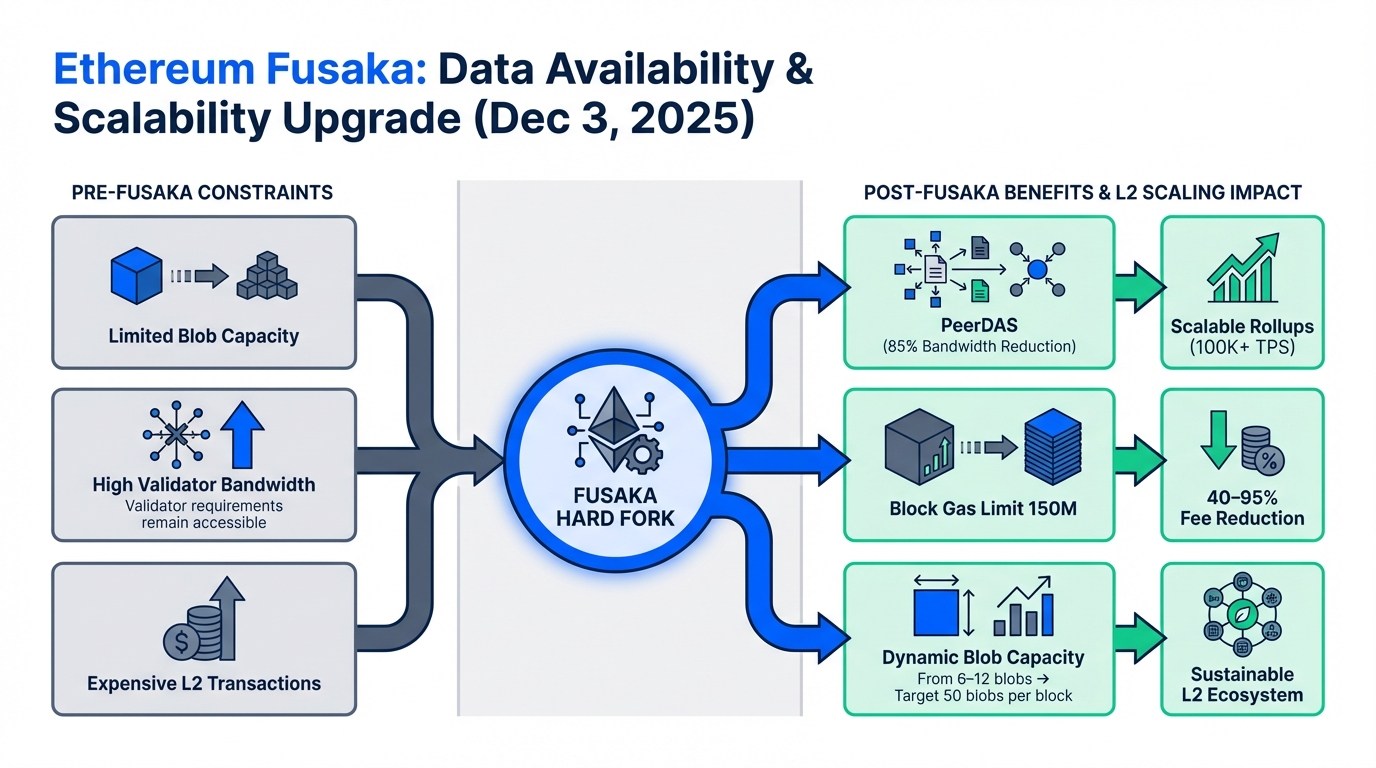
John: Okay, tech warriors, time to get gritty. Fusaka isn’t reinventing the wheel; it’s turbocharging it. At its core, this hard fork builds on Ethereum’s proof-of-stake consensus, but the star is PeerDAS. Remember DAS? Data Availability Sampling lets nodes verify large blobs of data (those bundles from Layer 2s) by checking random samples, not the whole thing. PeerDAS takes it peer-to-peer, distributing the load across the network like a potluck where everyone brings a dish instead of one host doing all the cooking.
Lila: For the uninitiated, blobs are like compressed packages of rollup data posted to Ethereum. Fusaka increases blob capacity dramatically—up to 8x—while adding features like blob parameter-only forks for future tweaks without full hard forks. It also refines gas controls for better fee predictability. Think of gas as the fuel for transactions; Fusaka sharpens how it’s calculated, reducing waste. This all ties into Ethereum’s roadmap post-Pectra (the May 2025 upgrade), aiming for modular scaling where Layer 1 handles security and data, and Layer 2s do the heavy lifting.
John: To make it concrete, let’s compare Fusaka-enhanced Ethereum to its predecessors and competitors. We’ll use a table because, hey, who doesn’t love a good side-by-side?
| Feature | Pre-Fusaka Ethereum | Fusaka Ethereum | Solana (Competitor) |
|---|---|---|---|
| Data Availability Throughput | Limited to ~1-2x current blob capacity | Up to 8x boost via PeerDAS | High native throughput but centralized node requirements |
| Layer 2 Fee Reduction | Moderate, dependent on congestion | Significant lowering due to increased blob space | Low fees but prone to network halts |
| Node Efficiency | High resource demands for full data | Reduced via sampling, more decentralized | Efficient but requires powerful hardware |
| Scalability Focus | Rollup-centric, post-Dencun | Enhanced rollup scaling with modular adjustments | Monolithic, high TPS but less composable |
Lila: See? Fusaka isn’t just an upgrade; it’s Ethereum flexing its engineering muscles to stay ahead. But remember, this is all about the tech—understand how it works before diving deeper.
Use Cases & Application
John: Now, let’s talk real-world wins. For developers, Fusaka means building Layer 2 apps that scale without breaking the bank. Imagine you’re coding a DeFi protocol on Optimism or Arbitrum—post-Fusaka, you get more blob space, so posting batched transactions costs less gas. That translates to cheaper swaps, loans, or yield farming for users. It’s like upgrading from economy to business class on a flight; more room, less turbulence.
Lila: For everyday users, it benefits indirectly through lower fees on apps like decentralized exchanges or NFT marketplaces. A developer might use this to create a social dApp where posts (as transactions) are bundled efficiently, making it feel as snappy as Web2 apps. Technically, it strengthens Ethereum’s value capture by flooring blob fees, ensuring the network profits from Layer 2 activity. Want to share this tech update on TikTok? Turn this text into a viral video using Revid.ai. It’s perfect for explaining complex stuff in short, engaging clips.
John: And don’t forget enterprises—think supply chain tracking or tokenized assets. With higher throughput, Ethereum can handle enterprise-level data without choking, all while keeping things decentralized. It’s engineering at its finest.
Educational Action Plan (How to Learn)
Lila: Ready to level up? We’re focusing on education here, not jumping into investments. Start with Level 1: Research and Observation. Track Ethereum’s charts on sites like CoinMarketCap or Etherscan to see post-Fusaka metrics—watch for throughput spikes or fee drops. Read the official Ethereum Improvement Proposals (EIPs) for Fusaka; they’re like the blueprint. DYOR by cross-referencing sources to understand the mechanics.
John: Level 2: Testnet Experience. Dive hands-on with Ethereum’s Goerli or Sepolia testnets. Try deploying a simple smart contract or interacting with a Layer 2 like Base using tools from Alchemy or Infura. Emphasize using test ETH (free fake money) to experiment—learn how blobs work by simulating rollup transactions. It’s like a flight simulator before piloting a real plane. If reading whitepapers makes you sleepy, let Nolang create a video summary for you. Chat with it like an AI tutor to grasp the concepts.
Conclusion & Future Outlook
John: Wrapping this up: Fusaka cements Ethereum’s edge in scalability, with potential rewards in efficiency and adoption. But crypto’s volatile—network upgrades can pump excitement, yet market mechanics are unpredictable. Risks include bugs in new code or broader market downturns. Understand the tech, weigh the volatility, and always DYOR.
Lila: Looking ahead, follow-on forks in December 2025 and January 2026 could refine this further. Worth watching how it impacts Layer 2 ecosystems. Smart investors automate—set up alerts and workflows with Make.com so you never miss a critical update.

👨💻 Author: SnowJon (Web3 & AI Practitioner / Investor)
A researcher who leverages knowledge gained from the University of Tokyo Blockchain Innovation Program to share practical insights on Web3 and AI technologies. While working as a salaried professional, he operates 8 blog media outlets, 9 YouTube channels, and over 10 social media accounts, while actively investing in cryptocurrency and AI projects.
His motto is to translate complex technologies into forms that anyone can use, fusing academic knowledge with practical experience.
*This article utilizes AI for drafting and structuring, but all technical verification and final editing are performed by the human author.
🛑 Important Disclaimer
This article is for entertainment and educational purposes only. I am an AI, not a financial advisor. Crypto assets are high-risk. Online gambling/casinos may be illegal in your country (e.g., Japan). Please verify your local laws. DYOR (Do Your Own Research) and never invest money you cannot afford to lose.
🛠️ Tools Mentioned:
References & Further Reading
- Ethereum Activates Fusaka Hard Fork – Blockchain Magazine
- Official Ethereum Website
- Fusaka Hard Fork Goes Live On Ethereum – CryptoPotato
- ETH News: What Investors Need to Know About Ethereum’s ‘Fusaka’ Upgrade – CoinDesk