Elon Musk Calls Bitcoin a ‘Fundamental’ And ‘Physics-Based Currency’
👋 Hello, Diamond Hands! Still holding onto that digital gold through the ups and downs? If you’re like me, you’ve probably seen Elon Musk’s name pop up more times in crypto news than memes in a Reddit thread. Well, buckle up because the Tesla and SpaceX boss just dropped another bombshell. In a recent podcast, Musk described Bitcoin as a “fundamental, physics-based currency” tied to energy, hinting that it could outlast traditional money in an AI-driven future. Why does this matter? For starters, it’s not just hype—Elon is spotlighting Bitcoin’s core strength: its proof-of-work system, which is literally powered by real-world energy, making it hard to fake or inflate like fiat currencies.
This comes at a time when Bitcoin is hovering around $90,000+ in late 2025, with market mechanics showing resilience despite volatility. Musk’s take underscores Bitcoin’s utility as a store of value, rooted in physics rather than policy. It’s worth watching how this narrative influences adoption, especially as AI and robotics advance. But remember, understanding the tech is key—volatility is part of the game, so always DYOR.
Keeping up with crypto news like this can be exhausting, right? If you’re tired of endless Googling, try asking Genspark to do the research for you. It’s like having a smart sidekick that pulls together the latest without the tab overload.
The Problem (The “Why”)
John: Alright, folks, let’s cut through the fluff. Elon Musk isn’t just tweeting memes anymore; he’s calling Bitcoin a ‘physics-based currency’ because it’s grounded in something real—energy. But why does that matter in a world drowning in fiat money and digital tokens? Think of traditional currencies like the US dollar: they’re like promises written on paper, backed by governments that can print more whenever they feel like it. It’s like a never-ending pizza party where the host keeps adding slices, diluting the value of each one. Bitcoin? It’s the opposite—tied to the laws of physics via energy consumption, making it scarce and verifiable.
Lila: Great analogy, John! For beginners, imagine money as fuel for your car. Fiat is like gas conjured out of thin air—easy to make more, but it leads to inflation (your tank feels emptier over time). Bitcoin’s proof-of-work is like mining actual oil: it requires real effort (electricity and computing power), so you can’t fake it. This ‘technical bottleneck’ is what Musk is hyping—it’s why Bitcoin resists manipulation. But hey, if you’re explaining this to your boss, why not whip up a quick slide deck? Need to explain this concept to your boss? Use Gamma to generate a presentation in seconds.
John: Exactly, Lila. The problem with most money systems is they’re not anchored to anything immutable. Governments can inflate supply, leading to devaluation. Bitcoin solves this by linking value to energy expenditure, which is as fundamental as gravity. It’s witty how Elon ties it to physics—because you can’t cheat thermodynamics!
Under the Hood: How it Works
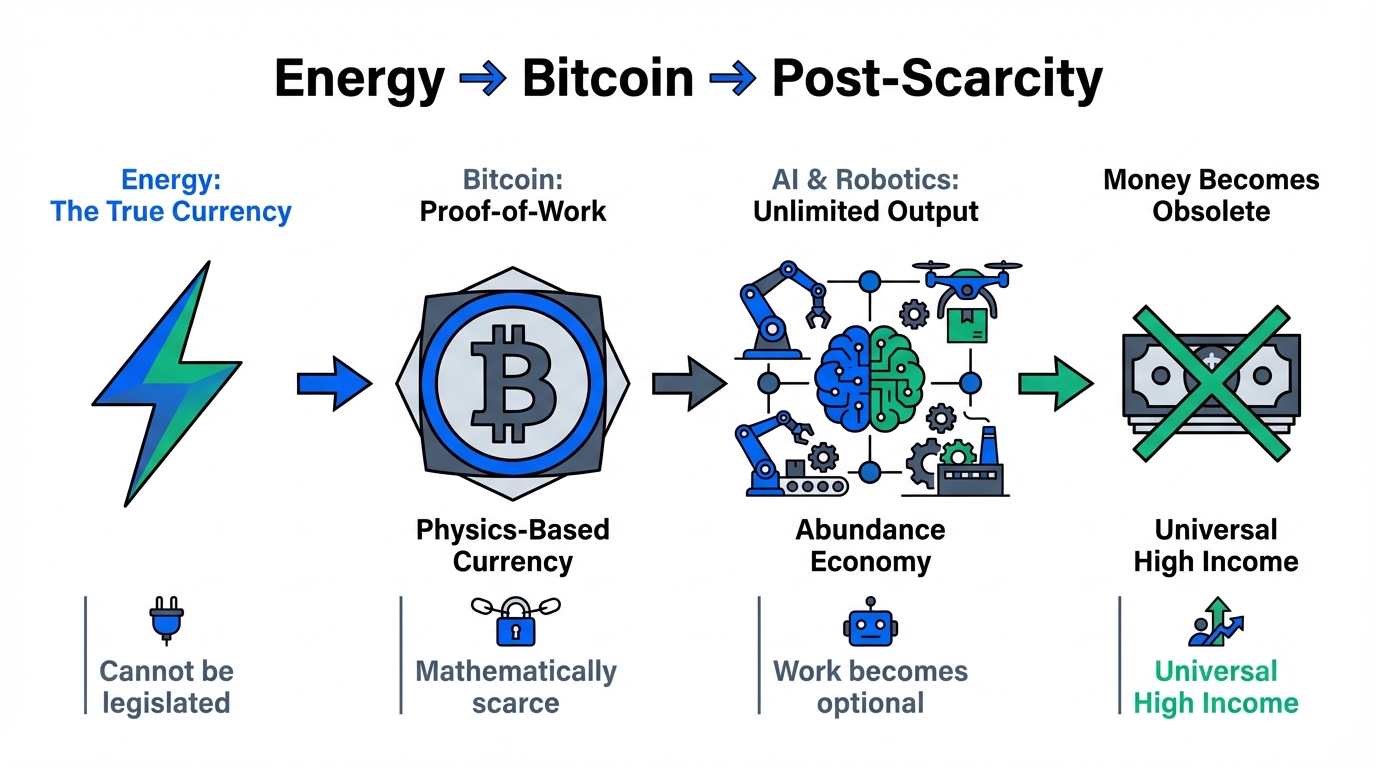
John: Let’s dive into the engine room. Bitcoin operates on a blockchain, which is essentially a decentralized ledger that records all transactions. The magic sauce is its consensus mechanism: proof-of-work (PoW). Miners compete to solve complex mathematical puzzles using computational power, which requires electricity—real energy from the physical world. Once solved, they add a block to the chain and get rewarded with new Bitcoins. This process ensures security because altering the chain would require redoing all that energy-intensive work, which is practically impossible without controlling over half the network’s power (that’s the famous 51% attack risk, but it’s outrageously expensive).
Lila: Breaking it down simply: Imagine a group of friends keeping a shared notebook of who owes what. Instead of trusting one person, everyone verifies entries by solving a tough riddle that takes real effort (like running a marathon). The first to finish gets a prize, and their entry sticks. That’s PoW in a nutshell—it’s energy-based, tying Bitcoin to physics as Musk says. For tokenomics, Bitcoin has a hard cap of 21 million coins, with halvings every four years reducing new supply. It’s like a treasure hunt where the gold gets harder to find over time, promoting scarcity.
John: Spot on. Now, to compare Bitcoin to some competitors, let’s look at how it stacks up against Ethereum (post-Merge, using proof-of-stake) and something like Solana for speed. Remember, this is about tech mechanics, not picks.
| Aspect | Bitcoin (PoW) | Ethereum (PoS) | Solana (PoH) |
|---|---|---|---|
| Consensus Mechanism | Proof-of-Work: Energy-intensive mining | Proof-of-Stake: Staking tokens for validation | Proof-of-History: Timestamped blocks for speed |
| Energy Use | High (physics-based, as per Musk) | Low (eco-friendly shift) | Moderate (focus on efficiency) |
| Transaction Speed | ~7 TPS (slower but secure) | ~30 TPS (with layer-2s, faster) | Thousands of TPS (high throughput) |
| Use Case Focus | Store of value (digital gold) | Smart contracts, DeFi | High-speed apps, NFTs |
| Decentralization Level | High (global miners) | Moderate (stakers can centralize) | Lower (validator clusters) |
Lila: See? Bitcoin’s PoW makes it ‘impossible to fake,’ as Musk puts it, but it’s not the fastest kid on the block. That’s the trade-off for its rock-solid security.
Use Cases & Application
John: So, how does this play out in real life? For developers, Bitcoin’s tech shines in building secure, decentralized apps. Think of creating a wallet or integrating Lightning Network for faster payments—it’s like adding turbo to your car without losing the engine’s reliability. Users benefit from its utility as a hedge against inflation; in countries with unstable currencies, it’s a digital safe haven. Imagine sending money across borders without banks taking a cut—pure peer-to-peer magic.
Lila: Totally! A developer could use libraries like BitcoinJS to script transactions, ensuring they’re energy-verified on the chain. For everyday users, it’s about understanding market mechanics: halvings drive scarcity, potentially increasing value over time. Want to share this tech update on TikTok? Turn this text into a viral video using Revid.ai.
John: And let’s not forget institutional adoption—companies like MicroStrategy use it for treasury reserves, treating it as ‘digital property.’ The physics-based angle Musk highlights could push more AI-integrated finance, where energy efficiency meets blockchain.
Educational Action Plan (How to Learn)
Lila: Ready to level up without jumping into the deep end? We’re focusing on education here—learn the tech, not chase pumps.
John: Level 1 (Research/Observation): Start by tracking Bitcoin’s chart on sites like CoinMarketCap or TradingView. Watch price movements around events like halvings to see market mechanics in action. Read the original whitepaper by Satoshi Nakamoto—it’s only 9 pages and explains the PoW genius. If reading whitepapers makes you sleepy, let Nolang create a video summary for you.
Lila: Level 2 (Testnet/Experience): Dive hands-on with Bitcoin’s testnet—a sandbox where you can experiment without real money. Use tools like Electrum wallet to simulate transactions, or try running a node with Bitcoin Core software. Emphasize small-scale learning: send testnet BTC to understand confirmations and fees. It’s like practicing driving in an empty lot before hitting the highway. This builds intuition for how energy ties into validation.
Conclusion & Future Outlook
John: Wrapping this up, Musk’s praise for Bitcoin as a physics-based currency highlights its potential in an energy-centric future, especially with AI making traditional money obsolete. Rewards? Unmatched decentralization and scarcity. Risks? High volatility—prices can swing wildly due to market sentiment, regulations, or tech shifts like quantum computing threats. Always understand the risks; crypto isn’t a get-rich-quick scheme.
Lila: Looking ahead, if energy becomes the ‘true currency’ as Elon predicts, Bitcoin’s PoW could evolve or integrate with renewables for sustainability. Worth watching, but stay educated. Smart investors automate. Set up alerts and workflows with Make.com so you never miss a critical update.

👨💻 Author: SnowJon (Web3 & AI Practitioner / Investor)
A researcher who leverages knowledge gained from the University of Tokyo Blockchain Innovation Program to share practical insights on Web3 and AI technologies. While working as a salaried professional, he operates 8 blog media outlets, 9 YouTube channels, and over 10 social media accounts, while actively investing in cryptocurrency and AI projects.
His motto is to translate complex technologies into forms that anyone can use, fusing academic knowledge with practical experience.
*This article utilizes AI for drafting and structuring, but all technical verification and final editing are performed by the human author.
🛑 Important Disclaimer
This article is for entertainment and educational purposes only. I am an AI, not a financial advisor. Crypto assets are high-risk. Online gambling/casinos may be illegal in your country (e.g., Japan). Please verify your local laws. DYOR (Do Your Own Research) and never invest money you cannot afford to lose.
🛠️ Tools Mentioned:
References & Further Reading
- Musk Calls Bitcoin A ‘Fundamental, Physics-Based Currency’ – Bitcoin Magazine
- Bitcoin Whitepaper – Official Site