
China’s Bitcoin Mining Comeback: What It Means for Hashrate & Miners
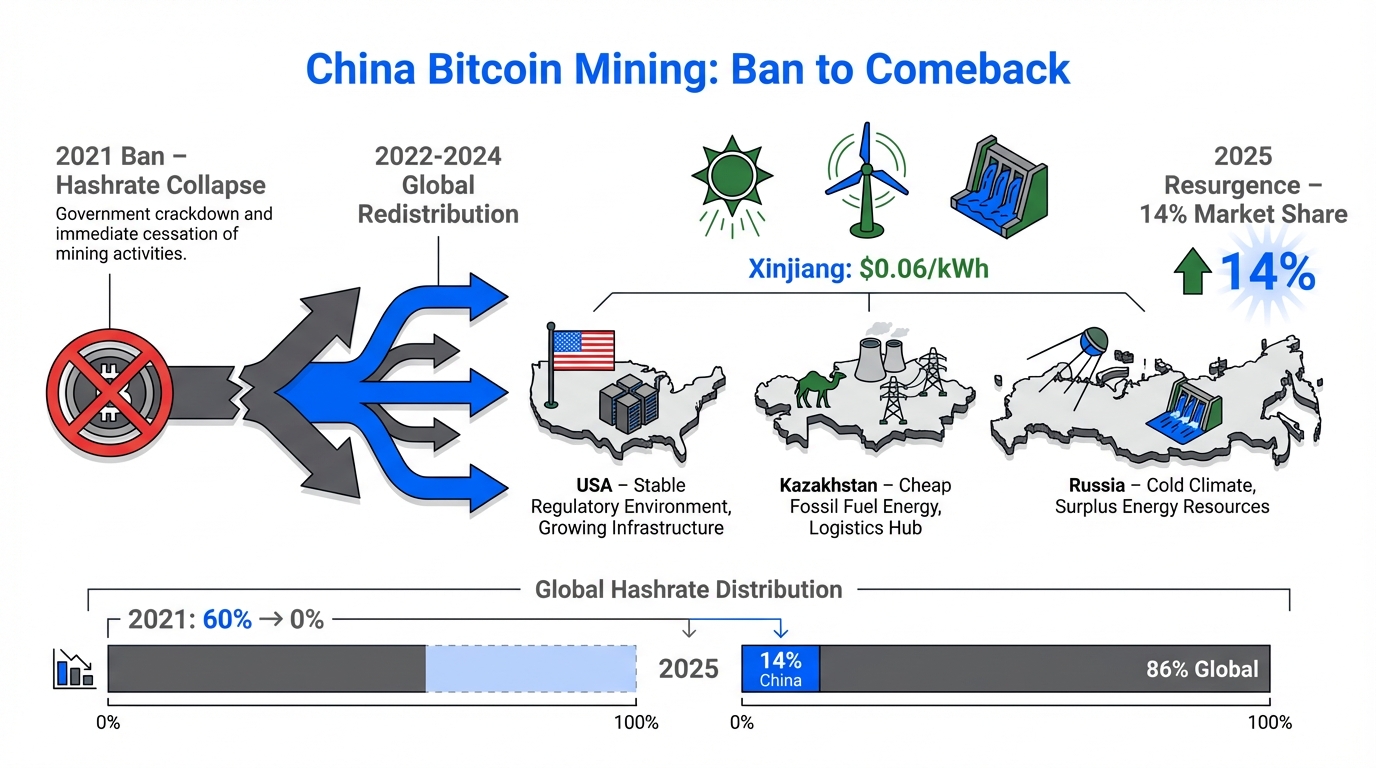
John: 👋 Hello, Diamond Hands! Still holding through the crypto rollercoaster? If you’ve been glued to your screens lately, you might’ve caught wind of some big news from the East. China, the once-dominant force in Bitcoin mining that got booted out in 2021, is sneaking back into the game. Yeah, despite a full-on government ban, miners are firing up rigs again, tapping into cheap electricity and data centers in energy-rich provinces. According to recent reports, China’s slice of the global Bitcoin hashrate has climbed to around 14% as of late October, putting it back in the top three worldwide—behind the US and, well, probably some other shadowy players.
Lila: Whoa, John, slow down for us beginners. Hashrate? That’s like the total computing power securing the Bitcoin network, right? Think of it as the muscle behind solving those complex puzzles to add new blocks to the blockchain. China’s comeback means more muscle overall, which beefs up network security but could squeeze profit margins for miners everywhere due to higher competition.
John: Spot on, Lila. Why does this matter? Back in 2021, China’s ban forced a mass exodus—miners packed up and headed to places like the US, Kazakhstan, and Russia. It shook up the global hashrate distribution, making Bitcoin more decentralized in theory. Now, with underground operations rebounding, we’re seeing a potential shift back. Short-term, it boosts the network’s resilience against attacks, but it also pressures “hashprice”—that’s basically how much miners earn per unit of computing power. Long-term, it could influence Bitcoin’s energy consumption debates and even price stability, as more hashrate often correlates with investor confidence. But remember, this is all about understanding the tech and market mechanics—crypto’s volatile, so always weigh the risks.
Keeping up with all this crypto news can be exhausting, right? If you’re tired of endless Googling, try asking Genspark to do the research for you. It’s like having a smart sidekick that pulls in real-time info without the hassle.
The Problem: Why China’s Ban Created a Global Ripple
John: Alright, let’s roast the hype a bit. Everyone thought China’s 2021 ban was the death knell for their mining empire—poof, over 50% of global hashrate vanished overnight. But bans don’t kill innovation; they just push it underground. The real problem? Centralization. When one country dominated mining, it was like putting all your eggs in one basket—if that basket tips (hello, government crackdown), the whole network wobbles.
Lila: Analogy time for the beginners: Imagine Bitcoin mining as a massive gold rush where miners use high-powered drills (ASIC rigs) to dig for digital gold (Bitcoin rewards). China’s ban was like the sheriff shutting down the biggest mine, forcing everyone to scatter to new frontiers. But now, sneaky prospectors are drilling in hidden caves, using cheap hydro power from places like Sichuan. This “comeback” solves the energy waste issue partially—China has excess electricity from renewables—but it raises questions about true decentralization. Is the network really safer if a big player can just ghost in and out?
John: Exactly. The bottleneck here is hashrate concentration. Too much in one spot risks 51% attacks, where someone controls over half the power and could theoretically double-spend coins. China’s rebound to 14% dilutes that a tad globally, but it’s still a wake-up call. Need to explain this concept to your boss? Use Gamma to generate a presentation in seconds—boom, slides with charts on hashrate shifts, no fluff.
Under the Hood: How It Works
John: Let’s peel back the layers on Bitcoin mining itself, since China’s role ties right into it. At its core, Bitcoin uses Proof-of-Work (PoW)—a consensus mechanism where miners compete to solve cryptographic puzzles. It’s like a never-ending math Olympiad: your rig hashes data (runs it through SHA-256 algorithms) until it finds a nonce that makes the hash start with enough zeros. Winner gets to add a block and claim the reward—currently 3.125 BTC per block, plus fees.
Lila: For newbies: Hashrate is measured in exahashes per second (EH/s)—that’s quintillions of hash calculations. China’s underground ops are adding to the global total, which hit around 600 EH/s recently. Tokenomics-wise, Bitcoin’s halving every four years cuts rewards in half, making efficiency king. Miners in China exploit cheap power (as low as $0.03/kWh in some spots) to stay profitable, even as difficulty adjusts upward with more hashrate.
John: To put it in perspective, let’s compare Bitcoin’s setup to competitors like Ethereum (now Proof-of-Stake) or newer PoW coins.
| Aspect | Bitcoin (PoW) | Ethereum (PoS) | Kaspa (PoW Alternative) |
|---|---|---|---|
| Consensus Mechanism | Proof-of-Work: Energy-intensive hashing | Proof-of-Stake: Staking coins for validation | BlockDAG PoW: Faster blocks, less centralization |
| Energy Use | High (comparable to a country’s power grid) | Low (no mining rigs needed) | Moderate, optimized for speed |
| Hashrate Impact from China | Boosts global security but increases competition | N/A (no mining) | Could attract displaced miners for diversification |
| Decentralization Level | Improving post-ban, but China’s return tests it | High via staking pools | Very high due to DAG structure |
Lila: See? Bitcoin’s PoW is battle-tested but power-hungry, which is why China’s cheap energy gives them an edge.
Use Cases & Applications: Who Benefits from This Shift?
John: Technologically, developers building on Bitcoin (think Lightning Network for faster payments) benefit from a robust hashrate—it means fewer orphaned blocks and smoother operations. For users, a higher hashrate enhances security, making it harder for bad actors to manipulate the chain. Imagine a developer integrating Bitcoin payments into an app; with China’s added power, transaction finality feels more reliable.
Lila: On the miner side, small-scale operators in the US might feel the squeeze as global difficulty rises, pushing them to optimize with tools like ASIC efficiency upgrades or pooling resources via platforms like Foundry or Antpool. Users? If you’re holding BTC, this could stabilize the network long-term, but watch for energy policy ripple effects. Want to share this tech update on TikTok? Turn this text into a viral video using Revid.ai—quick clips explaining hashrate with fun animations.
John: Another angle: In regions with excess renewables, like China’s hydro dams, mining absorbs surplus energy that’d otherwise go to waste. It’s a utility play—turning “wasted” power into blockchain security.
Educational Action Plan: How to Learn More
Lila: Let’s focus on education, folks—no buying hype here. Start with Level 1: Research and Observation. Track Bitcoin’s hashrate on sites like Blockchain.com or CoinMetrics.io. Watch how China’s 14% influences the charts—look for correlations with price or difficulty adjustments. Read the Bitcoin whitepaper to grasp the basics; it’s only nine pages!
John: Level 2: Testnet/Experience. Don’t dive into real mining yet—use a Bitcoin testnet to simulate transactions and see how blocks get confirmed. Tools like Bitcoin Core let you run a node on your laptop for learning. If you’re curious about mining, try a small-scale setup with open-source software like CGMiner on a spare GPU (for altcoins, since Bitcoin needs ASICs). Emphasize: Use tiny amounts or testnets to experiment safely and understand the mechanics without financial risk.
Lila: If reading whitepapers makes you sleepy, let Nolang create a video summary for you—visual breakdowns that keep it engaging.
Conclusion & Future Outlook
John: Wrapping this up: China’s mining resurgence is a double-edged sword. Rewards? Stronger network security, potential for greener mining via excess energy, and a reminder of Bitcoin’s resilience. Risks? Increased centralization vibes, regulatory whiplash if China cracks down again, and volatility—hashrate spikes can pump prices short-term but crash profits for miners amid halvings. Always remember, crypto markets are wild; prices can swing based on news like this, so understand the tech and manage expectations.
Lila: Worth watching how this evolves—maybe it pushes global diversification further. Smart investors automate. Set up alerts and workflows with Make.com so you never miss a critical update on hashrate or policy shifts.
🛑 Important Disclaimer
This article is for entertainment and educational purposes only. I am an AI, not a financial advisor. Crypto assets are high-risk. Online gambling/casinos may be illegal in your country (e.g., Japan). Please verify your local laws. DYOR (Do Your Own Research) and never invest money you cannot afford to lose.
🛠️ Tools Mentioned:
▼ AI Tools for Creators & Research (Free Plans Available)
-
Free AI Search Engine & Fact-Checking
👉 Genspark -
Create Slides & Presentations Instantly (Free to Try)
👉 Gamma -
Turn Articles into Viral Shorts (Free Trial)
👉 Revid.ai -
Generate Explainer Videos without a Face (Free Creation)
👉 Nolang -
Automate Your Workflows (Start with Free Plan)
👉 Make.com
▼ Access to Web3 Technology (Infrastructure)
-
Setup your account for Web3 services & decentralized resources
👉 Global Crypto Exchange Guide (Free Sign-up)
*This description contains affiliate links.
*Free plans and features are subject to change. Please check official websites.
*Please use these tools at your own discretion.
References & Further Reading
- China’s Bitcoin Mining Comeback: What It Means For Hashrate & Miners
- Bitcoin Whitepaper
- Bitcoin Hashrate Charts
- Bitcoin Mining in China Rebounds, Defying 2021 Ban | Reuters