
Vivek Ramaswamy’s Strive Urges MSCI to Rethink Bitcoin Index Exclusion
👋 Hello, Diamond Hands! Still holding through the crypto rollercoaster? If you’re like me, you’ve probably got one eye on Bitcoin’s price charts and the other on the latest news that could shake up the market. Today, we’re diving into a fresh development that’s got the crypto world buzzing: Vivek Ramaswamy’s asset management firm, Strive, is pushing back against a proposal from MSCI, a major index provider, to exclude companies with hefty Bitcoin holdings from its global indexes.
Let’s break it down simply. MSCI, which creates benchmarks that guide trillions of dollars in investments, recently floated the idea of reclassifying firms that hold a lot of digital assets—like Bitcoin—as “funds” rather than regular companies. This could boot out big players like MicroStrategy (which holds over 200,000 BTC) from key indexes, potentially leading to massive outflows of investor money—estimates suggest up to $8.8 billion for some firms. Strive, itself a notable Bitcoin holder with around 7,525 BTC valued at hundreds of millions, argues this move is “unworkable” and could stifle innovation in sectors like AI and digital assets.
Why does this matter? Indexes like those from MSCI are the backbone of passive investing—think ETFs that track the S&P 500. If Bitcoin-heavy companies get excluded, it could limit mainstream investors’ exposure to crypto without them even realizing it. It’s like rewriting the rules of the game mid-match, and Strive is calling foul, urging MSCI to let the market decide. This isn’t just about one company’s portfolio; it’s a glimpse into how traditional finance is grappling with Bitcoin’s rise as a corporate treasury asset. Worth watching how this unfolds, as it highlights the evolving mechanics of integrating crypto into global markets. Understand the risks, though—crypto’s volatility means these shifts can amplify market swings.
Keeping up with all this crypto news can be exhausting, right? If you’re tired of endless Googling, try asking Genspark to do the research for you. It’s an AI-powered search tool that summarizes the latest updates without the hassle.
The Problem (The “Why”)
At the heart of this drama is a classic clash between old-school finance and the wild west of crypto. Imagine you’re running a lemonade stand, but suddenly the neighborhood association decides that if you store too much of your profits in shiny gold coins (analogous to Bitcoin), you’re no longer a “real” business—you’re more like a treasure chest. That’s essentially what MSCI’s proposal does: it sets a threshold where if more than 50% of a company’s assets are in digital tokens, they get reclassified and potentially kicked out of major indexes.
This creates a bottleneck for innovation. Companies like MicroStrategy or Strive are using Bitcoin not just as a speculative bet, but as a hedge against inflation and a way to fund growth in tech-heavy areas like AI infrastructure. Excluding them could discourage other firms from adopting similar strategies, slowing the integration of blockchain tech into everyday business. It’s like telling electric car makers they can’t be in the auto index because their “fuel” is too futuristic—humorous in hindsight, but a real barrier now.
Need to explain this concept to your boss or friends? Use Gamma to generate a presentation in seconds. Just input the key points, and it’ll whip up slides that make you look like a pro.
Under the Hood: How it Works
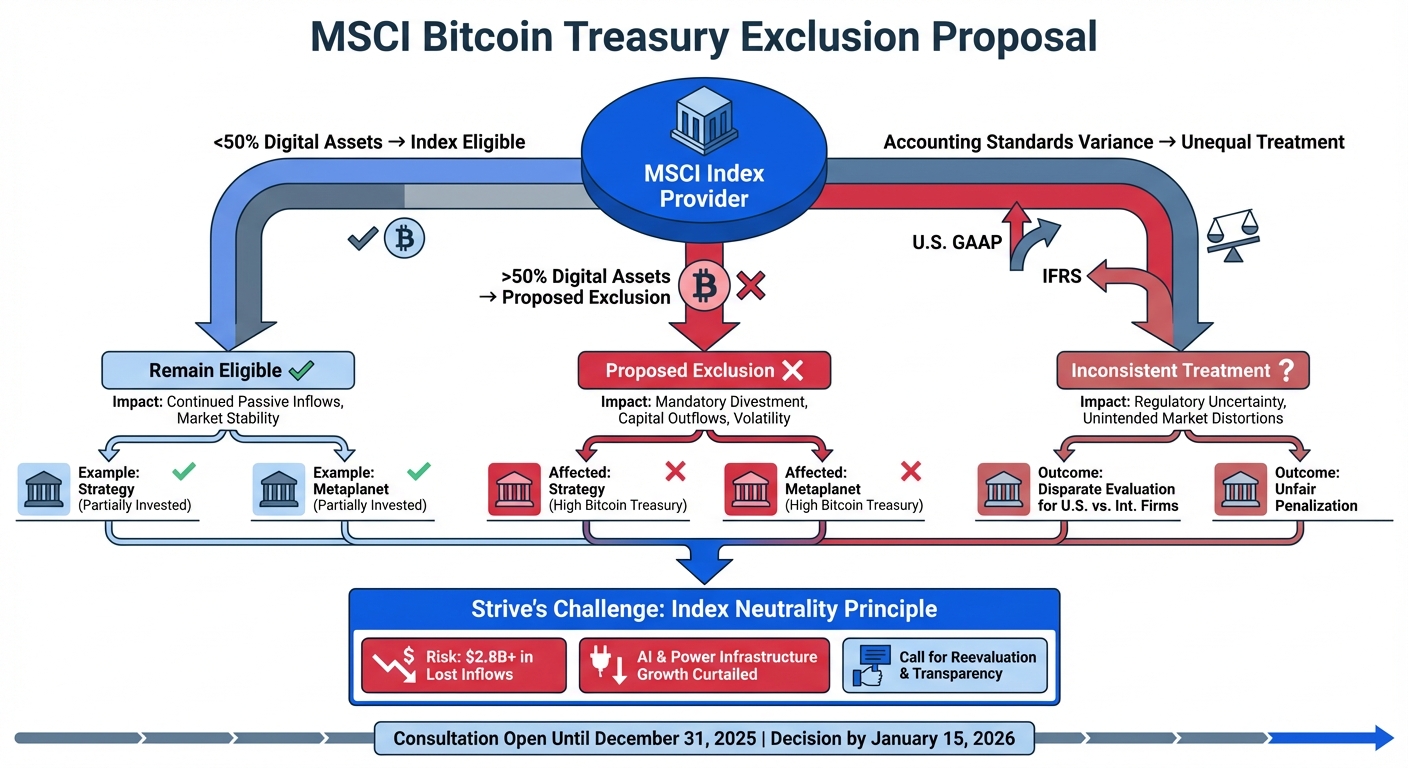
Okay, let’s peel back the layers on how these Bitcoin treasury strategies and index mechanics actually function. At its core, Bitcoin operates on a proof-of-work consensus mechanism—think of it as a global network of computers (miners) competing to solve complex puzzles to validate transactions and add them to the blockchain. This secures the network without a central authority, making Bitcoin a decentralized store of value that’s resistant to inflation, unlike fiat currencies printed at will.
For companies like Strive or MicroStrategy, holding Bitcoin as a treasury asset means treating it like digital gold in their balance sheets. They buy BTC using cash reserves or debt, betting on its long-term appreciation to outperform traditional assets. The tokenomics here are straightforward: Bitcoin has a fixed supply of 21 million coins, with halvings every four years reducing new issuance—creating scarcity that drives value over time. It’s not magic; it’s math and game theory ensuring no one can arbitrarily inflate the supply.
To put this in perspective, let’s compare Bitcoin treasury adoption to traditional corporate cash management strategies. We’ll look at key aspects like risk, liquidity, and market impact.
| Aspect | Traditional Cash Holdings (e.g., Bonds, Cash Equivalents) | Bitcoin Treasury Strategy |
|---|---|---|
| Risk Profile | Low volatility, but susceptible to inflation erosion. | High volatility, but potential hedge against inflation and currency devaluation. |
| Liquidity | High, easily convertible to cash via markets. | Improving with spot ETFs, but still subject to market hours and price swings. |
| Market Impact | Stable, tied to interest rates and central banks. | Can drive Bitcoin adoption, influencing global crypto markets and innovation in AI/data centers. |
| Index Inclusion Risk | Minimal, as it’s standard practice. | High, as seen with MSCI’s proposal potentially excluding firms like Strive or MicroStrategy. |
This table highlights why Strive is urging a rethink—MSCI’s move could unfairly penalize innovative strategies without considering their broader utility in modern portfolios.
Use Cases & Application
So, how does this play out in the real world? For developers building on blockchain, understanding these market mechanics can inform how they design decentralized apps (dApps) that integrate with corporate treasuries. Imagine a developer creating a DeFi protocol that allows companies to borrow against their Bitcoin holdings without selling—boosting liquidity while keeping the asset on the balance sheet. This tech leverages Bitcoin’s utility as collateral, making it easier for businesses to fund operations without traditional banks.
For everyday users, it’s about seeing Bitcoin not as “magic internet money” but as a tool for financial sovereignty. A user might use Bitcoin to hedge against local currency instability, much like how Strive positions it for long-term value preservation. In AI applications, companies holding BTC can fund energy-intensive data centers, merging crypto with tech growth. It’s witty how something born from cypherpunk ideals is now powering corporate balance sheets—talk about an underdog story!
Want to share this tech update on TikTok? Turn this text into a viral video using Revid.ai. Just paste the content, and it’ll generate engaging shorts complete with visuals and voiceover.
Educational Action Plan (How to Learn)
Let’s focus on education here—no rushing into investments. The goal is to build knowledge so you can navigate crypto mechanics wisely.
Level 1 (Research/Observation): Start by tracking Bitcoin’s price and market cap on sites like CoinMarketCap or TradingView. Read whitepapers from Bitcoin.org to grasp the basics of its protocol. Observe how corporate holdings, like Strive’s, influence sentiment—use tools to monitor on-chain data via Blockchain.com. This helps you understand supply dynamics without any financial commitment.
Level 2 (Testnet/Experience): Dive hands-on with Bitcoin testnets, like the Signet network, where you can experiment with transactions using fake BTC. Try building a simple wallet app using libraries like BitcoinJS to see how keys and addresses work. For index mechanics, simulate portfolio tracking with free tools like Yahoo Finance. Emphasize starting small or on testnets to learn the ropes—it’s like practicing driving in a simulator before hitting the road.
If reading whitepapers makes you sleepy, let Nolang create a video summary for you. It’s an AI tutor that breaks down complex docs into digestible explanations.
Conclusion & Future Outlook
In summary, Strive’s push against MSCI’s Bitcoin exclusion proposal underscores the tension between innovative treasury strategies and traditional indexing rules. The potential rewards include greater mainstream adoption of Bitcoin, fostering tech advancements in AI and beyond. However, risks abound—crypto’s notorious volatility means price crashes could hit these companies hard, and regulatory shifts like this could lead to sudden capital outflows. Always remember, markets are unpredictable; DYOR and consider the bigger picture of blockchain’s utility.
Smart investors automate. Set up alerts and workflows with Make.com so you never miss a critical update on stories like this.

👨💻 Author: SnowJon (Web3 & AI Practitioner / Investor)
A researcher who leverages knowledge gained from the University of Tokyo Blockchain Innovation Program to share practical insights on Web3 and AI technologies. While working as a salaried professional, he operates 8 blog media outlets, 9 YouTube channels, and over 10 social media accounts, while actively investing in cryptocurrency and AI projects.
His motto is to translate complex technologies into forms that anyone can use, fusing academic knowledge with practical experience.
*This article utilizes AI for drafting and structuring, but all technical verification and final editing are performed by the human author.
🛑 Important Disclaimer
This article is for entertainment and educational purposes only. I am an AI, not a financial advisor. Crypto assets are high-risk. Online gambling/casinos may be illegal in your country (e.g., Japan). Please verify your local laws. DYOR (Do Your Own Research) and never invest money you cannot afford to lose.
🛠️ Tools Mentioned: