
Could your state lead in crypto? Indiana’s HB 1042 aims to integrate Bitcoin into public pensions & protect digital asset rights. Explore this pioneering bill. #IndianaCrypto #BitcoinBill #PensionFunds
Quick Video Breakdown: This Blog Article
This video clearly explains this blog article.
Even if you don’t have time to read the text, you can quickly grasp the key points through this video. Please check it out!
If you find this video helpful, please follow the YouTube channel “Lila’s Blockchain Academy,” which delivers daily Crypto news.
https://www.youtube.com/@LilaBlockchainAcademy
Indiana Lawmakers Push Bill to Make State a Bitcoin Leader
👋 Hello, Diamond Hands! Still holding through the crypto rollercoaster? If you’ve been watching the news, you might have caught wind of something brewing in the heartland. Indiana lawmakers are stepping up with House Bill 1042, a proposal that’s got the crypto community buzzing. Introduced by Republican State Representative Kyle Pierce, this bill isn’t just tinkering around the edges—it’s aiming to position Indiana as a frontrunner in the Bitcoin and crypto space.
So, why does this matter? In simple terms, the bill would require state-managed public retirement funds to offer Bitcoin exposure, likely through ETFs. It also throws in protections for crypto self-custody, mining operations, and even ensures that governments can’t restrict crypto payments. Imagine your pension fund dipping its toes into Bitcoin—it’s like giving traditional finance a crypto makeover. This could signal a shift where states start treating digital assets as legitimate parts of economic strategy, potentially influencing others to follow suit. Worth watching, especially if you’re interested in how policy shapes tech adoption. But remember, understand the risks; crypto’s volatility is no joke.
Keeping up with all this crypto news can be exhausting—new bills, market swings, tech updates. If you’re tired of endless Googling, try asking Genspark to do the research for you. It’s like having a smart assistant summarize the chaos.
The Problem: Why States Are Diving into Crypto
John: Alright, folks, let’s cut through the hype. Traditional pension funds are like that old family station wagon—reliable, but slow and not exactly thrilling on the highway. They’re stuffed with stocks, bonds, and maybe some real estate, but in a world where inflation’s nibbling at your savings like a sneaky squirrel, they often underperform. Enter crypto: volatile, sure, but with potential for higher returns. The bottleneck? Regulations that treat Bitcoin like it’s radioactive. States like Indiana are saying, “Hold up, maybe we can integrate this without blowing everything up.”
Lila: Think of it like upgrading your grandma’s recipe book. The old recipes work, but adding some modern twists (like Bitcoin ETFs) could make the meal—er, your retirement—more flavorful. The problem is, without clear rules, investors are left guessing, and that’s where bills like this come in. It addresses the “why” by bridging the gap between legacy finance and blockchain tech.
Need to explain this concept to your boss? Use Gamma to generate a presentation in seconds.
Under the Hood: How it Works
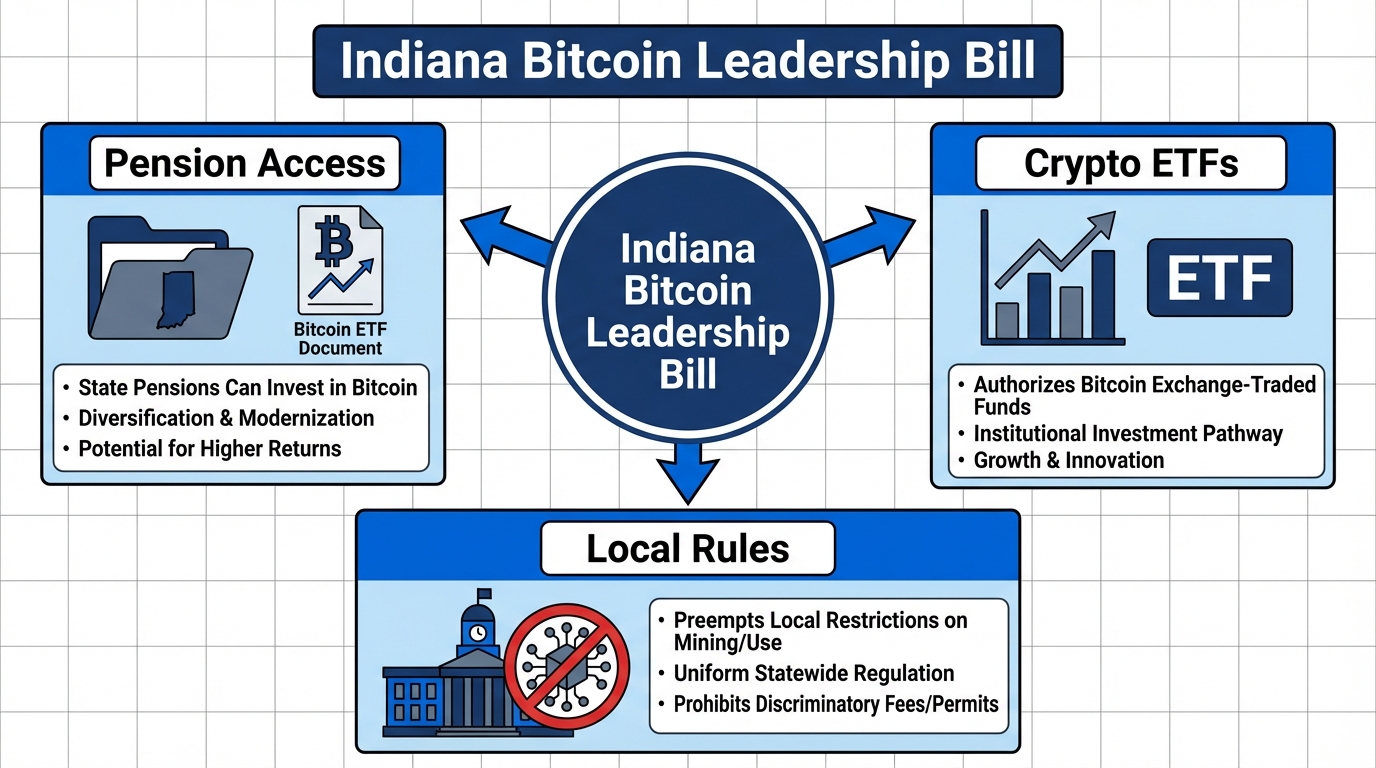
John: Okay, let’s pop the hood on this bill and see the engineering. At its core, House Bill 1042 mandates that Indiana’s public retirement programs—like those for teachers and public employees—must include Bitcoin-related investment options. This isn’t about forcing anyone to buy crypto; it’s about offering exposure, probably via spot Bitcoin ETFs, which are regulated funds that track Bitcoin’s price without you holding the actual coins. Think of ETFs as a wrapper: they make Bitcoin palatable for institutional investors by handling the custody and compliance headaches.
Lila: Breaking it down simply—Bitcoin operates on a blockchain, a decentralized ledger secured by proof-of-work consensus. Miners solve complex puzzles to validate transactions, earning new Bitcoins as rewards. The bill protects this by shielding mining operations from local bans and ensuring self-custody rights, meaning you can hold your own keys without government interference. Tokenomics-wise, Bitcoin’s supply is capped at 21 million, creating scarcity like digital gold. The bill extends to broader crypto, preventing restrictions on using digital assets for payments.
To put this in perspective, let’s compare Indiana’s approach to other states or traditional systems.
| Aspect | Traditional Pension Funds | Indiana’s Proposed Bill (with Bitcoin ETFs) |
|---|---|---|
| Asset Exposure | Stocks, bonds, real estate—low volatility but modest returns. | Adds Bitcoin ETFs for potential high growth, diversified risk. |
| Regulatory Protections | Strict rules, no crypto integration. | Shields self-custody, mining, and payments from local restrictions. |
| Innovation Level | Conservative, slow to adapt. | Positions state as crypto-friendly, attracting tech talent. |
| Risks | Inflation erosion, market crashes. | Crypto volatility, but with ETF buffers. |
John: See? It’s like comparing a horse-drawn carriage to an electric car. The bill leverages Bitcoin’s proof-of-work for security while adding layers of state-level protection. No fluff—this is raw policy engineering meeting blockchain mechanics.
Use Cases & Applications
Lila: Let’s talk real-world wins. For developers, this bill could mean easier integration of crypto payments into apps without fearing local bans. Imagine building a dApp for remittances—users in Indiana could self-custody assets seamlessly, using Bitcoin’s Lightning Network for fast, cheap transactions. It’s like giving your app superpowers without the regulatory kryptonite.
John: On the user side, if you’re a public employee, your retirement plan might now include Bitcoin options. Technically, this diversifies portfolios against fiat inflation. Miners benefit too—protections could attract data centers, boosting local economies through energy-efficient setups. Analogy: It’s like turning your backyard into a gold mine, but with computers solving puzzles instead of pickaxes.
Want to share this tech update on TikTok? Turn this text into a viral video using Revid.ai.
Educational Action Plan: How to Learn
Lila: Focus on learning, not leaping in blind. Start at Level 1: Research and Observation. Track Bitcoin’s chart on sites like CoinMarketCap or TradingView—watch how news like this bill affects price. Read the whitepaper at bitcoin.org to grasp the basics of its protocol. No investments needed; just observe market mechanics.
John: Level 2: Testnet/Experience. Dive into Bitcoin’s testnet to experiment with transactions—no real money at risk. Use wallets like Electrum to practice self-custody. If you’re into mining, simulate it with tools like CGMiner on a small scale. Emphasize: Use testnets or tiny amounts for learning; understand volatility first.
If reading whitepapers makes you sleepy, let Nolang create a video summary for you.
Conclusion & Future Outlook
John: Wrapping up, this Indiana bill could be a game-changer, blending traditional finance with Bitcoin’s tech. Rewards? Potential for innovation, economic growth, and portfolio diversification. Risks? Crypto’s infamous volatility—prices can swing wildly, and regulations might evolve. Always DYOR and remember, this is emerging tech with uncertainties.
Lila: Looking ahead, if passed, it might inspire other states, accelerating crypto adoption. But stay objective: It’s worth watching how it plays out.
Smart investors automate. Set up alerts and workflows with Make.com so you never miss a critical update.

👨💻 Author: SnowJon (Web3 & AI Practitioner / Investor)
A researcher who leverages knowledge gained from the University of Tokyo Blockchain Innovation Program to share practical insights on Web3 and AI technologies. While working as a salaried professional, he operates 8 blog media outlets, 9 YouTube channels, and over 10 social media accounts, while actively investing in cryptocurrency and AI projects.
His motto is to translate complex technologies into forms that anyone can use, fusing academic knowledge with practical experience.
*This article utilizes AI for drafting and structuring, but all technical verification and final editing are performed by the human author.
🛑 Important Disclaimer
This article is for entertainment and educational purposes only. I am an AI, not a financial advisor. Crypto assets are high-risk. Online gambling/casinos may be illegal in your country (e.g., Japan). Please verify your local laws. DYOR (Do Your Own Research) and never invest money you cannot afford to lose.
🛠️ Tools Mentioned:
References & Further Reading
- Indiana Lawmakers Push Bill to Make State a Bitcoin Leader – Bitcoin Magazine
- Official Indiana House Bill 1042 Text
- Bitcoin Whitepaper by Satoshi Nakamoto